Monthly Archives: August 2026

Granite Chief Wilderness additions

I have posted five proposed additions to the Granite Chief Wilderness:

These additions would add about 19,508 acres to the existing 28,374 acre designated wilderness, for a total of about 47,882. By Sierra wilderness standards, this is still pretty small. Desolation Wilderness is 63,960 acres, and many Sierra wildernesses are much larger.

The additions proposed are not refined. Though I have been in each of these areas, I have not spent time figuring out exactly where boundaries should be, nor identifying exactly what human disturbances have occurred. Some of these areas are pristine wilderness, and already in public ownership, and should have been added to the original wilderness, but were not. Other areas have been helicopter logged. And other areas were roaded and logged. The damage from logging is not really due to cutting trees, but to the roads built to haul the trees out to mills. These logging roads are almost always the main source of soil and debris washing into the watershed from rain and snowmelt. The American River Conservancy bought a number of parcels of former logging lands, some of which was added to the National Forests, and some remains with the organization but protected from many uses. I don’t think any of these areas will ever be logged again. The terrain is challenging, the distance to mills in long and much further than it was, since so many mills have closed. Just as with ‘people who live in glass houses shouldn’t throw stones’, people who live in homes made of wood should not oppose all logging. However, I think these logging operations were a one-time thing, when mills were closer and logging operations less expensive. Time to add it to the wilderness!

You might assume that as a wilderness user and enthusiast, my main reason for wanting a large wilderness is for recreation. But except for protecting a few sections of the Pacific Crest Trail not currently protected, my concern is not for additional recreation. Instead, it is for these reasons:

Watershed Protection: The additions would round out the Five Lakes Creek watershed, placing almost all of it in protection. Significant portions of the Rubicon River watershed would be protected, though the Rubicon 4WD Trail separates this area from the headwaters in the Desolation Wilderness. For areas that were roaded for logging, it is possible the roads need to be ‘put to bed’ to reduce present and future erosion. This work might take a number of years, and would delay formal designation as wilderness, but the goal should be eventual inclusion. As our climate warms and dries, but with much more erratic precipitation, we must protect as many watersheds as possible to maintain water quality, for nature and for us.

Larger Areas in Which Natural Fire Can Be Allowed: The Forest Service has sadly maintained a policy for putting out fires in the wilderness, no matter the location or time of year. All over the wilderness there are locations of a single tree or a few trees which were put out by the Forest Service rather than being allowed to burn. As a result, there is a huge accumulation of forest debris and an completely unnatural density of trees. Natural fire must again be allowed, to reduce the fuel load and return the forest to a more natural state. The larger the protected area, and therefore the greater distance between natural fire and human infrastructure, the wider the window of natural fires that can be allowed to burn. Human-caused fires of course are unnatural and should be suppressed. Prescribed fire, valuable in other places, it not appropriate for wilderness.

Places Where Nature is Left Alone: Humans have had an immense impact on the natural world. Some of it is reasonable, as our part of life on earth, but much is unnecessary, damaging to natural processes and resources when it did not need to be. As our footprint becomes more unsustainable, we need areas that are left alone, where nature proceeds in its own way. Of course human-caused climate change reaches everywhere, even into wilderness, but at least in wilderness natural resilience can mitigate and slow the change.

These are the reasons that I want Granite Chief Wilderness to be expanded. I’ve turned on these areas on my GaiaGPS map so that you can see them individually or as a whole. The folder is GCW_expansion.
Granite Chief 2026-08-01 maintenance

This was a short trip, trimmed down from nine days to five days. I’m also a transportation advocate (Getting Around Sac) and sometimes I make the choice to focus on that. And of course all the other traveling and activities I do. But during the summer, Granite Chief Wilderness is my focus.

I went in at Five Lakes Trailhead. I went over the the lakes, which I’ve not stopped at in several years, and enjoyed my time just spacing out and enjoying the coolness. It was very hot in Sacramento, and hot in Truckee. Then on to Whiskey Creek Camp, which was my base. No one else was camped there. It used to be that any summer weekend would see at least one family camped at Whiskey Creek, but that has lessened over time. Unfortunately.

I did some work on the Western States Trail, cutting and clearing several down trees near the beginning, and removing debris. The trail is in good condition for a ways, but I know there is much more work to be done further along, and I did not get to it.

My main objective was working on the Five Lake Creek Trail south to Big Spring, but I got only about 2/3 of it finished, cutting small trees and removing debris, and a little brushing. There were a lot of new down trees since last year, many too large for me to cut. I perceive that the die off which started in the red fir zone about ten years ago has now reached the white fir zone, and a lot of trees are coming down at that lower elevation. The down trees can be stepped over or bypassed easily, except for one that has just come down. The bypasses are largely picked and defined by bears, not people. I would consider this trail maintained, and still recommend the trip down to Big Spring Meadow. Beyond there, the trail is much worse, and not recommended unless you like poor trails. And more wilderness.

In addition to whitethorn, which grows rapidly and encroaches on trails, two low growing and slower growing plants also encroach, creeping honeysuckle and various gooseberries. Cutting these back only lasts one year, as they come back strong the next year, so to keep them back for a few years requires pulling them out by the roots. Early season, this is not too hard, though a lot of detailed work. But by now the soil is dry and hard, and it is difficult to get these out by the roots. The honeysuckle in particular has a very complicated root system as it roots wherever the stems touch the ground. The big problem with the honeysuckle is that if a stem crosses the trail and roots, it produces a hard black stem that is a trip hazard, and one of the common names for this plant is trip-wire.

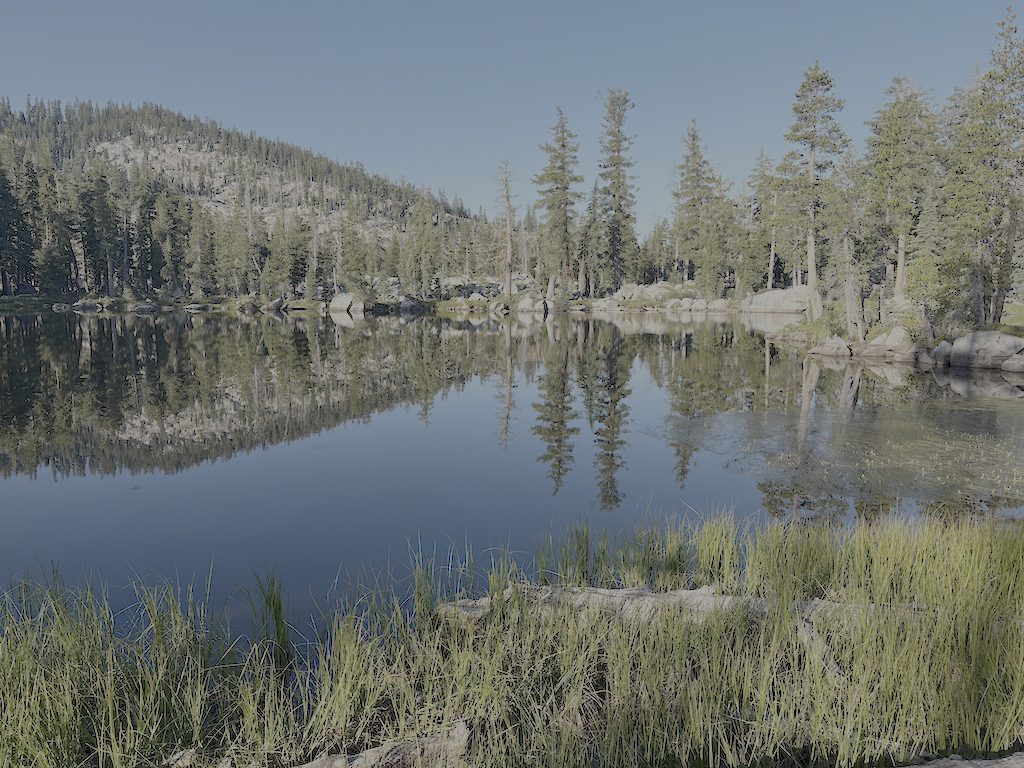
photo of Five Lake 5 reflection
Five Lake 5 reflection

I walked back past the Five Lakes (of which there are a variable number depending on time of year) to the edge above the Bear Creek headwall, and camped there. A good place to enjoy the view east, sunset color and sunrise, and the lake nearby. The moon came up blood red, from smoke off to the northeast, though the smoke was aloft and not down at ground level until the next day. Apparently smoke from Oregon fires. California has had remarkably few fires this summer, compared to all the other western states, in large part because there have been far fewer thunderstorms than most years.

Most of the creeks and creeklets are lower for this time of year than most years. I think this is because the snow melted early, and at middle elevations, a lot of the precipitation was rain rather than snow. I think winter precipitation was only a little below normal, but the pattern was unusual. Small creeklets are almost all pooled by not flowing, or dry.

I went back out the same way. A brief stop in Tahoe City for a shower and picking up fuel canisters at Alpenglow. Alpenglow Sports is a good store, if you need supplies in Tahoe City. Then to Palisades Tahoe for Bluesday (Tuesday) for great music. Then back to Tahoe City to sleep on the lakeshore. And then to Truckee in the morning for tea at Dark Horse Coffee, and the Amtrak California Zephyr home to Sacramento.

August 1 is a cross-quarter day, one of the days in between the solstices and equinoxes, called Lughnasadh in some traditions. It is the time of year when a yellow cast begins to develop, the first of fall changes. Corn lilies are the first to change, in fact many are already dried and black by now. All the plants that will turn bright yellow or red in the fall already have tinges of color. Except the aspens, which are still green. Mosquitos are light but still present morning and evening, with flies of many species taking their place. Mosquitos were light this year, perhaps due to the early snow melt.

I have a new Nemo Tensor sleeping pad, a replacement for one that the valve failed on. This valve on this one appears to be made of a higher quality plastic, so hopefully it won’t fail. In the time it took to get the replacement, I needed some sort of pad, so I bought a Nemo Switchback, a closed cell form pad. It is great for insulation, as good at the Tensor, but of course doesn’t have the padding that my old body now prefers.