Tag Archives: Barker Creek

Granite Chief Wilderness additions: Barker Creek

Granite Chief Wilderness was established in 1984 with the California Wilderness Act, at about 24,000 acres (97 km2). About 10,000 acres were purchased by American River Conservancy under the Granite Chief Wilderness Campaign, some of which were added to the wilderness after restoration, mostly putting an old and barely passable road to bed (see new wilderness boundary), bringing the wilderness acreage to 28,374 (114 km2).

But there are extensive areas contiguous with the existing wilderness that are of wilderness character that I believe should be added to the wilderness. Some sections of the Pacific Crest Trail are not in the wilderness, when they could easily be with slight boundary adjustments. Some of the additions are pristine wilderness, and some are areas that were logged but are healing and could be added now or in the future.

I believe in wilderness, not just for the recreational value, but as areas we set aside for nature to flourish and heal, where we interfere little if any in natural processes. This has become all the more important with climate change and all the related issues including insect die-off and red fir die-off. When we have the opportunity to expand existing wilderness areas, we should. As our use of non-wilderness lands intensifies, we need to balance that will additional wilderness. The Granite Chief is one of those areas.

So, I will post a series on my proposed additions. It is a lot of work to look closely at maps and on the ground to develop recommendations, and then map them accurately. I’m using ArcGIS Pro to do this, and investigations on the ground. The posts may stretch out over a couple of years, and I’m guessing there will be at least six. When the series is complete, I’ll create a single map showing all the additions together.

Caveats

Some of the areas I’m proposing have been logged, many of them just before or just after the wilderness was established. I don’t believe that it will be economically possible, and questionably environmentally responsible to log these areas again. The distance from the forest to remaining mills is just too great. Barker Pass Road was originally meant to go across Five Lakes Creek watershed to Mosquito Road and to mills in Foresthill or Placerville, but that will never happen, and those mills are long gone.

That is not to say there could not be fuel reduction projects, and perhaps some of these areas should be treated before inclusion in wilderness. Because of the misguided Forest Service policy of immediate suppression of lightning caused fire, even when far remote from human development, there are overstocked forests and years of debris on the forest floor, a conflagration waiting to happen. In the lower elevation forests, this is a completely unnatural, dangerous, and human-created condition. In the red fir and hemlock forests at higher elevations, it is not clear to me what the natural fire regime was or should be.

There are also logging roads associated with that logging. Almost all of these have deteriorated to be 4WD, not accessible for most recreationists, and are used primarily by off-road type users. This, in my mind, is not a valid use of National Forest lands. As an example, old logging roads on the mesas above Five Lakes Creek valley were closed for a while by downed trees, allowing nature to recoup and the peace and silence to return (see Granite Chief 2025-09-13 mesas). The views from the edge of the mesas are incredible, but the vehicle use here is not of that purpose, it is just for using vehicles. Unfortunately 4WD users with heavy chain saws and long bars managed to cut the trees out and return the roar of engines and tearing up of road surfaces. I have no sympathy for this.

Barker Creek addition

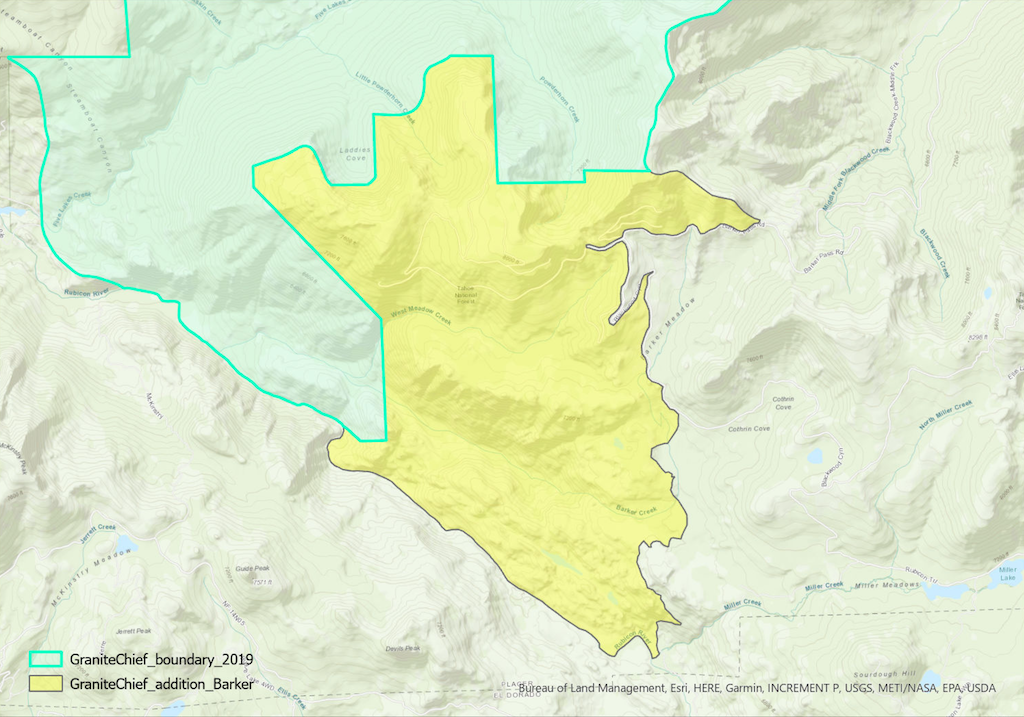
The first area I’m recommending I call the Barker Creek addition. It is within the Barker Creek drainage, which is a tributary to the Rubicon River. It would close Barker Pass Road at the Powderhorn Trailhead. It leaves open Barker Creek Road, which connects to the famous Rubicon 4WD trail, but it would close the rogue user-created roads off that road. It includes the logging area of West Meadow Creek, which was logged long ago, but is healing fairly well, with the logging road having been long closed.

The area is about 5,611 acres. A map is below, showing the adjacent designated wilderness and the proposed addition. It includes a small section of the Pacific Crest Trail, north of Barker Pass. The western boundary is the Rubicon River, which I’ve used for convenience of mapping, though there are wilderness quality lands west of the river as well. (pdf)
Hell Hole and Barker Creek 2020-10

My late October to early November trip into the Granite Chief included the Shanks Cove and Greyhorse trails, which I’d not been on this year, the Hell Hole trail and explorations around there, and a off-trail hike up the Rubicon River and then out Barker Creek to Barker Pass.

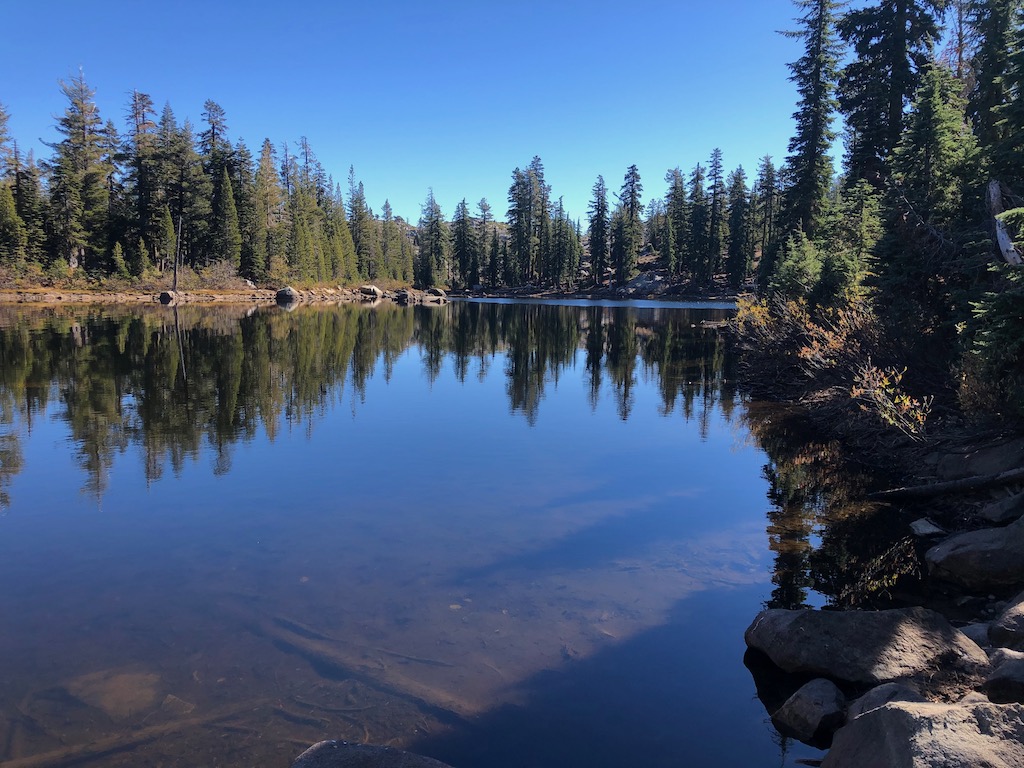
On my trip up to the area, I slept out near Truckee, and it was very, very cold, well below freezing, so I guess I can call summer over. After tea and breakfast to warm up, I headed into the wilderness at Alpine Meadows TH, thence to Whiskey Creek Camp. I explored around Five Lakes lake, the largest one, which is the only one with significant water late in the year, which I’d not done in years. I generally avoid this most popular destination for day hikers, but it was early and on a weekday, so I figured correctly there would be few people. It is a beautiful lake, the only really alpine looking lake in the Granite Chief.

Five Lakes main lake

From Whiskey Creek Camp I followed the Western States (Picayune Valley) trail to the junction with Shanks Cove trail, and thence up to the ridge where I camped for the night. It was much warmer up there than it had been in Truckee, though I was 650 meters higher, since cold air drains away from the ridges and towards the valleys. In the morning I walked out the Greyhorse trail to the trailhead, which is no longer marked by anything, then back to the ridge and down Shanks Cove trail to the Five Lakes Creek trail. The Shanks Cove and Greyhorse trails have not been maintained in a long while, and there are many trees down, most easy to bypass but a few not. The winter debris (which this year came mostly from high winds in the fall) is thick in many places. And brush is encroaching on the trail in many spots. On the plus side, there were small flows of water in some of the little creeks that I was sure would be dry in this dry year.

I camped near Diamond Crossing and spent time just watching the creek and seeking out the brightest fall color trees. Then down the Hell Hole trail. The two forks of Buckskin Creek were flowing a little, but Steamboat Creek was completely dry. I explored downstream, where I have found water in the past, and did not find any, but I didn’t check upstream. Steamboat is always one of the earliest creeks to dry. Down the the bottom, where there is a vague junction with the trail coming from the 4WD road at Greyhorse Creek, with the route up canyon parallel to Five Lakes Creek. I have found and maintained about half this trail, but the other half is still uncertain, just wandering through forests and finding vague traces of trail here and there.

I continued my exploration of trails and routes in the Hell Hole and Rubicon River area, trying to make sense of how they fit together. I made some progress. I walked out the official 14E02 Hell Hole Trail to the dam and across. It is not marked in any way at the trailhead, but if going in that way, one would park at the boat trailer parking lot, walk down the steps, across the dam, and to the beginning of the trail on the south side. The dam is not open to vehicles but there is a hiker gate. This trail is not much used, but is surprisingly pleasant given how close it is to the reservoir, and is decently maintained. At a point just above the Upper Hell Hole Campground, which gets very heavy use by boat-in campers when the reservoir is up and the weather nice, a connector trail goes down through the old upper campground and to the east end of the lower campground. Continuing on the main trail, it gets harder and harder to follow, but traces of it exist and seem to lead to the Rubicon River just where it narrows in its first canyon. From the eastern-most campsite, a route marked with rock ducks heads along the ridge, then down to a crossing of the Rubicon at what I call huckleberry camp (there are more red huckleberry bushes in this area than one would expect at this elevation), then back up onto the ridge between the Rubicon and Five Lakes Creek, connecting with the route from Five Lakes Creek end of the Hell Hole trail and the route that goes down to the Rubicon at the same canyon point as the possible trail. With a better understanding of how the trails and route fit together, I have updated my tracks on GaiaGPS.

Rubicon River

I then spent half a day trying to figure out where the McKinstry trail goes, but at this I failed completely. There are little fragments of trail along the Rubicon River, but they don’t seem to connect. I know that when I walked the McKinstry trail years ago, it was not that hard to follow though not maintained, but now I can’t even seem to find the place where it climbs up out of the Rubicon Canyon. So, that remains for another trip, and I still don’t know what the condition of the McKinstry trail is.

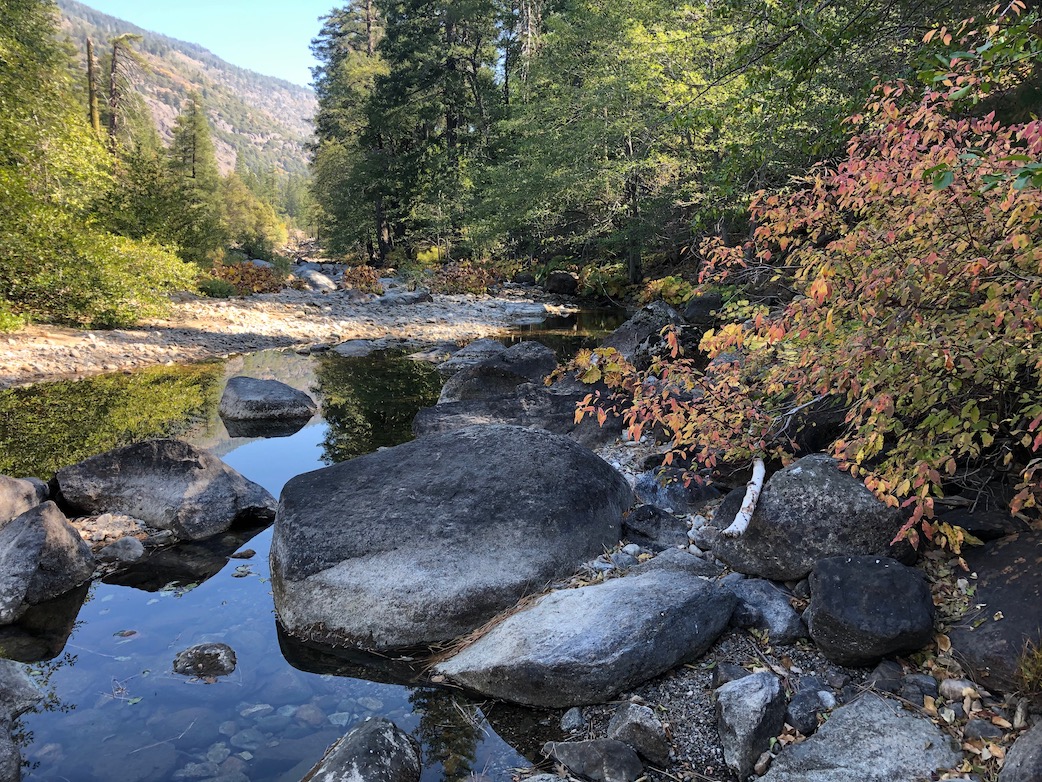
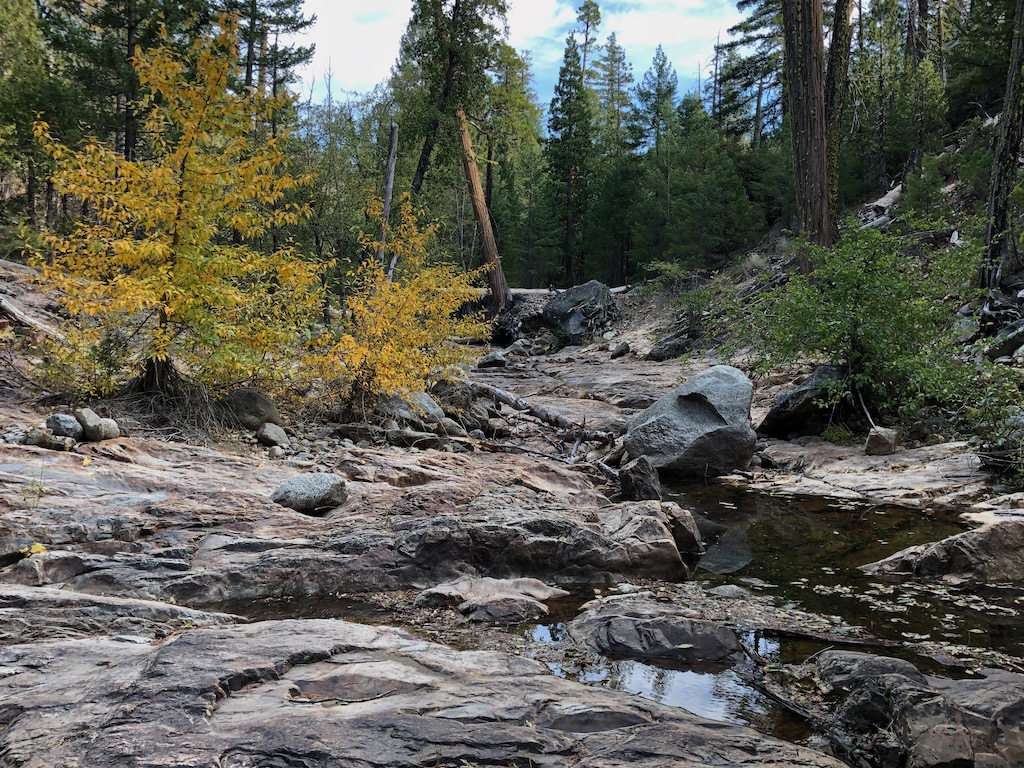
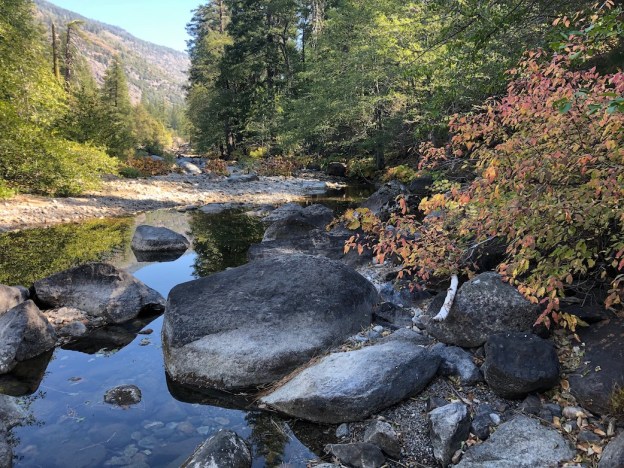
Leaving the trail finding project behind, I ventured out on a no-trail trip up the Rubicon River and then Barker Creek. The river canyon was dark and cold, probably never getting direct sunlight at this time of year, so I decided against continuing up canyon, which is beautiful, and only possible in low fall water. Instead I headed up Barker Creek, which is incredibly beautiful. There are here and there traces of a route marked by rock ducks, but it pretty much is just walking up the bottom of the canyon, walking around pools and jumping the small creek. The canyon eventually gets too rough to follow and I climbed out alongside the canyon to the more gentle terrain above. From there cross-country, and along some of the OHV trails (fortunately empty on this day), and then the PCT/TRT up to Barker Pass. And then down to Blackwood campground for the night, and out to catch the TART bus in the morning to Tahoe City.

Barker Creek,cottonwoods

I bought some gloves from Alpenglow, which I had most unfortunately forgotten on this trip, and have only some heavy waterproof gloves at home, and spent the rest of the day just enjoying Tahoe City. The following morning to Truckee, and caught the Amtrak California Zephyr home to Sacramento.

This will be my last long backpack trip (nine days) and my last mountain backpack trip of the year, but I’ll continue shorter backpack trips in the Sierra foothills and the bay area throughout the winter and spring, until next summer backpack season in the Granite Chief.

Photos on Flick: https://www.flickr.com/photos/allisondan/albums/72157716780807318; Granite Chief collection on Flickr: https://www.flickr.com/photos/allisondan/collections/72157637640215275/.

Down in the Rubicon 2010-07

ridge south of Little Needle Peak

Had another wonderful five day backpack in the Granite Chief last week. A lot of the trip was just re-visiting places I’d been before, some of them not in several years though.

As a new trip I went to Little Needle Lake which I’d heard other people mention but not been to. It is a shallow, alder and willow bordered lake in the volcanic rock below Little Needle Peak. It is a pretty setting, with soggy wet meadows surrounding the lake and a spectacular cliff above. The route is is a vague trail, and there are some seldom used campsites at the lake. To avoid the thick mosquitos at the lake, I camped to the north on a granite bench, where there were some really cool trees and a great view of the end of the day down the Middle Fork American River canyon. The next day I headed up onto the ridge and south, following the divide between Picayune Valley and Five Lake Creek, eventually reconnecting to the Picayune Valley trail a little east of where it climbs out of Picayune Valley. The ridge does not have a trail, but the going was pretty easy, with great views and a different perspective than I’ve gotten elsewhere.

Continue reading