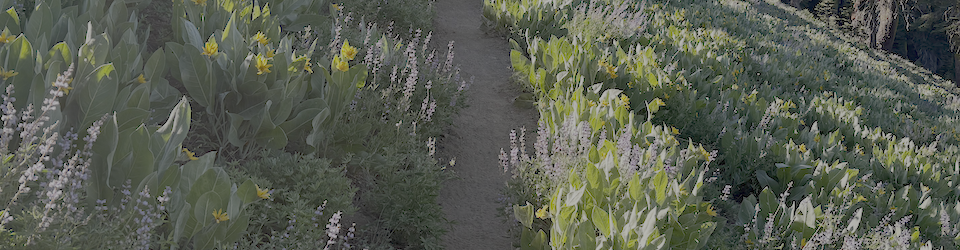
My third Granite Chief Wilderness trip was for trail maintenance. My original intent was to work on either the Five Lakes Creek Trail or the Western States Trail, but on my way in, found that the ‘Squaw’ Saddle Trail, PCT-d segment (my term, not related to PCT segments), and Whiskey Creek Trail needed work, so spent my time on those.
‘Squaw’ Saddle Trail (needs to be renamed by apparently has not been renamed by Forest Service) is now in good condition. Open Street Map shows Five Lakes Trail going by the largest lake and then reconnecting with the ‘Squaw’ Saddle Trail, but signing indicates this is not an official trail. I’m calling this ‘Squaw’ Saddle Trail all the way to junction with PCT.
PCT-d, the segment between ‘Squaw’ Saddle Trail and PCT is in good condition except for one down tree that intrudes into the trail but can be stepped around. I did a lot of spot brushing on this trail, as brush was starting to encroach.
Whiskey Creek Trail was a mess. Four down trees remain, one a slide under and three with good bypasses. At the crossing of Whiskey Creek, there is a log jam where the trail once crossed. You can cross below the jam, going down the bank, using a rock hop (at current water level), and then climbing up beside boulders and willows. I removed or modified several down trees.
Five Lakes Trail is maintained by Truckee Trails Foundation, and it is in good condition. It does not maintain the section west of the largest lake, which is no longer an official trail.
Though this work was not my original intent, at least it will be easier and quicker to get to Whiskey Camp next time. One family was camped at the camp on Saturday night, but I saw no one else there. In times past, it was rare that there was not a group, or many groups, at Whiskey Camp, but use seems to have tapered off.
I spend a lot of time pulling creeping honeysuckle or creeping snowberry (Symphoricarpos mollis) out by the roots. The hiker name for this plant is tripwire, as the vines root, creating segments that harden into a black, very strong trip wire. If it crosses the trail and roots, it is a clear hazard to hikers. I have been tripped up a few times, even though I am quite aware of the plant. Cutting the vines simply produces more vines, so taking it out by the roots is the only solution that lasts more than one year. Strangely, I don’t have a photo of the trip wires. The snowberry shrub (Symphoricarpos albus) also has tough stems, but doesn’t grow low to the ground. On the PCT section, huckleberry oak, whitethorn, and sagebrush were the most common plants crowding the trail.
Mosquitos are present, but not abundant. There are probably as many flies, but I did not see the large one with green eyes that bites a chunk out of you.
It rained for a half hour or so on Thursday morning
Sunday morning was a magical cloud day, a great one for lying on the back and making animal shapes of the clouds. It eventually thickened, and there was a smattering of rain on my way out.

- Photos on Flickr: https://www.flickr.com/photos/allisondan/albums/72177720334452840
- Granite Chief collection on Flickr: https://www.flickr.com/photos/allisondan/collections/72157637640215275/

