Tag Archives: Tevis Cup Trail

Granite Chief 2025-06

My first Sierra backpack of the season! Rode to Truckee on the California Zephyr, and then Olympic Valley on the TART 89 bus. I enjoyed Palisades Tahoe Bluesday, then hit the trail to sleep out. Went up the Granite Chief Trail, which is largely in good condition. I took a side trip north on the PCT to North Fork American River, and then a short way down the Painted Rock Trail. A reader had asked me about that trail, so I wanted to at least know if it was still there and findable. It is, though hard to follow and not used so far this year. I’ve not used that trail in many years, but the challenge was the wet areas with alder and willow thickets where is was hard to follow the trail.

Then headed south on the PCT, I was intending to traverse north to south as a survey trip. But my attention was grabbed by the Tevis Cup Trail reroute, which I’d written about last year in Granite Chief 2024-08 trail survey. There is no evidence of trail crews there this year, and information on Western States Endurance Run indicate that funding was canceled or held as part of the Trump destruction of the Forest Service. I walked the east end, which is more or less as it was last year, though one blast area has been reconstructed. The middle part is a bit more polished than last year, and extends a little further west though a meadow. I had been told last year that the flagging extended all the way west, but I was not able to follow it past a alder and willow riparian area, so it may or may not exist. I gradually descended through open forest and small meadows to rejoin the existing trail near the switchbacks (the nearly-flat switchbacks). I headed out to the trailhead at Forest Hill Divide (as I call it, it doesn’t seem to have an official name) where the Tevis Cup Trail continues west along the ridge, heading eventually to Auburn.
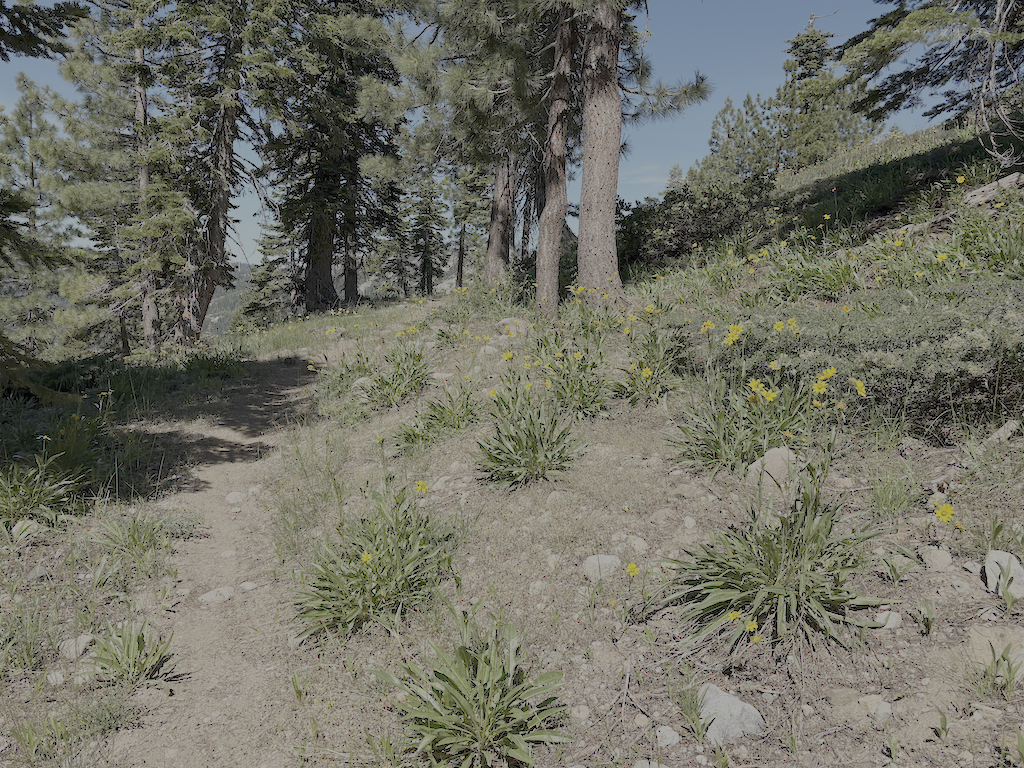
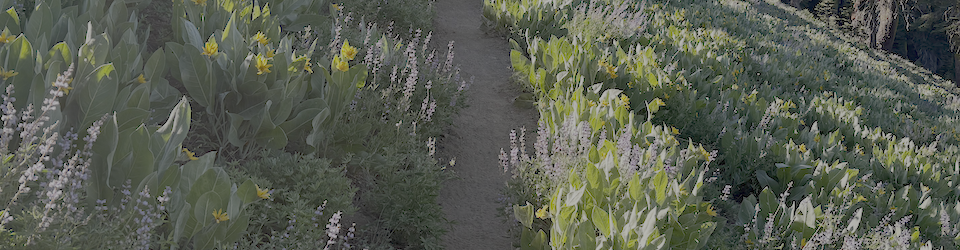
photo of Tevis Cup Trail and flowers
Tevis Cup Trail and flowers

Walked down the Talbot Creek Trail, which was constructed a few years ago, some following an old logging road and some newly constructed. It has a nearly-flat switchback section as well, probably the same designer. The trail is not much used. The southern end trailhead is not marked by any signage, nor is the junction of Forest Road 51 with French Meadows Road, which leads to the trailhead.

After a rest at Talbot Campground, I headed back into the wilderness on the Western States Trail, my favorite trail and location in the wilderness. There are a lot of trees down, joining those already down from previous years. And a lot of winter debris, heavy in some areas. Crossing Middle Fork American River is close to a rock-hop, but still wet. I used a log downstream. The wet areas beyond, particularly in the aspen grove areas, have dense growth that obscures the tread, though your feet can find it, and branches hidden away to trip you. Other than an area on the switchbacks to the saddle, and descending to Whiskey Creek, brush is not bad.
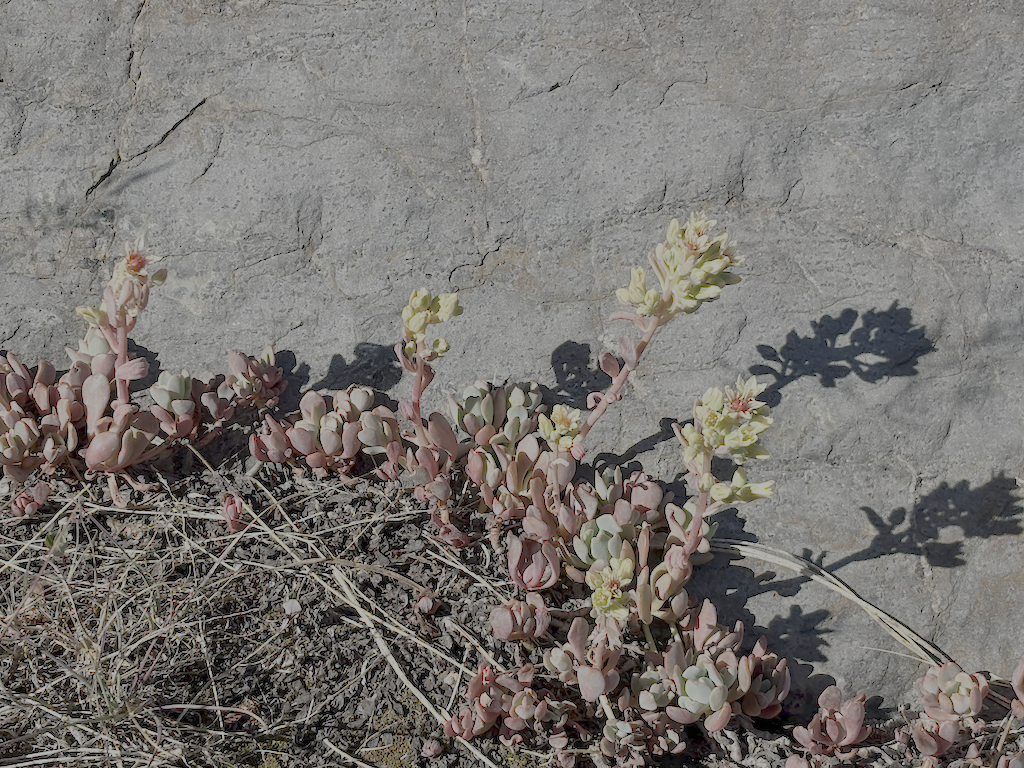
photo of Sierra stonecrop
Sierra stonecrop

I passed a group of eight backpackers headed along the Western States trip from Whiskey Creek, which is about as many as I usually see in a year. The crossing of Whiskey Creek has another tree down, blocking the rock-hop, but the large tree that has been down for several years makes a good crossing. Whiskey Creek Trail has a few rotted down trees, and one new small, otherwise in good condition. I camped north of the ‘Squaw’ Saddle Trail, at the divide between Five Lakes and Olympic Valley. With runners in the area for three events, including the Western States Endurance Run the next day, there were runners all over the place. Most place names have been changed away from ‘squaw’ but I don’t know if the trail name has been. This trail descended into Olympic Valley, and is the original trail route before the Five Lakes Trail was constructed.

Walked out the Five Lakes Trail, which is in good condition, caught the bus to Tahoe City, grabbed some items at Alpenglow Sports, best in the area, then back to Truckee on the TART bus, to Word After Word for a book, to Dark Horse Coffee in Truckee for tea, reading and writing, and then the Amtrak bus home to Sacramento. Whew!

Though plans are never certain, and I often change my mind, I think my next two trips are going to be for trail maintenance on the Western States Trail. Survey trips on the other trails will have to wait. It was hot enough at Talbot Campground/Trailhead, 1722m, that I think my trip on the Hell Hole Trail to the end at 1439m will get delayed until September, though I’m always looking for cooler stretches of weather.

Granite Chief 2024-08 trail survey

With this trip, I retired my old hiking boots and started with new. My boots are Altra Lone Peak, which is the only brand I’ve found that offers a wide toebox that my feet require. The old lasted a little over three years, since June 2021, not bad. The soles were more worn that the tops, but both were done. Altra has saved my hiking, as any boot without a wide toebox causes me great pain, and the one other common brand with wide toebox just doesn’t work for my feet.

The purpose of the trip was mainly trail condition survey. I often do that early in the season, but didn’t get to it this summer. Conditions for the trails I did are listed below. I went in at Granite Chief Trail (after enjoying Bluesday at Palisades Tahoe), then south on the PCT. The number of PCT hikers has dropped off, but there are still some going, either late starts or flip-flopping.

I was curious about rerouting of the Tevis Cup Trail, a project which started last summer and will continue through next summer. A CCC (California Conservation Corps) trail crew is base-camped at Little Needle Lake, and working from near the PCT to the west. The reroute is in varying stages, ranging from just sketched out enough to follow from being walked on by the trail crew repeatedly, to essentially complete. Several rock outcrops near the east end had just been blasted the day before, leaving a mess that requires a lot of reconstruction. The crew has worked as far west as a small seasonal creek, which will probably be the only water source on the rerouted trail. Though the trail route has been flagged through to its connection with the old trail, somewhere, I did not follow beyond the existing work, but I’m guessing a little more than half of the reroute has at least been started. This will be a very nice trail when completed! As I’ve written before, the Tevis Cup Trail design was horrible, gaining and losing altitude repeatedly, often for no apparent reason. I don’t recommend that you try to follow the new trail until the end of next summer, I do encourage you to enjoy it when finished.

A Great Basin Institute trail crew was working on the cross-trail between the PCT and Tevis Cup, which I call the Tevis connector though it is not clear what its official name and number is. They are camped at the flats beside the Middle Fork. Because the reroute crosses the slope of Lyon Ridge much higher than the old trail, several new switchbacks are being worked to bring it up to that level. If you follow the old trail west from the PCT, the obvious worked trail will take you all the way down to the Middle Fork. The junction with the old trail is marked by a rock wrapped with flagging, but could be easy to miss.

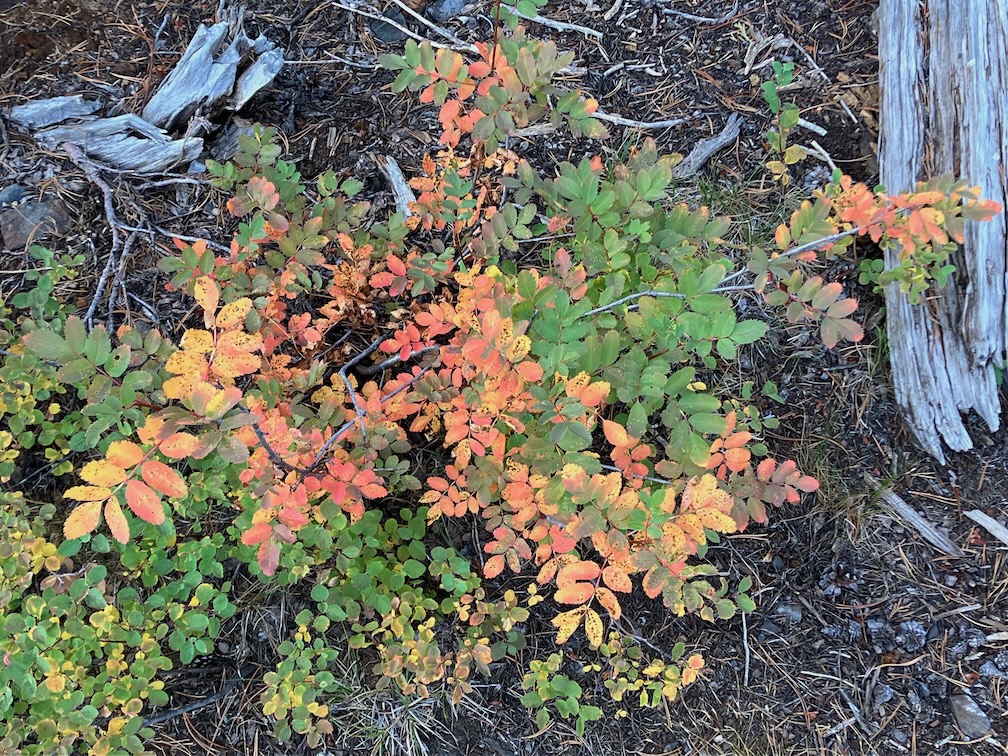
Knotweed is brilliant fall color right now, bright to pale red, and occasionally yellow and orange. It paints the west slopes below Wa-she-shu Peak with color, mixed in with other plants of fall color. Some of the wooley mules ears fields are browned out, while others are mix of green and yellow. Though few things are still flowering, the California fuschia at lower elevations are striking red.

photo of mountain ash in fall color
mountain ash in fall color

All my previous trips I had been sleeping under clouds, or smoke, or trees, but I had a full view of the sky with only a crescent moon to obscure. I have to admit I’ve forgotten a lot of constellations, but the night starts with the summer triangle overhead, and ends with Orion up in the east, and Jupiter.

I was going to do a loop out the Tevis Cup Trail to Talbot Creek Trail and back in on the Western States Trail in Picayune Valley, but realized I really didn’t want to deal with the old trail, and never will have to again. So I headed south on the PCT to Whiskey Creek Camp, and then west on the Western States Trail (which is called the Historical Western States Trail on some maps, I guess to distinguish it from the Western States Trail run on the Tevis Cup trail. Picayune is one of my favorite places in the wilderness, and I spent two nights there. Hiked out the trailhead one day, recording trail conditions, and lolled by the creek as much as possible.

The rain last week, while I was home, perked up three ferns that grow among the metamorphic rocks in Picayune Valley: cliff-brake, lace, and indian dream.

My ambition was to come back and do the Shanks Cove loop up the ridge and back down to Five Lakes Creek below Big Spring Meadows. But ambition failed me, and I stayed a night at Whiskey Creek Camp.

I hiked out Squaw Saddle Trail (has it been renamed?) and Five Lakes Trail to the trailhead. I walked the Bear Creek Trail towards River Ranch, planning to sleep part way along. But there are only two flat spots along the entire trail, one by the water tank and another on a bald hillock. But I noticed the hillock was covered with bicycle tracks, and I suddenly had a vision of being run over by night-riding bicyclists (which has become popular in the Tahoe area), and I had already passed the tank, so I walked all the way out to the stables and then bottom of Alpine Meadows road and camped by the river. I was surprised to see how many creeklets cross this trail, including at least three that are probably year-round. But the creeklets are all east of the water tank sleeping area.

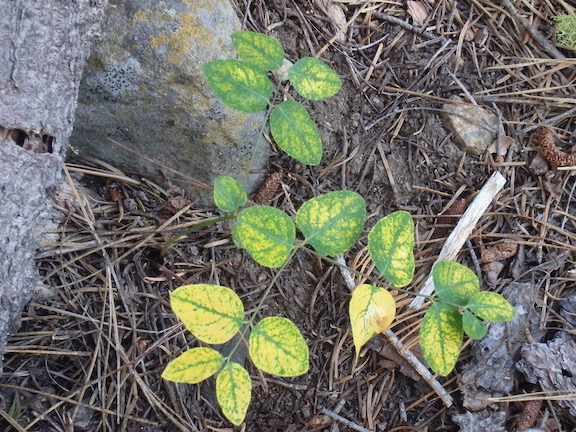
While on this trip I finally identified the low shrub that I had been working on the Powderhorn Trail. It is snowberry, Symphoricarpos. It spreads by sending out runners that root. Sometimes across the trail, and those runners age to an almost unbreakable trip-wire, which is part of the reason I try to get it out by the roots, and cut it back if I can’t. On my earlier trip, the white berries were not there, but now they are, so I was able to identify. On the plus side, there was a patch of the gooseberry without spiny fruits around the old wilderness info sign at the beginning of the Tevis Cup Trail. Hmm, delicious.

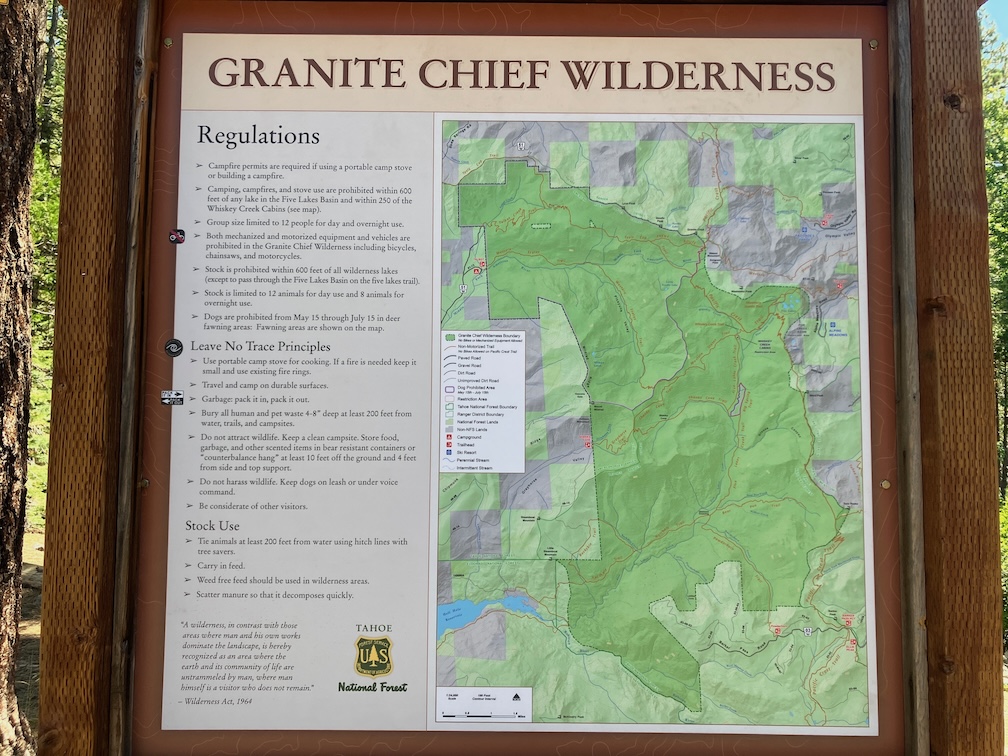
There is a new trailhead map at the Talbot trailhead. It has the extended wilderness boundary on the northwest (lands purchased by the American River Conservancy), the new name Wa-she-shu, and a few other details. Unfortunately, it still shows the Buckeye Trail, off the Hell Hole Trail, which is essentially unfindable.

photo of Granite Chief Wilderness trailhead map at Talbot trailhead
Granite Chief Wilderness trailhead map at Talbot trailhead

I finally figured out why my hips have been hurting this entire season. The waist belt on my Osprey Atmos 50 AG backpack has velcro attachments between the hip belt and the waist belt. On one side, the velcro no longer holds where it is supposed to, so the waist belt no longer cinches as tight as it should. So the pack was riding low on my hips and causing pressure with every stride. It also explains why I was more and more holding onto and pulling in on the shoulder straps, trying to pull the pack up off my hips. Though these are called hip belts, they are meant to go above the hips, to ride on top of the pelvis and not on the hips. I will have to get that fixed during my late fall slow backpacking time.

Trail Conditions

  • Granite Chief Trail (15E23): good condition, one 9 inch down tree, could use spot brushing; adopted by Truckee Trails
  • PCT south to Tevis: good condition, one 6 inch, some debris*
  • Tevis Cup Trail (16E04): see notes above, old trail unacceptable, new reroute not complete
  • Tevis Connector: good condition
  • Little Needle Trail: This is not marked on maps and was formerly just a seldom used and hard to follow hunters trail, but with the CCC trail crew camps at the lake, it is now easy to follow.
  • PCT south to Whiskey Creek Trail: good condition, five down but all easy to step over or bypass, some debris
  • Whiskey Creek Trail: good condition, except broken tree fragments at the bottom
  • Western States Trail (16E10): to Shanks Trail, 16 down trees, some very brushy areas, moderate debris; to Talbot trailhead, about 30 down (forgot to record), some brushy areas, some areas of moderate debris; most of the down trees have established bypasses or can be stepped over/climbed over, but some newly fallen are difficult; though there are a lot of down trees on this trail, it is still worth walking or backpacking; the trail sign at the junction of Western States and Shanks is broken and down, but still readable
  • PCT south to Squaw Saddle Trail: good condition, one down tree, well brushed
  • Squaw Saddle Trail (if it is still called that): good condition
  • Five Lakes Trail to Alpine Meadows Trailhead: good condition, could use spot brushing

Trails not checked so far this season:

  • Shanks Trail
  • Greyhorse Taril
  • Hell Hole Trail
  • Talbot Creek Trail

*debris: I used to call this winter debris, the branches and cones that fall out of the trees during the winter, but since if falls year-round now from dead trees, I’m calling it debris.

Photos on Flickr:

Tevis to Picayune

Paul VanderVoort shared with me last year a post from his blog, which I’ve linked to here: https://paulvandervoort.wordpress.com/2018/10/05/tevis-cup-trail-to-picayune-valley-x-c-path/. I have not followed this route, so how you use the information is entirely up to you. I have heard for years rumors of both a route, and an actual constructed trail (from long ago, not maintained) between the Tevis Cup Trail at the south-extending point, and a point near the crossing of the Picayune Valley (Western States) Trail and the Middle Fork of the American River, and have looked to see if I could see such, but did not find anything. I’ll try it out next time I have some off-trail yearning.

Granite Chief 2016-08

Note: this trip is LAST year, 2016, which I never got around to finishing, but here it is now. I like to post on every trip, in part so that I myself can keep track of trips and where I went. 

A dry year, dogbane turns color early

I went in at Squaw Valley (bus stop) and up Granite Chief Trail to Granite Chief saddle  where I camped for the night. The next day I walked out the Tevis Cup Trail and what I call the Tevis Cup Connector, one of the old Western States Trail alignments. Tevis Cup is easy to follow and has great views, but the trail itself is unpleasant,  climbing and descending repeatedly for no good reason, and poorly maintained. The end of the trail has been re-aligned off a gravel road onto a trail that goes past old ranch or FS buildings (not sure which), but ends at the same green gate as the old route. The Tevis Cup Connector is faded and jhard to follow in some places, as it descends and crosses the Middle Fork American River and then climbs to join the Tevis Cup. 

I headed south on the PCT, doing some spot brushing along the way, and continued to Barker Pass, to Powderhorn Trail and back into the wilderness. Powderhorn is in decent shape on the upper third and lower third, but almost completely brushed in in the middle third, with whitethorn and doghair fir. I camped at Diamond Crossing, explored Bear Pen trail which I’d not beeen on in several years. It is in decent shape, not too hard to follow, but where it crosses Bear Pen Creek before the meadow, eroded banks make it necessary to climb down and back up, awkward with a pack. 

Some sort of bee or wasp is incredible abundant, everywhere but particularly along the edges of creeks. Yellow and black striped body, but no fuzziness and no constriction between the thorax and abdomen. Not sure what it is. Also saw a lot of grouse on this trip, at least 40. 

I went out Five Lakes Creek Trail, which has received some logging out, perhaps by the horse trip that comes in once a year to a Big Spring meadow, and then out to the Five Lakes trailhead. And back to Truckee by bus and back home on the train. 

Photos on Flickr; Granite Chief collection