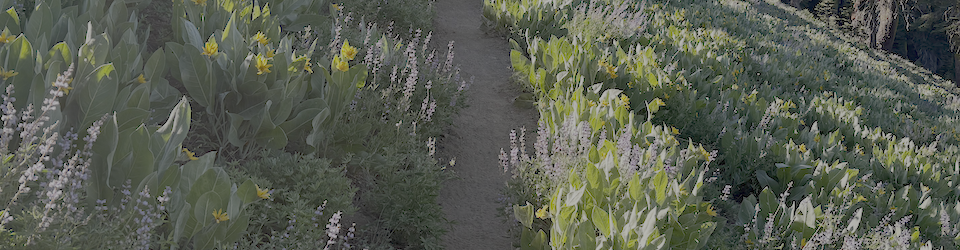
My seventh trip of the season was a trail survey, to pick up the major trails that I had not yet visited this season.
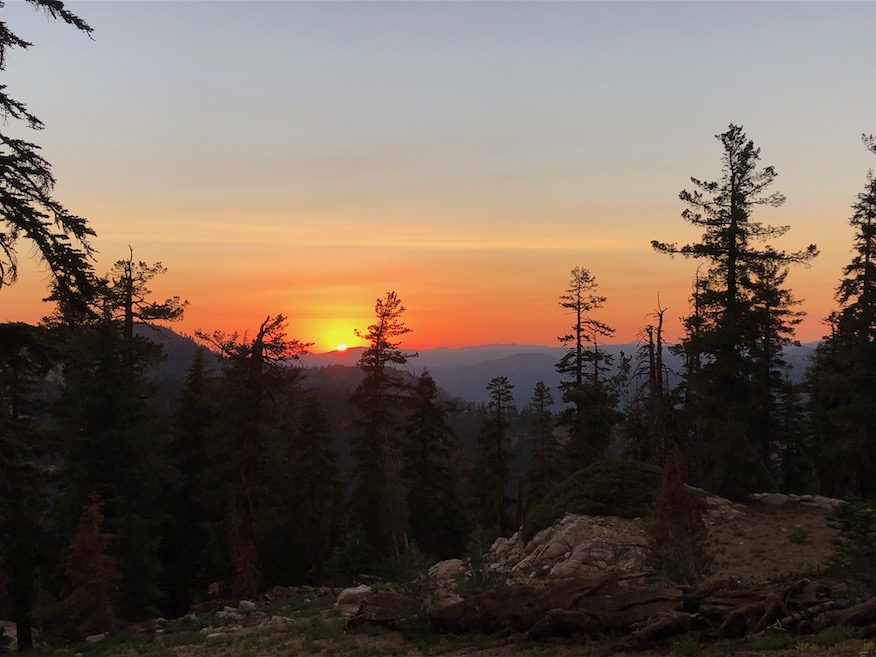
My first day up in the mountains I went to Bluesday at Palisades Tahoe, then to Tahoe City to sleep. It rained a lot in the afternoon, but tapered off by mid-evening. I went in at Five Lakes Trailhead. It rained and hailed hard on my way down Five Lakes Creek, and I sheltered under some trees for the heaviest part. By late afternoon, it had stopped, and I made camp near Diamond Crossing at a campsite that I often use. A few red clouds at sunset. This campsite is next to Five Lakes Creek, and up against the high ridge on the north side of the creek, so the sun goes away very early, but shows on the canyon rim to the east for quite some while after.
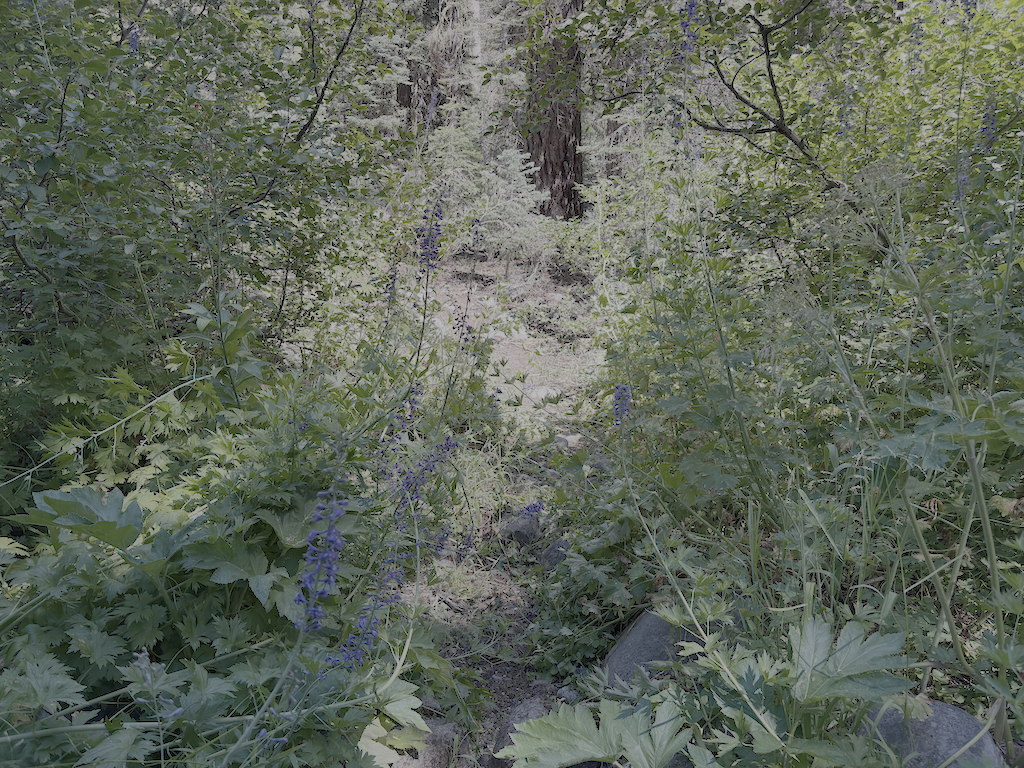
Next day I headed down the Hell Hole Trail, from Diamond Crossing. I last used this trail, as far as Steamboat Creek, last year, but it has been since 2020 going further than Steamboat, and longer since doing any maintenance on the trail. There are more down trees than before, but most noticeable change is the thick layer of winter debris, particularly before Steamboat but throughout. It was hard to see the trail in several locations, and I found myself off the route several times. Steamboat Creek is seasonal, always dry at this time of year. The trail route which I had defined and maintained from Steamboat down to the bottom was still OK in some places, but thick with debris on many, and I lost the route here and there. Having my earlier GPS track helped. I had previously edited the Open Street Map route to combine upper and lower Hell Hole Trail, but realized on this trip that was a mistake. Upper was once maintained, and though hard to follow due to lack of maintenance, it is still accessible to horses. Lower is steeper, narrower, not at all safe for horses, and though it was constructed in a few spots, there are sections that either were not or have disappeared. Though bears are largely responsible for keeping these trails open and visible, they don’t always stay on the ‘official’ trail, and their network of trails can be confusing.
From the bottom of the Hell Hole Trail, I headed west on a trail that traverses along the north side of the reservoir, to a trailhead on the jeep road. Neither end of the trail is signed. The trail was probably constructed when the reservoir drowned the historical trail closer to the Rubicon River, but two short sections were never finished. Greyhorse Creek does not have a bridge, and the crossing is not safe for horses, nor is it safe for anyone during high water. So far as I can tell, the trail was never assigned a trail number or official name.
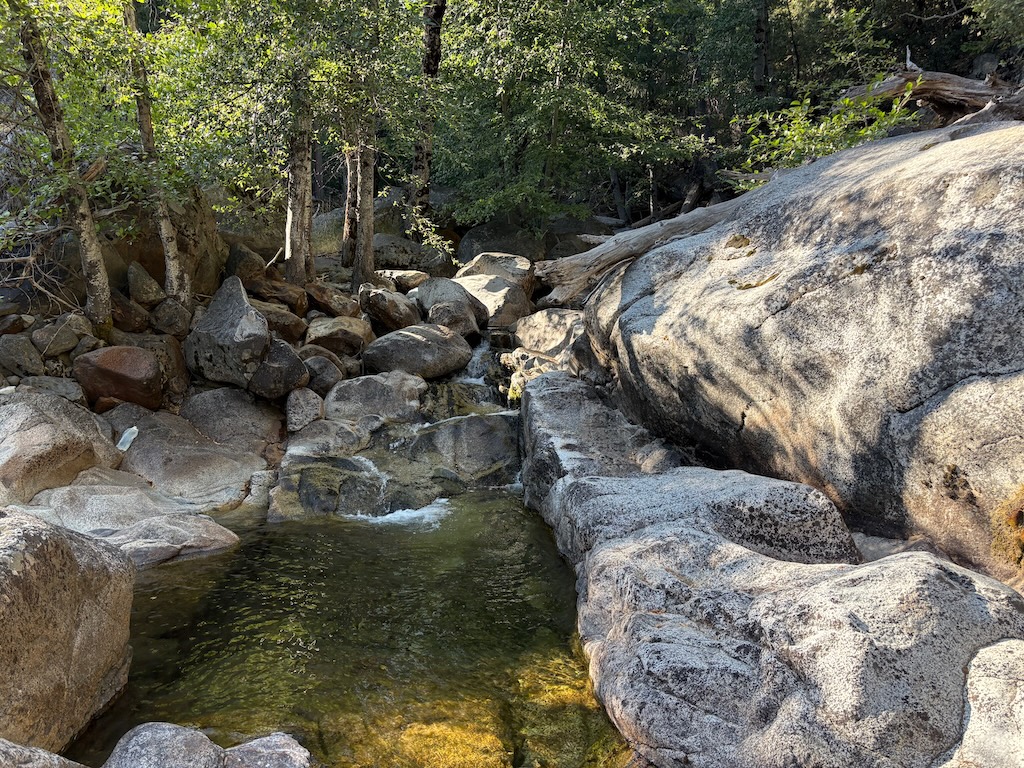
With the reservoir way down, as it always is this time of year, I opted to hike across the bottom, much of which was a large meadow before being drowned, to Upper Hell Hole Campground. This developed campsite, with tables, grills, and port-a-potties, is mostly used by people boating in when the reservoir is up.
The next day I walked the ‘other’ Hell Hole Trail (14E02) to Hell Hole Dam. The trail has been logged out this year, though there were two down trees since the log-out, one of which is a mess to get through or bypass. But overall, good condition. There are a number of tipped-over trees with root balls intact (firs tend to snap off above the roots), mostly Jeffery pine but some others, all tipped down canyon. I wonder if there are major wind events blowing down canyon. With the same name, though different number, one might presume that the two Hell Hole Trails connected, but there is no constructed trail between the two. There are a variety of use trails, some fairly easy to follow, others not.
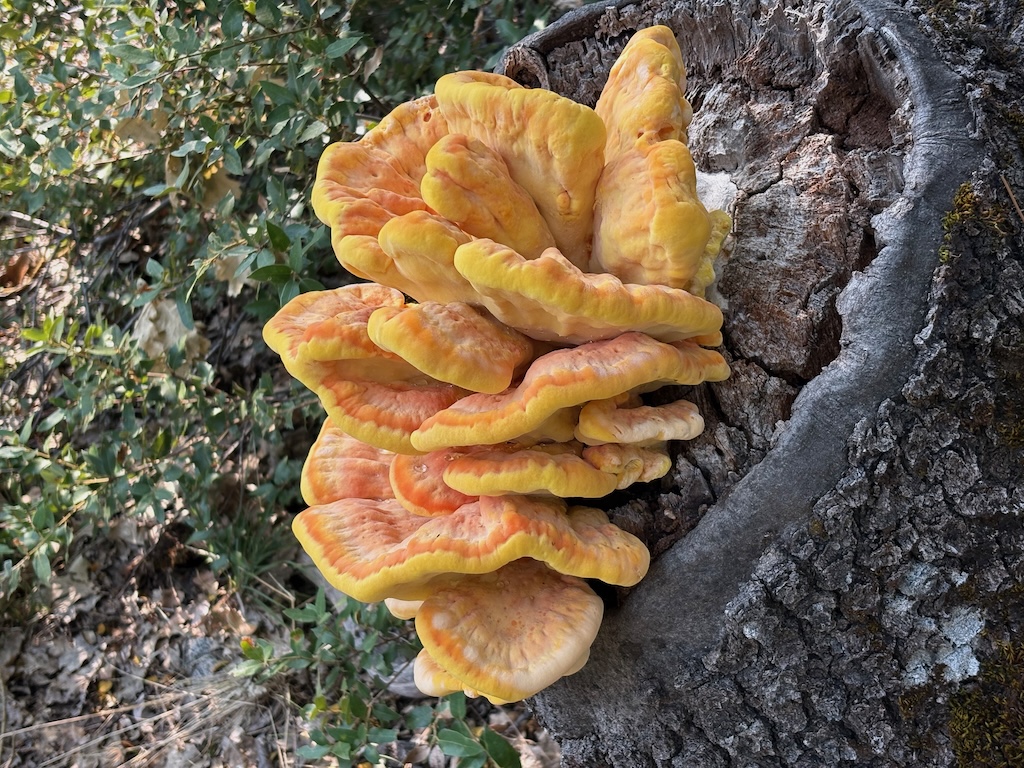
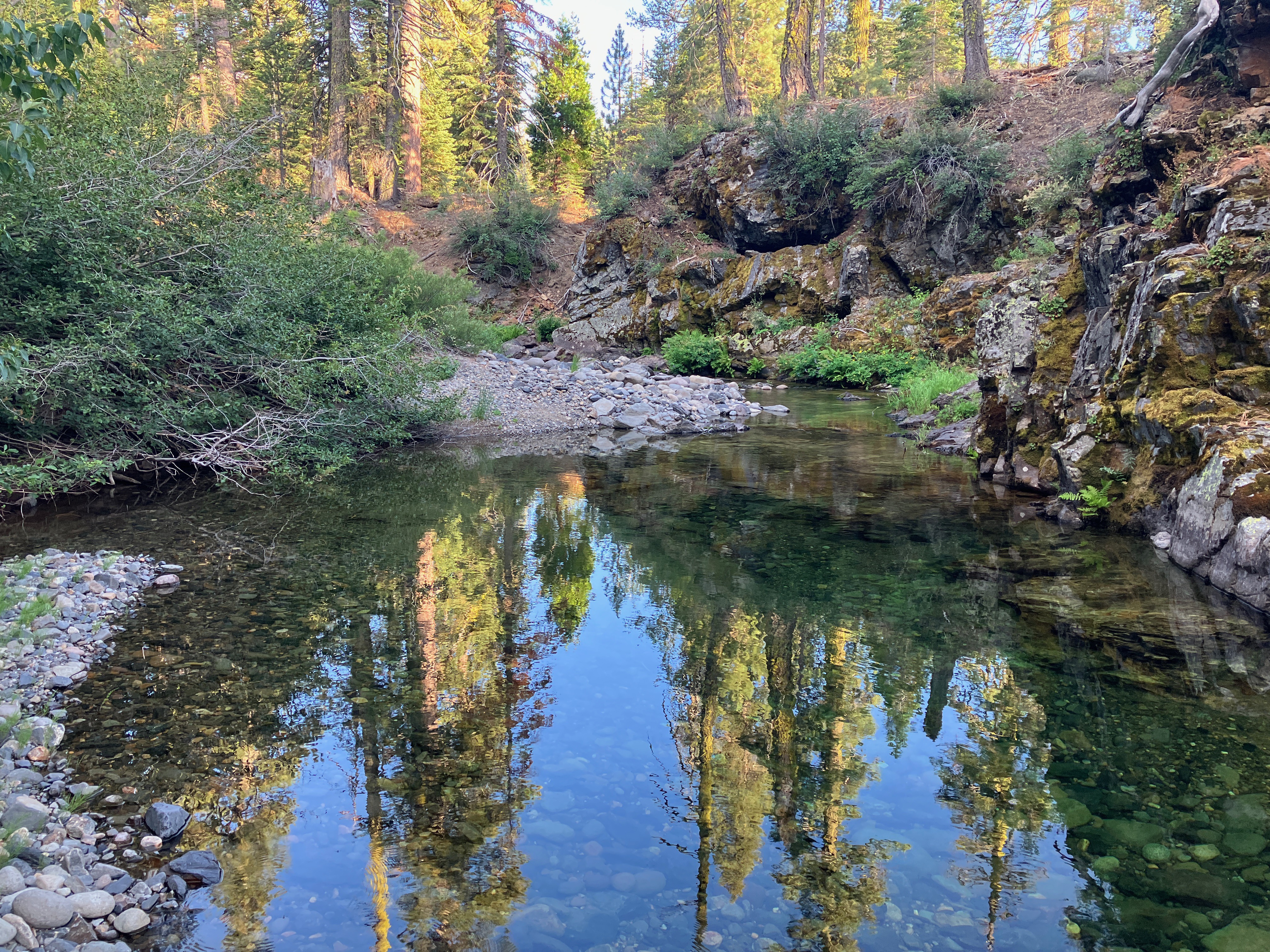
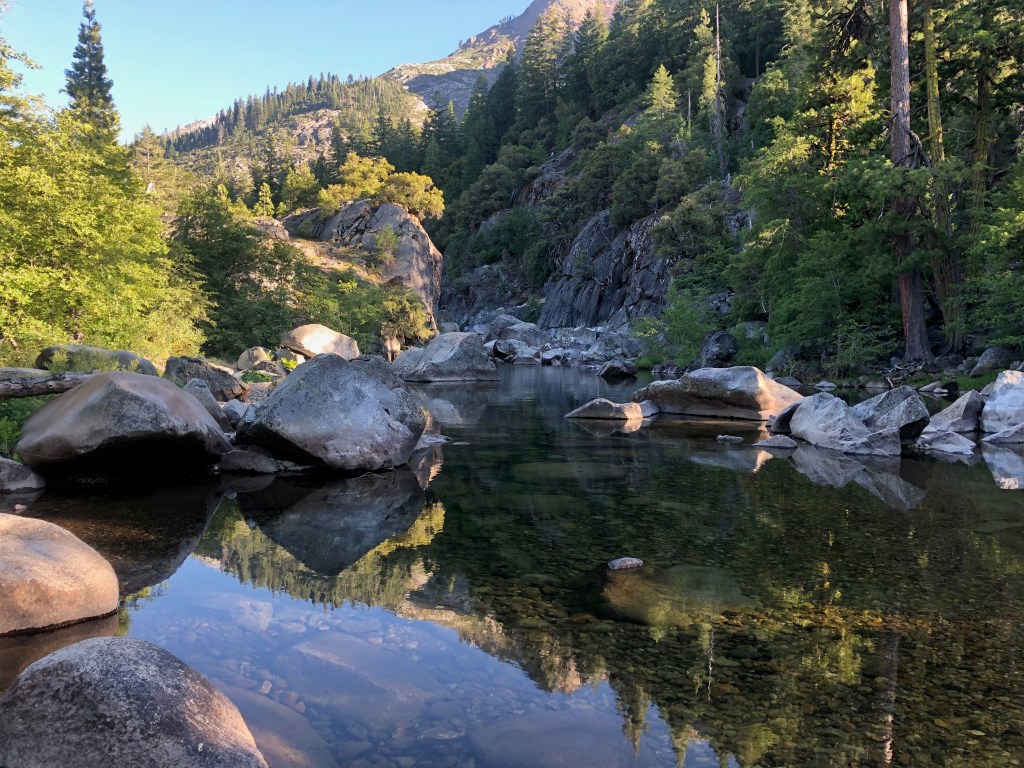
I had already decided to move my next camp up the Rubicon River a ways, and my choice was solidified when a group of jeeps arrived in the campground. I would have guessed that the campground was inaccessible by vehicle, but true jeeps (as in old and the Jeep brand), modified with crawler gears and large tires, can go almost anywhere. I camped on a bluff above the pothole section of the Rubicon, where it drops through several waterfalls and eventually down to the reservoir floor. This is all underwater when the reservoir is up.
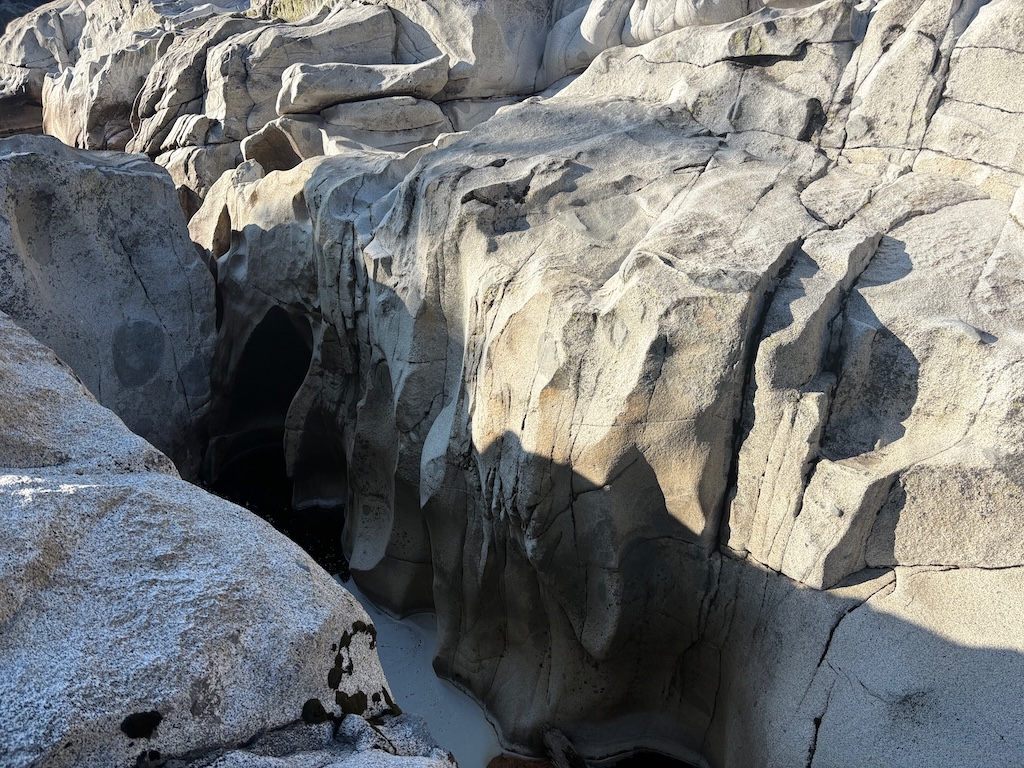
Next day, I made my way on use trails to the waterfall on Five Lakes Creek, then along a trail or route that I have partially maintained, and back to the bottom of the Hell Hole Trail. Though nothing like a constructed trail, the route can be followed, except closest to Hell Hole Trail, where I have not been able to find or define a trail through the logged area. This area was helicopter logged.
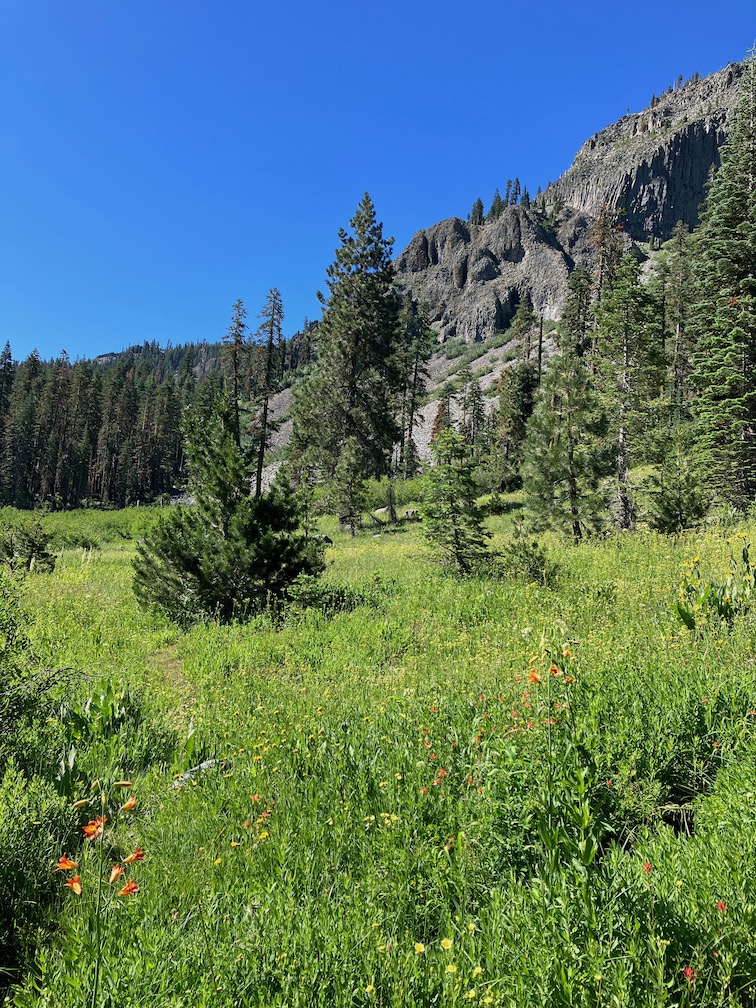
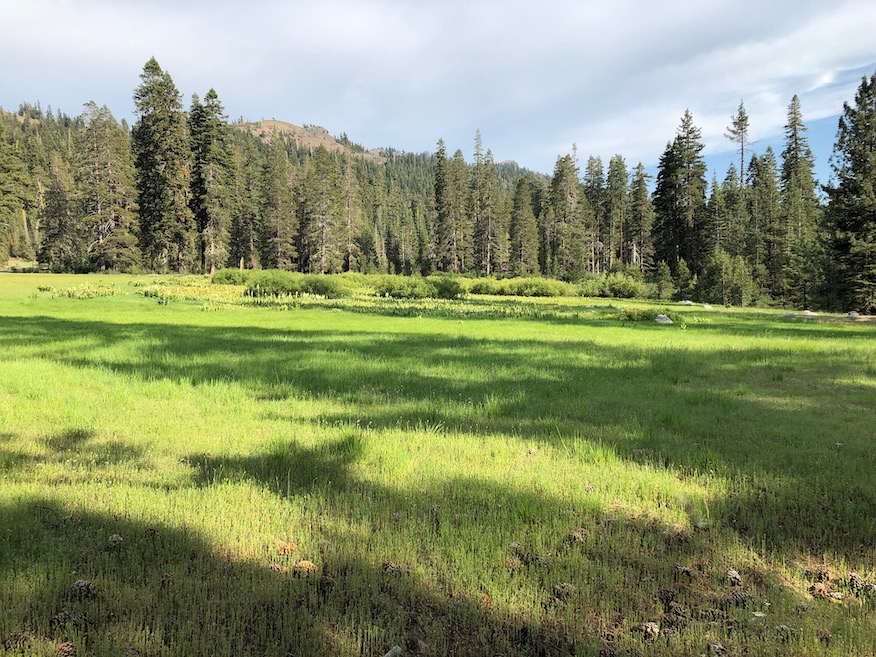
I headed back up the Hell Hole Trail, able to find it a bit more often for having walked it, and then the Five Lakes Trail, and camped at Big Spring Meadow. There were other campers there. Big Spring Meadow used to be a popular destination for both hikers and horse riders, but has been seldom used the last few years. In part due to the deteriorated trails. Next day, out at Five Lakes Trailhead, hitched a ride to River Ranch, and then again to Truckee, as the TART bus was nowhere to be found.
Note on gear
I have a pair of Altra waterproof mid-height boots. This is my last time every buying waterproof boots. They work fine if water never gets in the top, but once water does, from creek crossings or rain running down legs, they do not dry. My boots were still wet five days after the earlier rainstorms, despite often stopping to try to dry them out. As a result, my feet suffered, severely, rubbed raw in a number of places, painful to walk. Altra trail shoes are the only brand that fits my distorted feet, so I will buy them again, but never waterproof versions.
I have been hiking the last few years in convertible pants, with zip-off legs. I like them, but wanted to try again wearing Patagonia baggie shorts, as I used to do. Much more comfortable hiking. The unmaintained trails on which I spent about half of this trip are not the place to be wearing shorts. Debris kept flipping up and scratching my legs. So, love them baggies, but only for maintained trails.
Note on Hell Hole area trails
The GaiaGPS maps show a 4WD road from Greyhorse Creek to the east and around the Rubicon. This is fabricated. There never was not could be a road here. There is an old road that goes up to a mine prospect, but it is no longer usable. I asked GaiaGPS about this road, and they blamed it on Open Street Map (OSM). It is not and has never been in open street map. It is a relict from some earlier map. Several areas along the Rubicon River were logged, but it was helicopter logging, not road logging.
I have looked for two trails shown parallel to lower Hell Hole Trail, 15E17 and 15E18, but have not found them. I think they were entered by someone sitting at a desk, not from someone in the field.
Though GaiaGPS claims that they load from OSM, thereby correcting these errors, this is a lie. Apparently they add new data from OSM without removing old data. So fabrications and relicts remain, year after year after year. The Buckskin Trail, two branches off of Hell Hole Trail, are another example. Not in OSM in years, and not followable on the ground, yet it remains on GaiaGPS maps. GaiaGPS has always had some problems, but since it was acquired by Outside, it has really gone downhill. So to speak.
For the trails I have created in GaiaGPS, trails that are or were recently maintained are shown in red. Trails that may have been constructed, but have not been maintained in a long while and may be difficult to follow are orange. Use routes, never constructed, and of various ease of use and visibility, are yellow.
I have a thought that someday I’ll figure out all the trails and routes in the Hell Hole and Rubicon River area, and map them correctly. I’m probably fooling myself.
- Photos on Flickr: https://www.flickr.com/photos/allisondan/albums/72177720328848766
- Granite Chief collection on Flickr:
- https://www.flickr.com/photos/allisondan/collections/72157637640215275/
 Granite Chief Wilderness