Category Archives: Trip Reports

more Hell Hole area trail work 2020-07

My July 18-24 backpack was into the Hell Hole area of the wilderness, mostly for trail work.
I went in at Granite Chief trailhead in Squaw Valley, and up to the PCT. I camped along the ridge with a view west and particularly northwest, but there was a band of clouds in that direction and I did not see the comet. From there I headed south on the PCT, turned to Whiskey Creek Camp, and south along the Five Lakes Creek Trail. From Diamond Crossing I went down the Hell Hole Trail, doing some light trail work along the way, and down to the junction near the reservoir with what I call the Hell Hole Connector Trail, which goes to the road into lower Greyhorse Creek, and the McKinstry ‘trail’ route down from south of the Rubicon.

I manage to follow the Hell Hole Trail all of the time from Diamond Crossing to Steamboat Creek now, with the trail definition I’ve done, but I sometimes still lose the trail for a while from Steamboat Creek down to the bottom. The problem is that there have been many trails, many of them marked with rock ducks and cairns, so if I get off the main trail, I find other trails and it takes me a while to realize. Nevertheless, it is now much easier to find your way than it used to be. Someone has marked parts with orange flagging, and there was only one place the orange flagging was in the wrong place, and I removed it.

From the junction near the reservoir, I went upstream to where the ‘trail’ route crosses Five Lakes Creek, and camped near there. My time down in the canyon was split between exploring to find trails and doing trail work. I walked about half way out to dam along the trail 14E02. I had thought this trail did not exist, but it does, and it is actually in pretty good condition. From the Upper Hell Hole Campground, there is a clear trail to the upper campground area, and then a vague short trail connecting to this trail, and that is how I accessed it. Coming back, I followed it eastward. Though the trail becomes vague, and then mostly disappears when it drops into a forested flat, it does seem to go all the way to the Rubicon River, very near where a waterfall area forces the route from Five Lake Creek area up and over a bench. The official maps show this, more or less, though I did not really believe them. I also explored the many routes between the trail at Five Lakes Creek and the Rubicon River. There are several routes in places, only one in other places. Where the seemingly main route comes down to the Rubicon River, there is a campsite with a heart shaped rock wired to a tree, not far from a pond on the divide between the creek and river. Just upstream along the river is a thicket of huckleberries, which are rare in this area and at this elevation.

My main objective was to further locate and define the trail between the Hell Hole junction and Five Lakes Creek. I partly found the trail, though across the manzanita flat I could not really tell where the trail had been because the manzanita had grown so thick over the years. I cleared a new or old trail through the manzanita, so that there is now a visible trail for about half the distance. I also think that I have located the traces of trail to link together to complete the other half, but there will be at least one more trail work trip to make that visible. And, then, there is the whole question of the McKinstry Trail which crosses the river and climbs south to a road. I don’t know whether it exists anymore. I’ve heard various and conflicting information. That will probably have to wait for next year, as it will take this year to clear the trail to get to the Rubicon.

I have a GPS track for the section of the McKinstry Trail I’ve made visible, but it needs some editing, so is not posted the my GaiaGPS maps yet.

All of the creeks are now rock-hopable. Some of the smaller creeks and the ones which are seasonal every year have dried. Steamboat Creek was still flowing at the time of my trip, but was dropping, and I very much doubt that it still flows, at least at the trail crossing.

I went back out via the PCT and Five Lakes Trail, to catch the bus at River Ranch.

Trail conditions:

  • Granite Chief Trail: good condition, some brushy areas but no problems
  • PCT, Granite Chief Trail to Whiskey Creek Camp Trail: good condition with a few downed trees and a few brushy areas
  • Whiskey Creek Camp Trail: good condition, one downed tree
  • Five Lakes Creek Trail, Whiskey Creek Camp to Diamond Crossing: many downed trees so that it is becoming unpleasant and slow to walk; this trail has not been logged out in many years; severe tread erosion in may places
  • Hell Hole Trail, Diamond Crossing to junction with McKinstry Trail: hard to follow from Diamond Crossing down to Five Lakes Creek, easy to follow to Steamboat Creek, challenging to follow from Steamboat Creek to junction, but mostly visible and marked with rock ducks; many downed trees but with ways around or over all of them
  • McKinstry Trail: no longer a trail, but a route that can be followed with close attention to maps/GPS tracks and visible remnants and rock ducks; unknown condition past the crossing of the Rubicon River
  • PCT, Whiskey Creek Camp Trail to Squaw Saddle Trail: good condition, some brush
  • Squaw Saddle Trail: good condition
  • Five Lakes Creek Trail, to Alpine Meadows Trailhead: good condition

I’m off for a trip in the Mokelumne Wilderness, and then back to the Granite Chief for my next trip in September. For my readers and backpackers, enjoy your travels, and let me know of your experiences.

Photos on Flickr: https://www.flickr.com/photos/allisondan/albums/72157715387628207; Collection on Flickr: https://www.flickr.com/photos/allisondan/collections/72157637640215275/.
trail work 2020-07

My trip July 2-9 was mostly into the Hell Hole Trail area. I went in at Alpine Meadows trailhead, down Five Lakes Creek, to Hell Hole Trail and McKinstry Trail, and then back out via Powderhorn Trail, north along the PCT, and out at Alpine Meadows ski area.

The Five Lakes Creek Trail is in gradually deteriorating condition, with more down trees added to the existing ones, and more issues with tread erosion. The Hell Hole Trail is in decent shape though there are downed trees that have now been there for years, and a few more are added every year. I have been working on defining the tread, so the trail is becoming somewhat easier to follow, though some sections still have a lot of winter debris accumulation. The trail from Diamond Crossing down disappears as it approaches Five Lakes Creek, due to thick willows and downfall, but it is not too hard to find a way through. The trail from there to below Steamboat Creek (which was still flowing well) is in decent condition, though it requires close attention to follow. There are a large number of oak trees down over the trail switchbacks about 2/3 of the way down the hill to the lower end of the trail, but you can bypass them by paying close attention.

I did some more work on what I’ll call the McKinstry Trail, from the junction at the bottom of the Hell Hole Trail, so it is now defined from the point near Five Lakes Creek crossing to about a third the distance back to the junction. But the 2/3 closer to the junction is very hard to find, and I have not yet identified what the best route is. I’m sure the original trail just headed across the forested flats, but the helicopter logging that left all the debris, and a weakened forest generating downfall, has completely obscured these sections. Eventually I’ll figure and and define the best route, but for now, one just has to head in the right directly and hope to pick up the trail again.

After crossing lower Five Lakes Creek, the route again is lost in the forested flats. It shows up again where it climbs up on the ridge separating Five Lakes Creek drainage from the Rubicon River, and is marked with rock ducks to where it comes back down to the river. I have not been past the crossing of the Rubicon in years, so the condition of the rest of the McKinstry Trail is unknown to me. There are also use trails that follow the ridge between the two drainages down towards the reservoir, but I haven’t been on those in years either.

Heading back out, I took the Powderhorn Trail, which has more downed trees but is not in bad condition, walked the road to Barker Pass, and headed back north on the PCT. The PCT is in good condition from Barker to the PCT/TRT junction. After all these years, it seems the the Tahoe Rim Trail Association has finally reached the desired state of good repair: no downed trees, no brushy sections, tread in good condition. Thank you! North of that junction there are a few downed trees, and some areas needing brushing (which apparently only I do, but I haven’t done in about three years). I intended to go out through Five Lakes back to the trailhead, but realized there were going to be hundreds of people on that trail, so I went out through the Alpine Meadows ski area, which is no shorter than the trail, but I only saw one person.

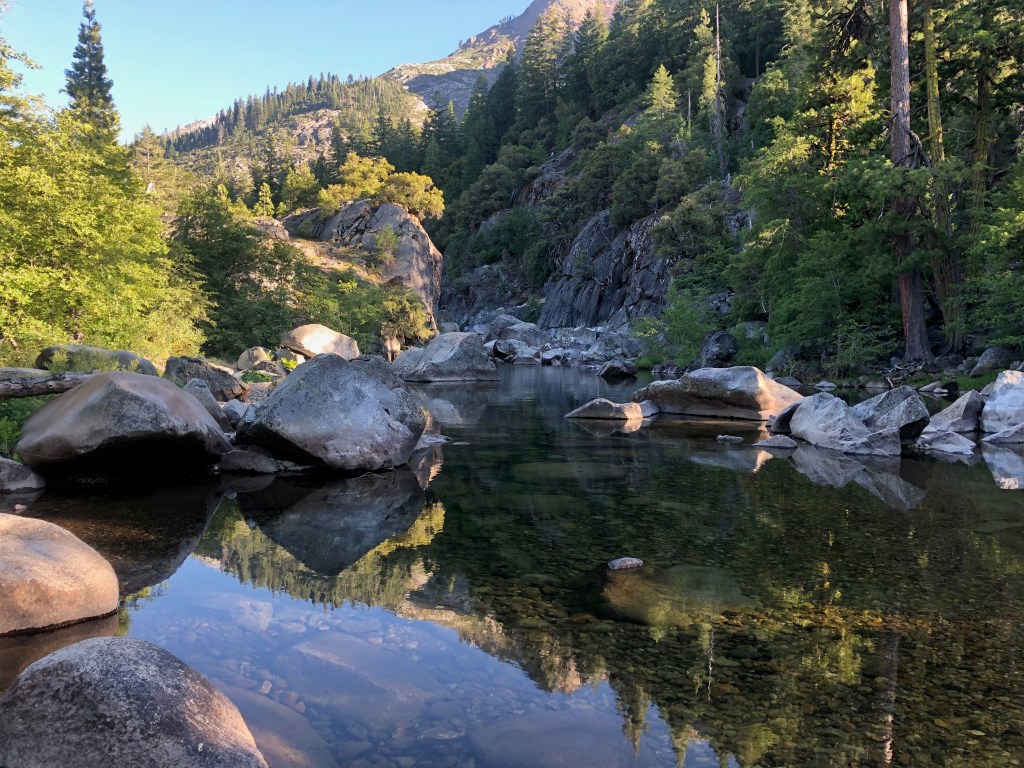
Rubicon River near McKinstry Trail

I’m just about to head back into the same area, to do a little more trail work and a little more exploring.

Photos on Flickr: https://www.flickr.com/photos/allisondan/albums/72157715140370061

Hell Hole part 2 2019

As is not unusual, I forgot to complete my post on the final trip of the 2019 season. I only had two trips in 2019 because deep snow kept me out of the mountains until mid-July, so instead I backpacked parts of the Bay Area Ridge Trail. And was back at work in mid-August, with my long weekends otherwise occupied.

This was another trip into the Hell Hole Trail for maintenance and trail finding. I have tried many times over the years to create a single track for the Hell Hole Trail from Steamboat Creek down to the intersection with the McKinstry Trail, but failed. This time I finally succeeded, but it took two days of walking up and down, and some editing of the resulting GPS track when I got off track despite all my prior explorations. The trail is now available on GaiaGPS in my Granite Chief folder, labeled as ‘Granite Chief HellHoleTrail lower’. I spent some time working on the least obvious spots, but the trail is still hard to follow and I’d not be surprised if others lost the trail. The gully section is marked with cairns (rock piles of three or more large rocks), but unfortunately so are many of the less than desirable routes. In 2020 I hope go back and define the trail better. I cleared and defined the trail from Steamboat Creek to where it first comes into the gully, which stays higher on the slope than many of the other routes. I think this may actually be a bear trail rather than the official route, but it works better than the others, so it is the one I’ve used. I’ve changed the track color to yellow, which means a route rather than a trail, since much of it is still hard to follow. This trail is not safe for horses. Most of it is, but there are three cruxes where the trail has slipped away and the tread is too precarious. Though, long ago, this was definitely a horse trail. I’ve wondered if the gully was similar when the horse trail was still usable, or if it developed afterwards and is why it is no longer horse-usable. Don’t know.

I also worked the trail section from the jeep road to Grayhorse Creek to the junction with the lower trail (above) and the route that heads up Five Lakes Creek and sort of connects to the McKinstry Trail. This 4WD, high clearance most of the way until it starts dropping into Grayhorse Creek, take off from FR 24 near the Hell Hole Guard Station (not in use). The part from the trailhead, which is unmarked, to Grayhorse Creek was well overgrown in many places, but is now followable. If you are coming down the jeep road, the trail starts at a little grassy bench just before the last very steep road down to the reservoir. Early in the season, Grayhorse Creek roars down its gorge and may be impossible to cross at the trail. I did some work on the remainder from the creek to the trail junction, but it is not as clear and may be hard to follow in places. If the reservoir is down, you can also follow the shoreline from the base of the 4WD road and informal camping area, to the old mining road, and thence up to the trail crossing. The junction with the Hell Hole Trail lower is not obvious, but is on top of a ridge just beyond a bouldery dry creek. This section is available in GaiaGPS as ‘Granite Chief HellHole connector’, orange on the map. Note that this is the same Grayhorse Creek that the Grayhorse Trail follows, but the two sections are about four miles from each other.

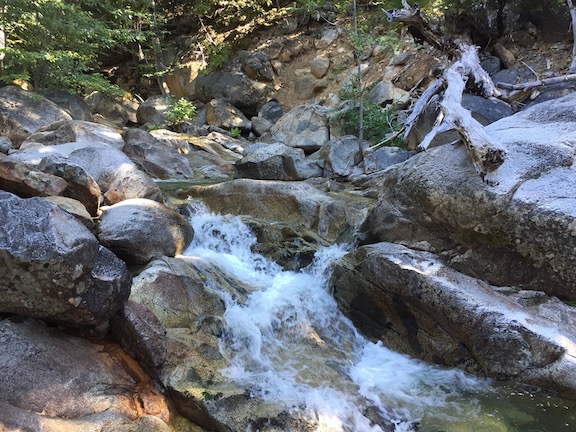
Grayhorse Creek at trail crossing

I’ve done a little bit of work on the trail section east of the junction, but can pretty much guarantee you won’t be able to follow it. In fact, there are several vague routes, which don’t always connect with each other. It will be many days work to find, and then make obvious, that trail. Nevertheless, there are many wonderful things to be seen along lower Five Lakes Creek and the Rubicon River, so if you are adventurous, don’t let the lack of a trail keep you out. You might even run into the fragments of trail I have worked.

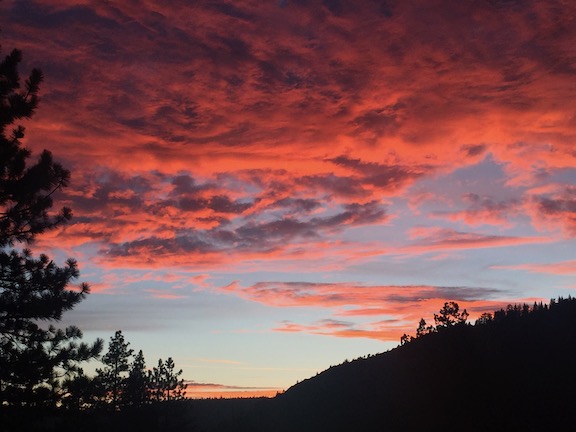
While doing trail work, I camped on the granite ridge which overlooks the Rubicon canyon, just south of Steamboat Creek. It is a great place to watch sunrises and sunsets, and the stars through the night. As I’ve stated elsewhere, Steamboat Creek is seasonal at the trail crossing, but it was still flowing for this trip. If it is dry at the crossing, either explore up or down the creek to find water, or just pick up water at Buckeye Creek on your way there. If you are coming up from the bottom, carry enough water to make Buckeye Creek in case Steamboat is dry. There are some small seeps in the gully, but I think they are seasonal as well.

sunset from camping spot

In my previous Hell Hole Trail post, I had noted an old trail sign and wondered if it marked the old Buckeye Trail (no longer a trail) junction, and yes, it does. I followed the trail for a half mile, and it is clear that it was at one time, long ago, constructed, though I don’t know whether it an be followed further. Another exploration for another trip!

Photos on Flickr: https://www.flickr.com/photos/allisondan/albums/72157710205332747

Trails on GaiaGPS: https://www.gaiagps.com/datasummary/folder/5b4e23c555d0dc5fd992f16948fb09de/

Hell Hole Trail 2019-07

I spent the second half of my recent backpack trip working on the Hell Hole Trail, specifically the upper part between Diamond Crossing (junction with Five Lakes Creek Trail and Powderhorn Trail) and Steamboat Creek.

Over the last few years, there has been more and more down trees on the trail, but by far the worst part was a ways past Buckeye Creek where there is a tangle of down trees in an Incense Cedar forest. This had gotten so bad that the bears had stopped using it and made their own way, with trails above it and below it, and the trail itself had essentially disappeared. The issue with the bear trails is that, though they eventually reconnect, it is quite some distance before they do, and a hiker is likely to notice there is no people maintenance and no people marking, and figure they are ‘lost’. Happened to me twice, and once was quite a long detour. So, I spent some while finding the trail again, and defining it well enough that it can be followed. I only take light trail tools, including a folding Fiskars saw, so can’t do anything about most of the down trees, but most of them are easy to step over or climb over, so defining the trail well enough to follow, keeps hikers on track.

There is also a lot of winter debris (that is what I call the branch litter that covers the trail after the snow melts, though any wind storm contributes to the debris). This can also make the trail quite hard to follow, so in confusing spots, I cleared the debris, perhaps a quarter of the total. There are a number of leaning trees, young white firs mostly but other species as well, that make the trail hard to use, and I was able to cut many but not all of those.

The section from Diamond Crossing junction down to the crossing of Five Lake Creek is partly marked with small rock ducks. There is a defined trail in places, but trees keep falling on the trail at the lower end, and when I’ve made bypasses, trees have fallen on those as well. Coming from Diamond Crossing, if you just keep heading downhill along the drainage, you will hit Five Lake Creek close enough to the crossing. Going up hill, it is easier to lose the trail, but you will eventually hit either the Five Lakes Creek Trail or Powderhorn Trail, and get back on track.

So, the status is that anyone who has a careful eye out for the trail should be able to use the trail again. However, beyond Steamboat Creek, you are on your own. I have neither walked nor maintained any of the lower trail in the last two years, and even that was minimal.

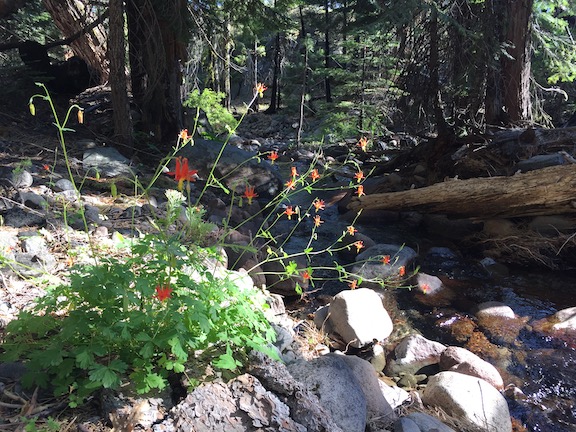
Crimson Columbine (Aquilegia) at Steamboat Creek

At the time of my trip, 2019-07-21/25, Five Lakes Creek was a calf-deep wade across a wide bar in the river. I always stay clear of the down tree tangle downstream, far more dangerous than anything in the creek. Both forks of Buckeye Creek were flowing, and I believe at least the eastern fork is year-round. Steamboat Creek was flowing well, however, it dries up at the trail crossing at some point during the summer, and I’m sure it will this summer. I have in other years found water upstream and downstream of the trail crossing, but there are no guarantees. If you are going, stock up on water at Buckeye Creek, as it is a long ways to Five Lakes Creek below, or the reservoir shoreline, if Steamboat is dry.

I followed the lower Hell Hole Trail a ways from the Steamboat Creek crossing. This section used to be obvious, but it is getting harder and harder to follow, and I lost it before getting to the gully. The bears have abandoned this trail, seeming to go above across the slope, but there may be other bear trails I did not find or notice. Coming up the gully, one apparent trail leads into a pretty valley between two ridges, but so far I’ve not found a route out of that valley and back to the main trail, so this may be a red herring. If the bears have their doubts, then I have my doubts, and I am not sure that the old trail alignment is the best route anymore. My next trip will be in part to determine what the best route is. I know that the bears are still going between lower Five Lakes Creek and middle Five Lakes Creek, but I don’t know what they have decided is the best route.

A little tidbit. Steamboat Creek is NOT where it is shown on the maps. The USGS map, and every map based on it, which is probably every map including GaiaGPS and the Forest Service base maps, has it to the east of its actual location. It is not that far off, only about 300 meters, but it is off.

GaiaGPS now offers the Forest Service base maps (USFS 2016 CalTopo), and it is interesting to see what the Forest Service shows for trail locations as opposed to other maps such as GaiaGPS, USGS, and Trails Illustrated. I am not sure which maps are available to which membership levels in GaiaGPS, so you will have to explore that on your own. GaiaGPS now offers scanned 1930 maps, and the trail locations definitely vary, however, these maps have much less accurate topography, at least in rough country such as the Granite Chief, so the trails may be less accurate as well.

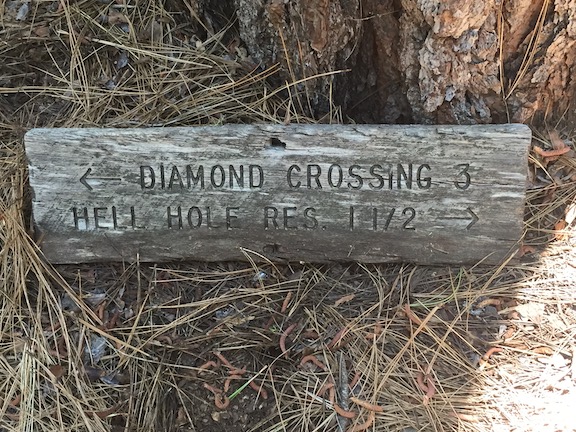
I noticed a trail sign on the ground that I had not seen before, below. I’m wondering if it is at one of the original locations of the west leg of the Buckskin Trail, so I will explore that on the next trip. I know that there is a vague old trail leaving the Hell Hole Trail just past Steamboat Creek, which is at least one alignment of that old trail, but there may be more than one, and some maps indicate that the trail takes off east of Steamboat Creek. I enjoy looking for and locating old trails which have not been maintained in decades, but at the same time, I want to do trail work on existing trails so that they don’t meet the same fate!

Photos on Flickr (this includes the entire 10 day trip, not just the Hell Hole portion): https://www.flickr.com/photos/allisondan/albums/72157710021027427.

Tevis & Talbot Trails 2019-07

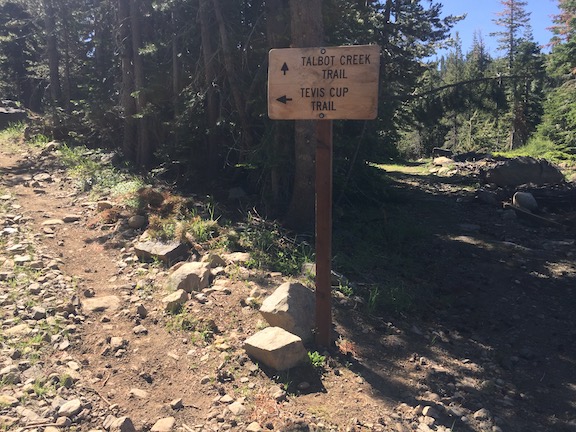
The American River Conservancy purchased about 10,000 acres of private land in 2015, and some of these lands were added to the Granite Chief Wilderness. As a stewardship project before the lands were turned over to the Forest Service, old logging roads in the new area were put to sleep or rehabilitated. Drainage and creek crossings were returned to their natural contours, and the road edge was removed in many places, leaving only space for a trail.

The Tevis Trail (also called the Tevis Cup Trail, and incorrectly, the Western States Trail – though the Western States trail run occurs on this trail, it never was the historic Western States Trail, which went through Picayune Valley) was realigned in the western portion, removing it from the heavily eroded logging roads to create an actual trail. The logging road from the Forest Hill Divide saddle to the trail (where the green gate used to be, if you remember) was turned into a trail. The trailhead for this trail is now the saddle, where a road comes up from the Soda Springs side of the divide, the North Fork of the American River. I created a track for the new trail alignment, available at http://bit.ly/GCW_TevisTrail. The old alignment is shown on a jpeg map.

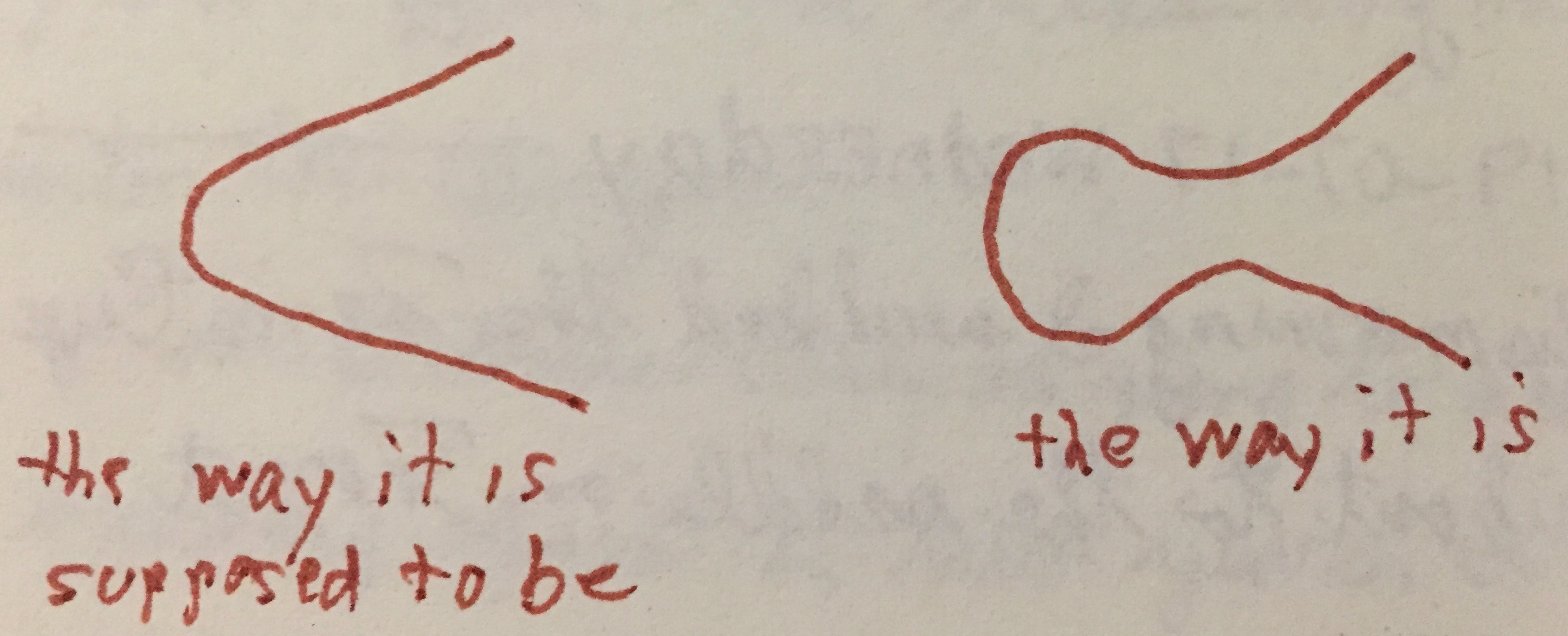
I’m disappointed at the design of the new trail that is not on the old logging road alignment. There are lazy looping switchbacks, at many of which the trail actually descends into the turn and then descends out of it (from the perspective of going up hill). See the diagram below, from my journal. Each of these locations will end up as a user cut-across of the switchback. Switchbacks should have climbing turns, where the trail is at no point closer to the other trail leg than at the turn. In addition, several stretches of trail are completely flat, which is remarkable given the elevation the trail must gain. I don’t know who is responsible for the trail design, but it was not done correctly. I was a trail crew foreman and trail construction instructor for the Forest Service for a number of years, and I know my trail construction techniques. Ah well, it will get corrected some day, and in the meanwhile it is much better than it was before, which was steep, eroded, rocky logging roads.

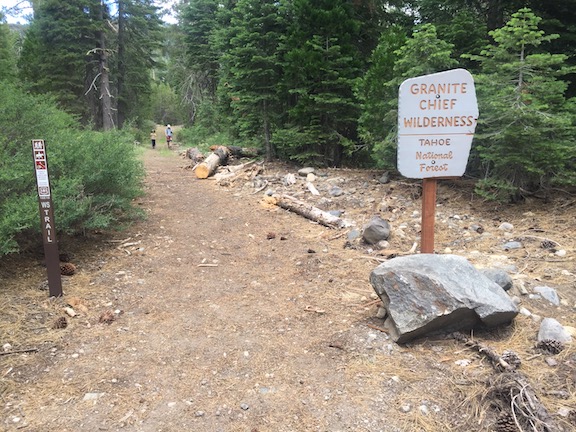
The new Talbot Trail mostly follows the alignment of the old logging road that used to connect the saddle to Talbot Campground area. Again, the roadbed was rehabilitated to a trail. Unfortunately, a lower segment that was pulled off the logging road has the same issue of lazy looping switchbacks that the Tevis Trail has. The trail comes out onto Forest Road 51 in a still open but very rough road section, where there is a Granite Chief Wilderness sign but no trail sign, then goes to the still maintained part of FR 51, which connects with the French Meadows Road going to Talbot Campground. It is unfortunate that trail energy was expended on the switchbacks when it could have been expended getting the trail closer to Talbot Campground. Again, someday, the trail will get to the campground without having to walk on hot ugly roads. The Talbot Trail track is available at http://bit.ly/GCW_TalbotTrail. This includes the portion on FR 51, which starts about where the last crossing of Talbot Creek is shown.

The cabin that used to be along the Tevis Trail is gone, with almost no trace of it remaining. I wasn’t even sure I was looking at the right place before I was able to compare photos after the trip. I understand why the Forest Service would want it gone, as it is an attractive nuisance and fire hazard, but it is still sad to see old cabins go, and the history they represent along with it. I do not know how old the cabin was.

I am making progress on my project to put all the trails, trailheads, and junctions into GaiaGPS for easier use, but it won’t be until after the summer backpacking season that I finish that and post on it.

Photos on Flickr (includes the entire 10 day backpack, not just the Tevis and Talbot trails): https://www.flickr.com/photos/allisondan/albums/72157710021027427.

Tevis to Picayune

Paul VanderVoort shared with me last year a post from his blog, which I’ve linked to here: https://paulvandervoort.wordpress.com/2018/10/05/tevis-cup-trail-to-picayune-valley-x-c-path/. I have not followed this route, so how you use the information is entirely up to you. I have heard for years rumors of both a route, and an actual constructed trail (from long ago, not maintained) between the Tevis Cup Trail at the south-extending point, and a point near the crossing of the Picayune Valley (Western States) Trail and the Middle Fork of the American River, and have looked to see if I could see such, but did not find anything. I’ll try it out next time I have some off-trail yearning.

Picayune 2018-07

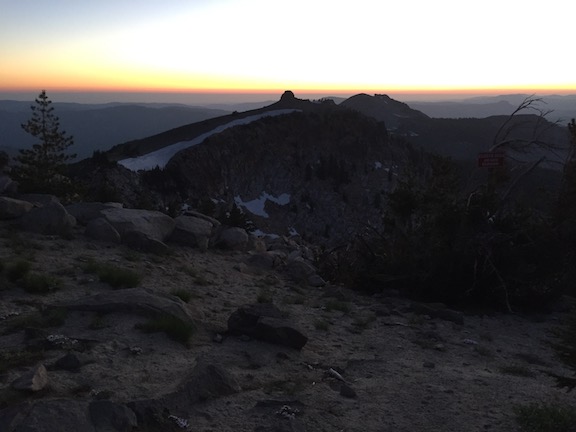
Last week I went in to the Granite Chief Wilderness at Granite Chief Trail, from Squaw Valley, and camped on top of Granite Chief (9018 feet). The wind howled all night, probably 30-40 mph, so I didn’t sleep much, but the stars were brilliant and the sunset and sunrise worthwhile.

Several times in the days leading up to the trip and even on the trip, I changed my plans about where I was going to go. I headed to Whiskey Creek Camp and on towards Picayune Valley, on the Western States Trail. The trail is in general in good condition, though I did brushing of whitethorn on about 30 feet of trail that was brushed in. Whitethorn requires a sacrifice of blood, as the thorn inevitably find their way to bare skin no matter how careful I am.

The section just below PIcayune saddle as the trail drops into the valley, however, is a total mess of downed trees. It took me quite a while to figure out where the trail even went. And below that it is pretty brushy for a ways. And below that, in good condition again. Some group has been doing trail work in the valley, light brushing and some tread work, and that is appreciated.

I camped at my favorite Picayune Valley campsite, right beside the creek on a sandy patch, with all the sky open to stars at night. Though it clouded up and there were fewer stars than the night before. The next day I walked out to the trailhead, so see what trail conditions are. Good. Talked to several day hikers, as this trail gets more day hike use than overnight use. The wilderness boundary sign has been moved to the new location, just east of the Talbot Trailhead. These lands were purchased by the American River Conservancy and have been added to the wilderness, so there is now a mile of additional wilderness trail here. Of course the lands have been logged and it will be years before it looks like wilderness again, but this is the first step to restoration.

While on the dayhike, it occurred to me that maybe now, with relatively cool weather for the summer, and no specific plans, I should hike the ADT-CA-3 section of the American Discovery Trail, which is the extension of the Western States Trail  westward. So I grabbed my pack and hiked out, to Lewis Campground, from which my trip continues at https://allisondan.blog/2018/07/10/adt-ca-3-2018-07/.

Photos on Flickr: https://www.flickr.com/photos/allisondan/albums/72157698464067794


Powderhorn trail work 2018-06

For my first trip of the season I mostly did trail work on the Powderhorn Trail. Working down from the top, I cleared brush, of which there is not all that much, and cleared or thinned young conifer trees, of which there is an infinite supply. The conifer trees seem nice, but if they are within four feet of the trail, and grow up, their branches always encroach on the trail. When there is dense conifer seedlings on both sides, it often essentially closes the trail. And of course as a natural process of thinning, most of these would eventually die on their own, but that leaves a tearing dead tree that is much harder to cut and remove than it was when it was alive. When it is clear that one tree is growing faster than the others, therefore quicker to reach the point where branches are above trail level, I leave that one and remove all the shorter ones around it.

I completed the work from the top to the postpile meadow, about 1/3 of the 3.5 miles, and did a minor amount of work below that. There are many days of work left to go, so unless a trail crew goes in, it will be several years before the trail is in good condition again. But it is usable, if not for downed trees.

There were eight down trees, six of which an be bypassed easily, and two of which hikers can clambered over or around but horses cannot pass. There is a moderate amount of winter debris, the branches that fall during the winter and can be stepped over, but when removed make a much nicer walk.

On the Five Lakes Trail, there were about five downed trees, none hazardous and all easy to go around.

I walked in from Kaspian Campground on Hwy 89 (a nearby bus stop), up Barker Pass road and then the old jeep trail to Barker Pass (steep but quiet and beautiful), then along Forest Road 3 to Powderhorn trailhead, and in. From Diamond Crossing, the junction of the Powderhorn, Hell Hole, and Five Lakes Creek trails, I walked up Five Lakes Creek trail to Whiskey Camp and then out at Alpine Meadows trailhead and down to River Ranch on Hwy 89 (a nearby bus stop).

There are patches of snow along the ridges, but most snow is gone. Many of the tributary creeks and creeklets are still flowing, but low, and will probably dry by mid-July. The flowers are moderate, in some places it is still early season and flowers have not developed, and in other places they are fading already.

finally! 2017-07

My latest trip was primarily for trail maintenance on the PCT, and after  11 years, I feel caught up. I removed the last brushed-in section, between what I call Two Towers (Lord of the Rings reference) and Twin Peaks. Of course in order to get done, I had to accept many places that could use brushing, and leave them for the future. In particular, the pine mat manzanita and sagebrush is pushing into the trail and narrowing the tread. It isn’t hard to clear, but is a lot of detailed work that I’ve often put off “for next year.”

The reason I pick this part of the PCT to work on every year is not just that it needs brushing, but that I so love spending time on this ridge. The views east are spectacular, over Lake Tahoe and the weather over the Carson Range, often thunderstorms developing when the main crest is clear. The views west are intriguing, down into the wilderness, where the real wilderness is, and beyond, to the coast ranges. When the valley air is clear, not often, the details of the coast range and Bay Area are clear, and at night the lights in the valley, kind of neat at a distance. Usually thunderstorms develop over Nevada, the Carson Range, and sometimes move west to the crest, but on Wednesday moisture coming from the west developed some thunderheads, thunder, and light rain for a half hour, while the Carson Range was mostly clear. 

When there is snow on the ridge, usually in banks on the east just below the ridge where it gets blown during the winter in strong winds, I can melt snow and stay up here for many days. I use my black Jetboil pot to melt, and I can keep up with my daily use if I stay on top of the melting. 

I went in on the Granite Chief Trail from Squaw Valley, which has a few trees down but easy to get around, then south along the PCT. Granite Chief saddle has a lot of snow on the north side, but the route is not hard to find. People southbound rarely have problems here, but many northbound hikers drop too far down into Shirley Canyon and have a hard time finding the trail again. The trail from the saddle south to the TRT/PCT junction is in good condition, a few tress down but surprisingly few, some trail erosion but not bad. 

I hiked out the TRT to Tahoe City, so don’t have anything to report about the TRT/PCT south to Barker Pass, but I’d guess many snow banks but no big issues. Other than snow banks on the upper portion, the TRT trail down into Ward Creek and Tahoe City is in good condition, having been logged out already by a TRTA trail crew. 

The PCT thru hikers are out in force, but interestingly, about half were going south, having skipped over the high Sierra to Donner or even Ashland and now heading south to pick up the section with somewhat less snow. Looking into the Desolation Wilderness, however, snow there is still deep and must be much deeper at high elevations to the south. Dicks Pass is 9400, but the highest pass on the PCT is 13,143, Forester Pass. There were people who had come through the high Sierra headed north, but I have to say that they all looked beat and not very happy. I think the route flippers were much happier. 

The next big project on my list, for next year, is to work on the Powderhorn Trail. If anyone hikes that and has conditions to report, please do so. I think the middle section is in horrible condition, brushed closed in spots, but I haven’t been there in two years, so I’m guessing. 

Photos on Flickr (more later, these are ones from my iPhone which are easy to upload, but I also used my regular camera)

Granite Chief 2016-08

Note: this trip is LAST year, 2016, which I never got around to finishing, but here it is now. I like to post on every trip, in part so that I myself can keep track of trips and where I went. 

A dry year, dogbane turns color early

I went in at Squaw Valley (bus stop) and up Granite Chief Trail to Granite Chief saddle  where I camped for the night. The next day I walked out the Tevis Cup Trail and what I call the Tevis Cup Connector, one of the old Western States Trail alignments. Tevis Cup is easy to follow and has great views, but the trail itself is unpleasant,  climbing and descending repeatedly for no good reason, and poorly maintained. The end of the trail has been re-aligned off a gravel road onto a trail that goes past old ranch or FS buildings (not sure which), but ends at the same green gate as the old route. The Tevis Cup Connector is faded and jhard to follow in some places, as it descends and crosses the Middle Fork American River and then climbs to join the Tevis Cup. 

I headed south on the PCT, doing some spot brushing along the way, and continued to Barker Pass, to Powderhorn Trail and back into the wilderness. Powderhorn is in decent shape on the upper third and lower third, but almost completely brushed in in the middle third, with whitethorn and doghair fir. I camped at Diamond Crossing, explored Bear Pen trail which I’d not beeen on in several years. It is in decent shape, not too hard to follow, but where it crosses Bear Pen Creek before the meadow, eroded banks make it necessary to climb down and back up, awkward with a pack. 

Some sort of bee or wasp is incredible abundant, everywhere but particularly along the edges of creeks. Yellow and black striped body, but no fuzziness and no constriction between the thorax and abdomen. Not sure what it is. Also saw a lot of grouse on this trip, at least 40. 

I went out Five Lakes Creek Trail, which has received some logging out, perhaps by the horse trip that comes in once a year to a Big Spring meadow, and then out to the Five Lakes trailhead. And back to Truckee by bus and back home on the train. 

Photos on Flickr; Granite Chief collection