Tag Archives: trail work

Granite Chief 2025-07 WS trail work

Second trip of the season, July 1 to 6, 2025. As always, I got to and from the wilderness using Amtrak train or bus from home in Sacramento, and the TART bus south from Truckee to Tahoe City. No need to drive!

I started at the Western States trailhead on Hwy 89 at the Truckee River bridge. I’m calling this the Western States (Olympic Valley) Trail to distinguish it from the Western States Trail through Picayune Valley. Both parts have the same trail number, 16E10. There is parking on the east side of the bridge, and a sidewalk on the bridge to the west side, where the trail starts. The first part of the trail is very well maintained, by Truckee Trails Foundation, and includes some new signing. As the trail crosses into Palisades Tahoe ski area, the trail is not as well maintained, and there is almost no signing for the trail, making it hard to follow. There were actually more signs when I last hiked it in 2021. Some parts are trail, some parts are on ski area roads. Nevertheless, I made it to Watson Monument on the ridgeline, and then descended to the PCT at the PCT/Tevis Cup Trail/Western States Trail junction.
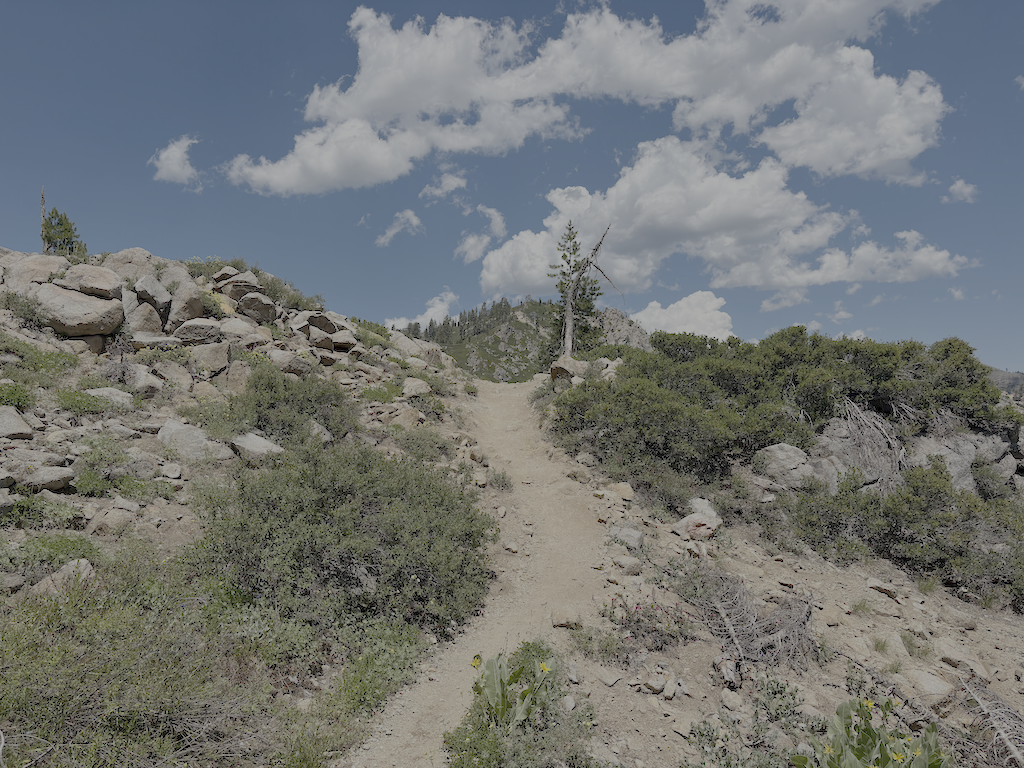
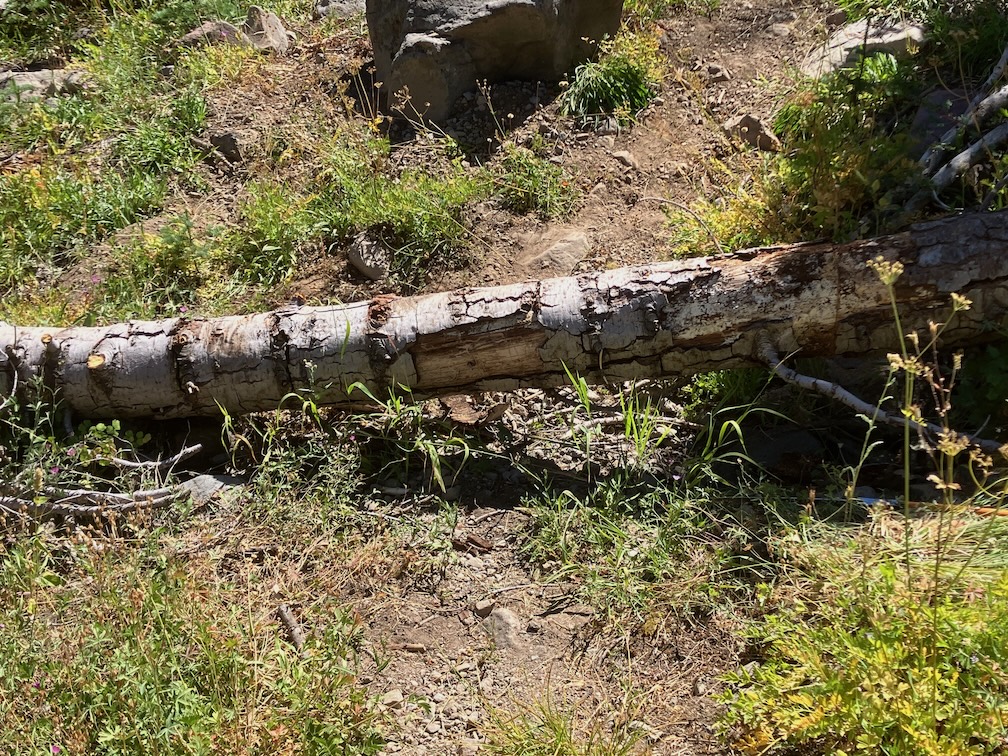
photo of Western States Trail (Olympic Valley) in Tahoe Palisades
Western States Trail (Olympic Valley) in Tahoe Palisades

I proceeded south on the PCT to Whiskey Creek Trail and then camped near but not at Whiskey Creek Camp. The PCT has not been maintained this year, so has down trees, light to heavy winter debris, and brush in some areas.

The primary purpose of this trip was to do trail maintenance on the Western States Trail. I had done a little last year, and continued, working west from the camp. There were two very thick brush areas, one of whitethorn and aspen, and the other of whitethorn. Whitethorn is much softer at the beginning of the season, but gets harder and sharper as the season goes on. It is not too hard to cut now, but later will exact a revenge in blood. I also cut a number of small down trees. Ten larger ones remain, but now with bypasses or step-overs. I worked as far as the creek crossing, which is a tributary to Five Lakes Creek, and the only water on the the trail before it drops into Picayune Valley. Only 1.4km of progress, but satisfying. I’ll likely continue on Western States next trip. I continue to be very happy with my Silky Big Boy folding saw and Fiskars nippers.
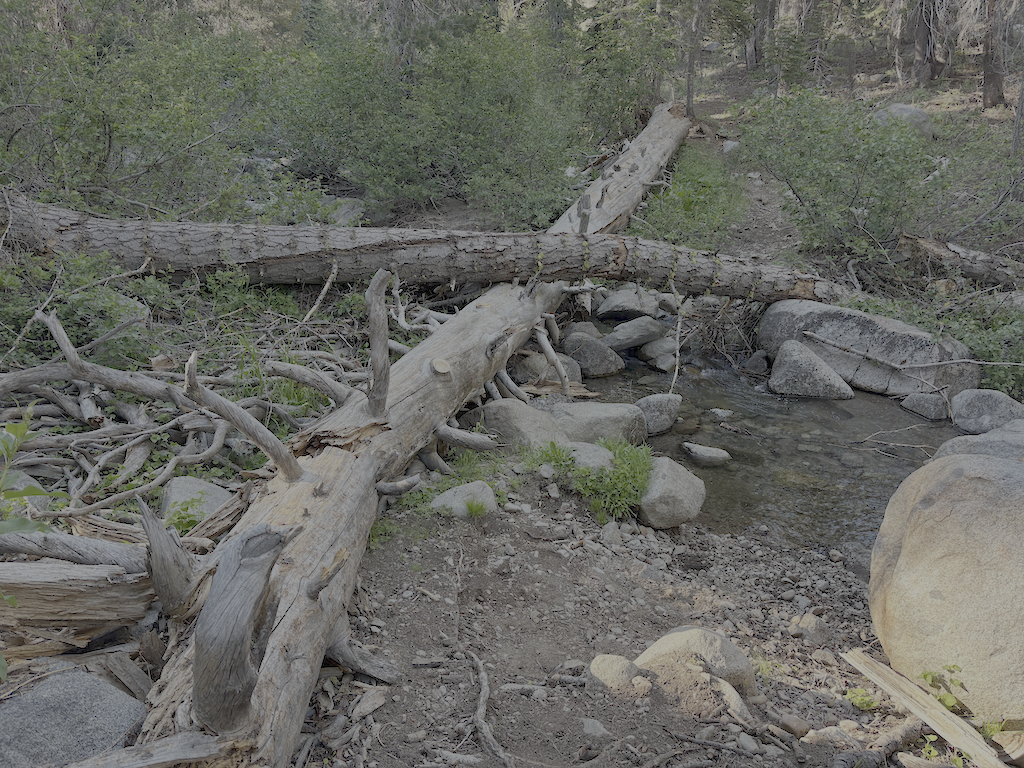
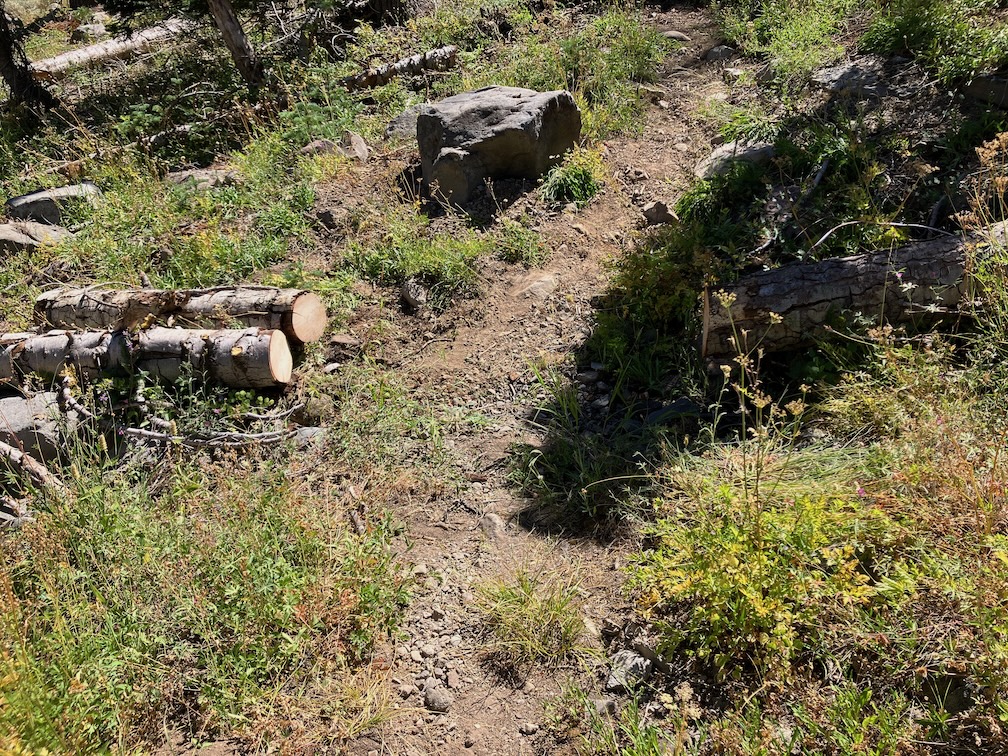
photo of down trees at Whiskey Creek crossing
down trees at Whiskey Creek crossing

After completing as much as I could, I returned to the PCT and headed south, camping on the ridgeline at one of the few flat spots. The tread has a lot of loose rock, particularly from Ward Peak south for a mile, and has some brushy spots. The section where I have spent many trail work trips keeping brushed out is starting to close in again, but should be OK until next year.

At the Tahoe Rim Trail (TRT), I headed out through Ward Creek to the road, and thence to Sunnyside. Lunch at the store, and bus to Tahoe City, for shower, pizza, concert, and sleep.

I have been buying a few things at Alpenglow Sports in Tahoe City. I can get the same, often less expensive, at REI, but since I’m in Tahoe City at the beginning or end of every backpack trip, it is actually more convenient to go there than the Sacramento REI which is in a car-infested part of Sacramento. And they are good, knowledgable people.

Check the Trail Conditions page for specific info on each of the trails that I walked.

Powderhorn trail work complete! 2024-08

This backpack trip was just for doing trail work on the Powderhorn Trail, to make up for two aborted or shortened trail work trips earlier this year. And I completed the trail! Yay!

There is a real pleasure to walking a well-maintained trail.

Of course trail work is never really complete. While doing trail work, things are growing, and dying, and falling. The upper section of the trail is noticeably needing brushing and removing conifer encroachment, developing in the time since I worked that section.

I was curious about my history with the trail, so looked back at earlier posts.

  • 2009: The trail was logged out by the Forest Service. This is the last time the FS worked on this trail, 15 years ago, so far as I know. All of the older, rotted and aged and often large down trees, were cut at this time. I don’t know if any other work was done at the time.
  • 2010-2017?: A horse group rode in every year to Big Spring Meadow for a long camp. On their way in, they cut enough of the trees to keep the trail open and useable. I don’t know whether their plans changed or they gave up on the trail and went elsewhere.
  • 2018: My first trail work, spot brushing and removing conifer sprouts (mostly red fir) that were closing in on the trail.
  • 2021: My first focus on Powderhorn, including marking the location of down trees. At that time I was still hoping that the Forest Service would log out the trail again, and so relayed to them the size, nature, and location of the trees. Though they thanked me for this year, they ignored later submissions, so I stopped sending them.
  • 2022: Continuing work on the trail, mostly the upper third.
  • 2023: Continuing work on the trail, mostly the lower third.
  • 2024: Continuing work on the trail, mostly the middle third.

I recently bought a new trail tool, a Silky Big Boy 2000 15-inch folding saw, to replace my Fiskars 10-inch folding saw. What a difference! The length has allowed me to cut many smaller down trees that I had always had to ignore before. The saw easily cuts 9-inch logs, and at a stretch 12-inch logs, though 12 inches is slow going. Radius SQUARED really makes a difference. And being new, the saw is sharp and cuts well on the pull stroke (it is designed to cut on the pull and won’t work pushing). There were quite a number of new down trees this year over last year, but with cutting the smaller stuff, the overall number of down trees is now less than last year. For those wanting to know the details, my GaiaGPS folder ‘down-tree‘ shows all of them on the Powderhorn Trail.

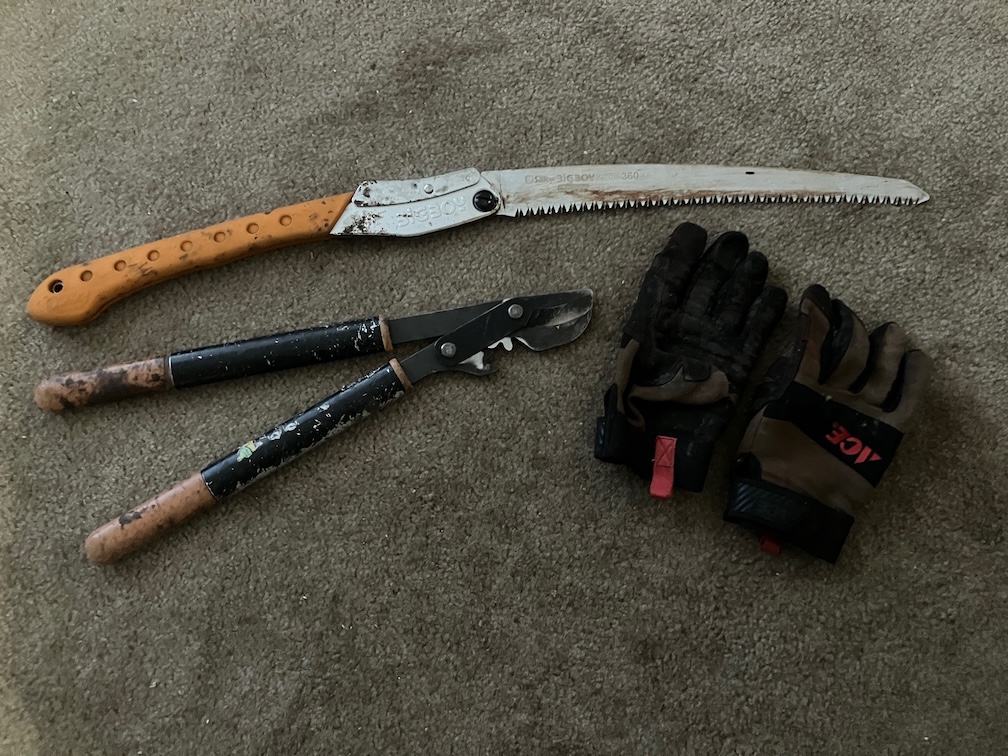
photo of tools of the trade: new Silky Big Boy folding saw, Fiskars nippers, and gloves
tools of the trade: new Silky Big Boy folding saw, Fiskars nippers, and gloves

If you like the Powderhorn Trail, or have been thinking about going there, now is the time! By next year there will be new down trees. About half the red fir trees are dead, though it varies from nearly all to very few. Of course there are abundant sprouts crowding the trail. Some of these will die and become what I call spars (similar to snags, but I use snags for large standing dead trees) and lean into the trail, ready to snag your clothes or skin. A significant percentage of young red firs develop a lean, hanging into the trail. I call them leaners. The standing dead have prominent white mushroom bodies all over the trunks, so they are already rotting while standing, and will fall. It used to take a high wind year with saturated soils to being down trees, but they are now falling year-round.

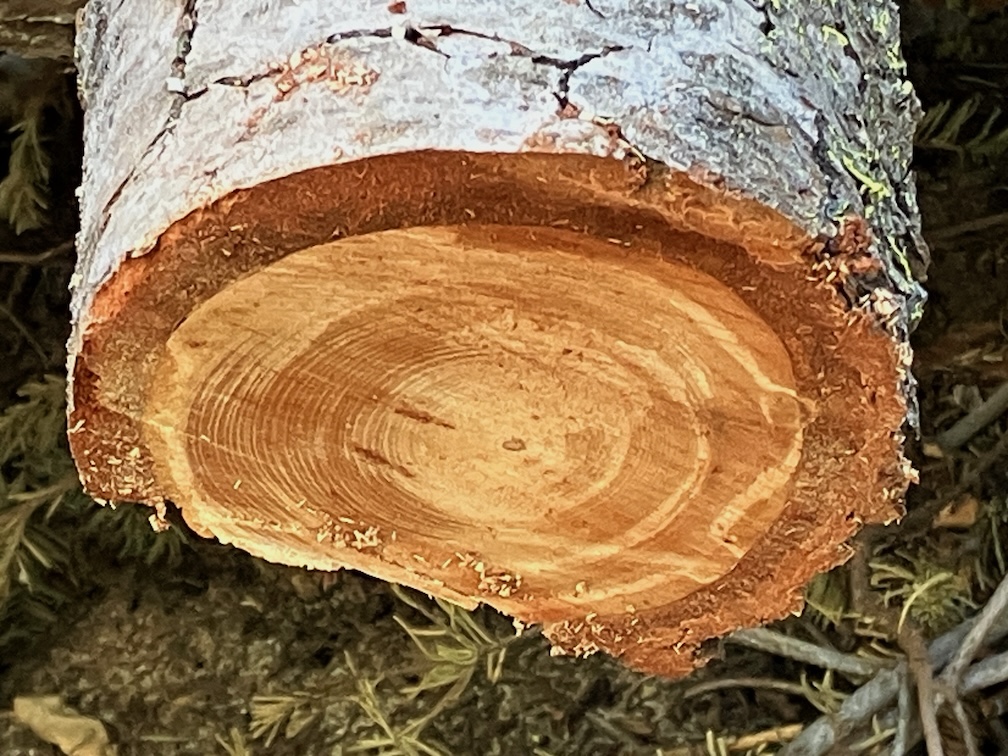
One of the down trees far too large for me to cut, I worked on the approach to the tree so that people could climb over or slide under. This red fir has the most dense wood I’ve ever experienced. A five-foot cut section of branch was so heavy I could hardly lift it. This must have been a very old and very slow growing tree. I’m unsure whether it died and fell, or was knocked down by another tree.

photo of dense red fir rings
dense red fir rings

The trail has at least two down trees that cannot be passed by horses, so it must be considered closed and dangerous to equestrians. One is the slide-under tree, where backpackers can slide under the down tree. I had roughed out a bypass two years ago, but a new tree fell directly on the bypass, closing it. Another down tree would be a challenge to all but very trail-wise horses, and there is no bypass.

Sometime earlier this summer, someone rode a dirt bike into the wilderness and about a mile down the trail before giving up at a large down tree with no bypass. That person did quite a bit of trail damage and left ruts that will erode next spring. The power of internal combustion engines causes brain damage and immorality.

Five Lakes Creek is flowing but noticeable low. Same for Powderhorn Creek. The creeklet that crosses the trail is barely flowing and may be dry soon.

I have often done a trail condition survey trip early in the summer, but did not do so this year, so know nothing about trail conditions except the PCT, good condition, Whiskey Creek Trail, good condition, Five Lakes Trail, good condition, and Five Lakes Creek Trail, horrible condition. I may get to the other trails on my next trip.

Photos on Flickr:

trail work on the PCT 2014-07

gcw_fivelakes-2

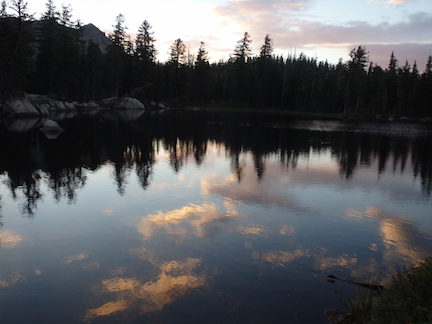
Five Lakes sunset reflection

Another missed trip.

This one was primarily a trail maintenance trip for the Pacific Crest Trail (PCT) along the ridge between Five Lakes and Twin Peaks. I went in at Alpine Meadows. Waiting until the next morning I had a chance to explore around Five Lakes which I’d not done in years, and do some brushing on the switchbacks up to the crest.

I planned on several days of trail work along the PCT between Five Lakes Creek and Twin Peaks, a section that doesn’t get maintained and tends to brush in. Ceanothus velutinus, commonly called tobacco brush, is the fastest growing brush, but other plants do their part. When I do brushing up on the crest I have to carry up enough water to camp with, so the trip up from the creek is heavy and slow. Unfortunately the blade on my loppers broke on the second day, and then on the third day the handle on my folding saw broke. These Fiskars tools are generally very reliable, lightweight, and easy to use, so this was unusual. But after completing only a portion of the work I’d hoped to, I just had to take off backpacking.

The springs in Blackwood Creek were lower than I’ve ever seen them at this time of year. I walked out Blackwood through some aspen restorations projects that seem to be having the desired effect, and caught the bus to Tahoe City. Overnighting there, I ran into a friend Jan Ellis who I’d not seen in years. Then breakfast in Truckee and home on the train.

Flickr: Granite Chief 2014-07-28

missing 2012 trips

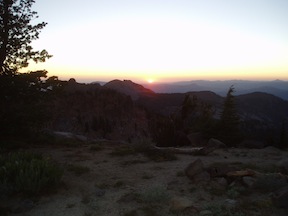
sunset from Granite Chief peak

sunset from Granite Chief peak

I never seem to get all my trips posted. Not only did I not post my 10-day trip into the Mokelumne Wilderness, the highlight of the summer, I did not get around to posting on next two trips into the Granite Chief Wilderness.

Trail Maintenance and Powderhorn

The first missing trip was seven days in July. I went in at Granite Chief trailhead, and in fact spent several days completing brushing trail work on that trail. Once that was done, I headed south and camped on the top of Granite Chief peak, a spectacular place to sleep. When the air of the central valley is reasonably clear, it is easy to see details of the coast ranges, and at night, the lights of the valley cities and towns.

Continue reading

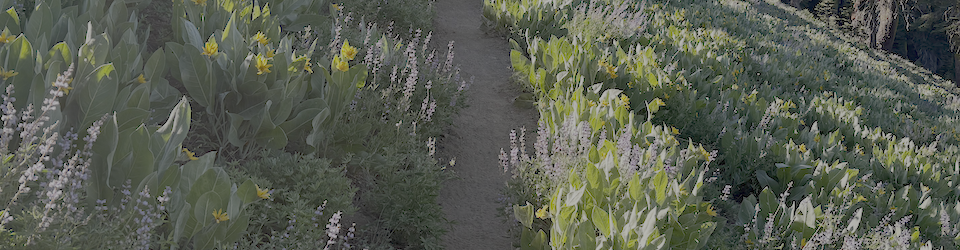
Along the PCT

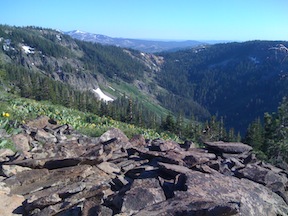
Powderhorn Canyon from the mesa edge

I had a wonderful five day trip, one of my non-driving trips on which I took the Amtrak to and from Truckee. I walked from Truckee up to and along the Donner Lake Rim Trail, then headed south on the PCT past Donner Pass, Mt. Anderson, the North Fork of the American River (which becomes the Royal Gorge downstream), and into the Granite Chief.

I did some brushing work on the PCT, particularly the section between Five Lakes Creek and Twin Peaks that was completely brushed in four years ago and got me into doing maintenance on the PCT. So the trail is now reasonably clear again, though it needs brushing every year.

Continue reading