My sixth trip of the season was for trail work and trail survey.
Five Lakes Creek Trail
I completed trail work on the Five Lakes Creek Trail, from the creeklet crossing where I’d stopped last trip, to the Five Lakes Creek Trail & Big Spring Trail north junction, and then on the Big Springs Trail down to the crossing of Five Lakes Creek. There remain about 14 down trees, too big for me to cut, but I created either good climb-overs or bypasses, and in one case, a duck-under of a hanging tree. Also removed winter debris and brushed several sections, though there was less debris and brush on this second part. The trail on the west side of the crossing of Five Lakes Creek was brushed in with alder and willow, and I cleared that. At current creek levels, there is a rock-hop crossing, but at higher levels one must go upstream or downstream, which means fighting alder thickets. I was expecting the work to take two days, but it only took one, so I had a free day, and used it to re-survey the Western States Trail in Olympic Valley.
Western States Trail (Olympic Valley)
I realized after looking at my old trail track for the Western States Trail, that I had been off-route for much of my survey trip in early June. So I backpacked from Whiskey Creek where I’d camped north on the PCT, and then the Western States Trail to Watson Monument on the ridge above Olympic Valley. From that point, the trail goes south a short distance along the ridge, and then down a trail across the ski area. None of these upper trails are signed, including where it uses a short distance of road. The trail stays as high along the north-facing slope of the valley as is possible. I have no idea where the original, historic Western States trail went, if it was even in the Olympic Valley at all, but the existing designated trail is quite nice, and avoids as much of the ski area infrastructure as it can. Before Alterra bought ‘Squaw’, the old Ski Corp groomed slopes with bulldozers and dynamite, built roads wherever a bulldozer could, and maximized disturbance of the natural environment. It was a terrible company. Alterra is not perfect, but it is far better.
Where the trail crosses ski area roads, of which there are an abundance, it is usually not signed at all. There are signs, here and there, but not at every crossing or junction, and they are often not obvious, sometimes small signs high up in trees, or very old wood signs. Every time you get to a trail junction or road crossing, it is worth pausing and orienting, or you will likely end up on the wrong route.
The most confusing location, for me, was where the correct trail stays high under a cliff, and does not descend on the more used and obvious trails. On my GaiaGPS maps, I’ve marked this waypoint as ‘Jct WS stay high’. A side trail, from the marked junction ‘Jct WS access’ is signed as Western States Trail, but it is not.
When I got above Palisades Tahoe village, I broke off the trail and descended to the village, for Friday music and some rest. I was tired! The remained of the trail east to the trailhead on Hwy 89 is correct and not very confusing. And better maintained.
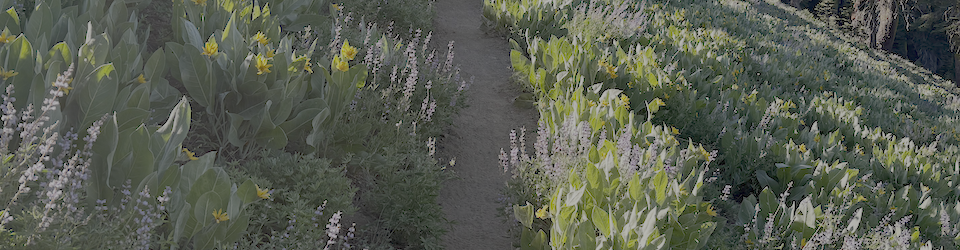
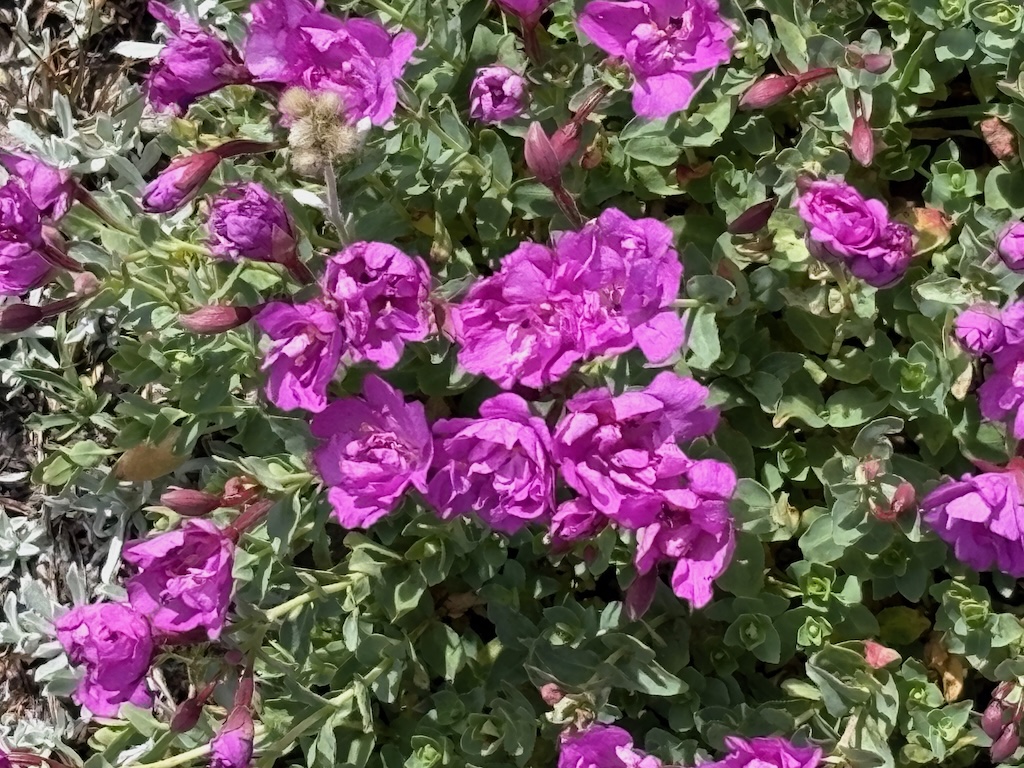
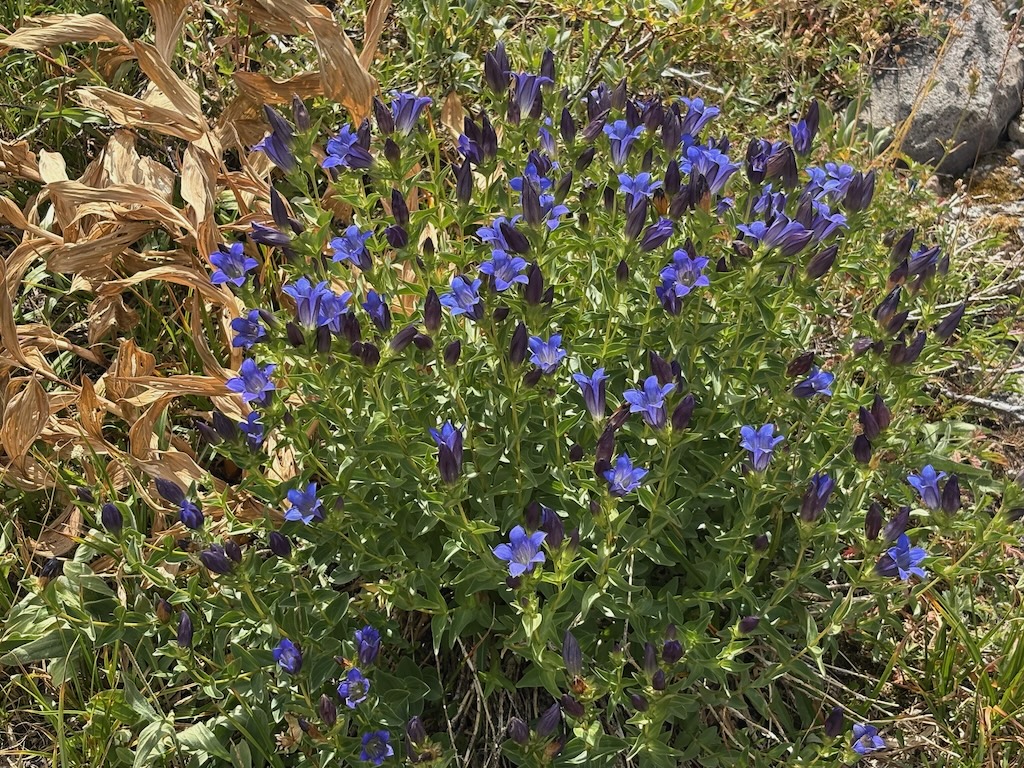
So, is this trail worth the challenge of following? Absolutely. The north-facing slope of the valley is sometimes bare rock or scree slopes, but it is also host to beautiful flower fields and clusters of trees. There are whole fields of brilliant pink rock fringe (Epilobium obcordatum, Onagraceae), which are fairly rare in this part of the Sierra crest. Gentian, probably explorer’s gentian (Gentiana calycosa, Gentianaceae), with its bright blue flowers is common, and again rare in this part of the crest.
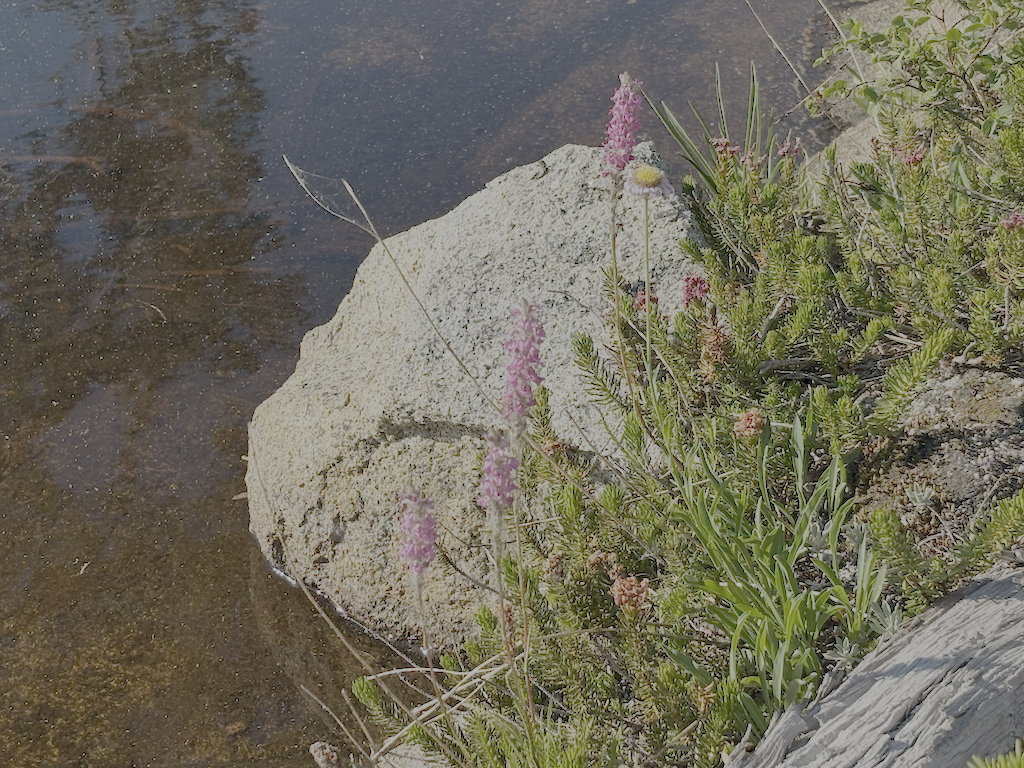
There is only one water source along this entire trail, at this time of year, a spring that may or may not be year-round. When I passed it, a dog was luxuriating in the cool shallow water, so I passed it up as a water source. Earlier in the year, there are many creeklets that cross the trail.
GaiaGPS and Open Street Map
Part way through my effort to make sure I had an accurate route for the Western States Trail through Olympic Valley, I realized why I was having a hard time. GaiaGPS has mis-labeled other trails as the Western States Trail, though they are not.
Which led to a closer look at GaiaGPS. The company, now owned by Outside, claims that they update from Open Street Map (OSM) on a regular basis, and if there are errors that have been corrected in OSM, they will be corrected in GaiaGPS. This is false. There are trails in GaiaGPS that have not been in OSM in years, if ever. I’m sure some of the trails are remnants from Forest Service maps, which include mistakes 20 or more years old. It may be that new information is added, but old, incorrect information is not deleted. Though I selected GaiaGPS over a number of other field mapping apps, years ago now, I’m becoming increasingly unhappy with it. Since it was bought by Outside, it has noticeable deteriorated.
I’m at work correctly labeling the Western States Trail (Olympic Valley) in OSM, but it is going slowly because I have a lot to learn about OSM and how to make edits. When I get the segments right, I’ll combine them into what is called a ‘relation’, for the whole trail from the trailhead on Hwy 89 to the junction with the Pacific Crest Trail.
- Photos on Flickr: https://www.flickr.com/photos/allisondan/albums/72177720328619648/
- Granite Chief collection on Flickr: https://www.flickr.com/photos/allisondan/collections/72157637640215275/
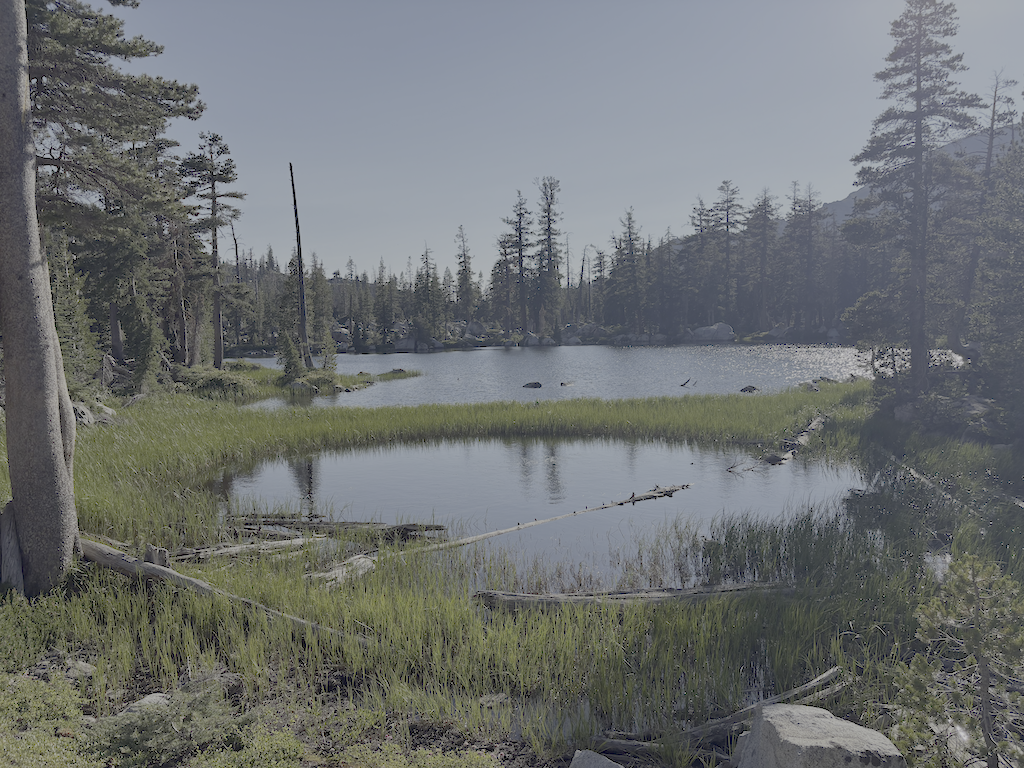
 Granite Chief Wilderness