Tag Archives: down trees

Granite Chief 2025-07-12 trail survey

My third trip of the season was intended to be a trail maintenance trip, continuing on the Western States Trail, but I got a day-late start and decided to do another trail survey trip instead.

I walked in from Sunnyside on the road and Tahoe Rim Trail, and camped near the junction of the PCT and TRT. As previously reported, the TRT is in good condition, better than any of the other trails. After a mosquito filled night, I headed south on the PCT to Barker Pass. All of the springs and creeklets in North Fork Blackwood Creek and Blackwood Creek are flowing well. The trail has been logged out (TRTA?) and both brush and winter debris are pretty good. There were a few patches of snow, but nothing hard to cross. Some PCT thru-hikers I passed mentioned that there was a trail angel setup at Barker Pass, so I was envisioning the massive take-over of the trailhead area from two years ago, but fortunately it was small. I headed west on Barker Pass Rd/Forest Road 3 to the Powderhorn Trailhead.
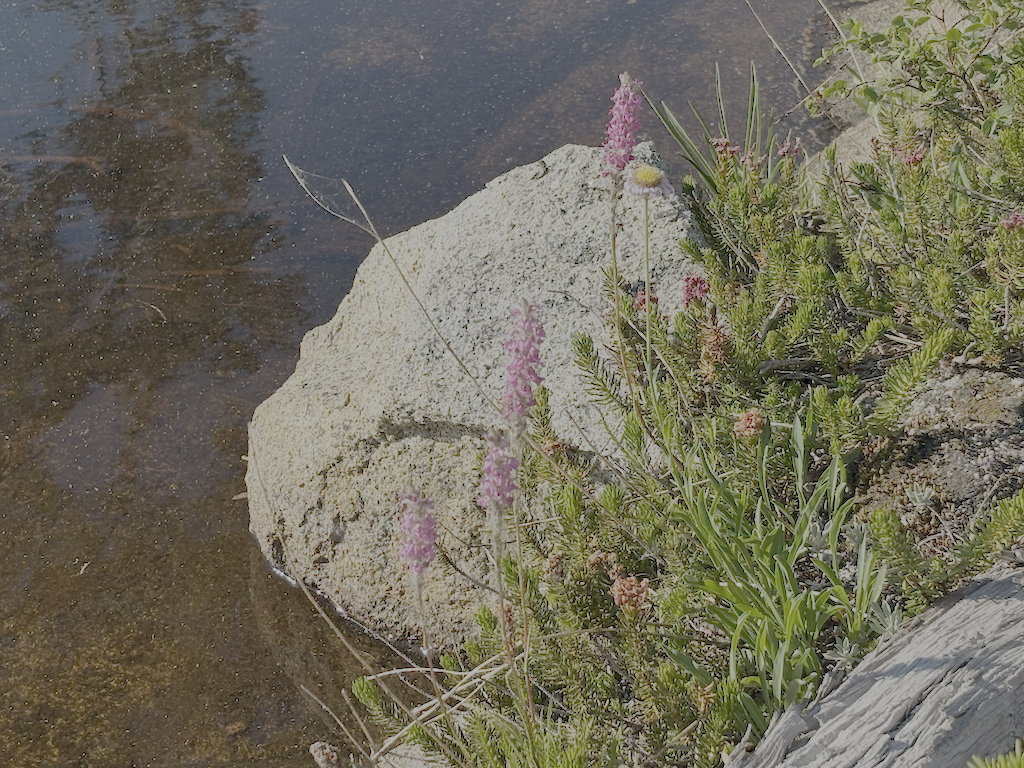
photo of mountain heather
mountain heather

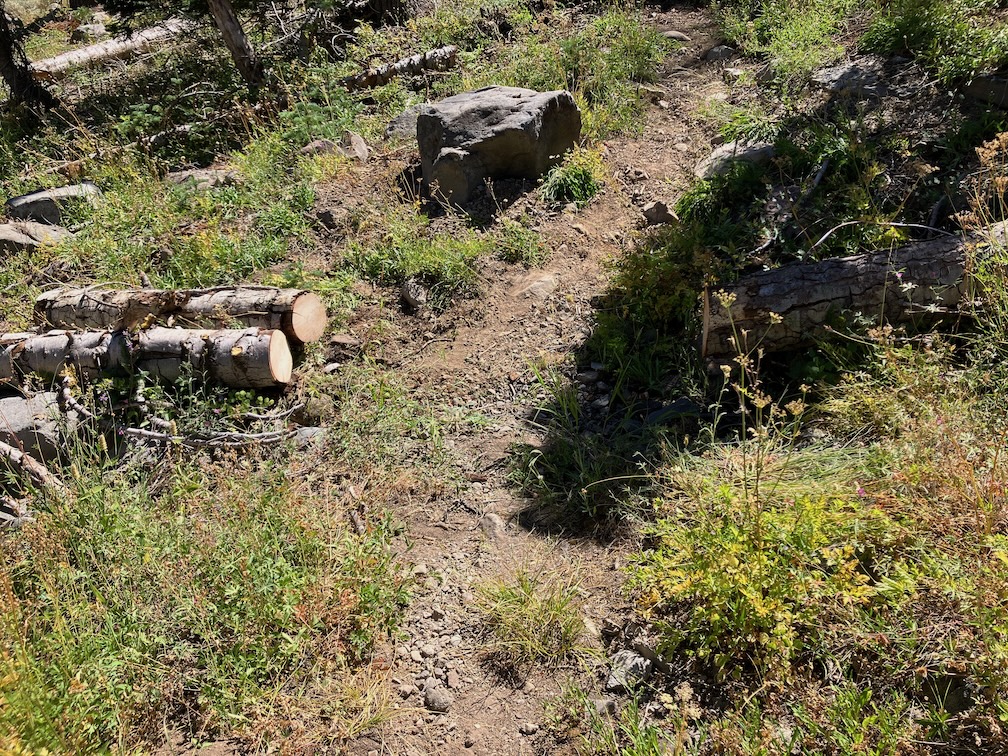
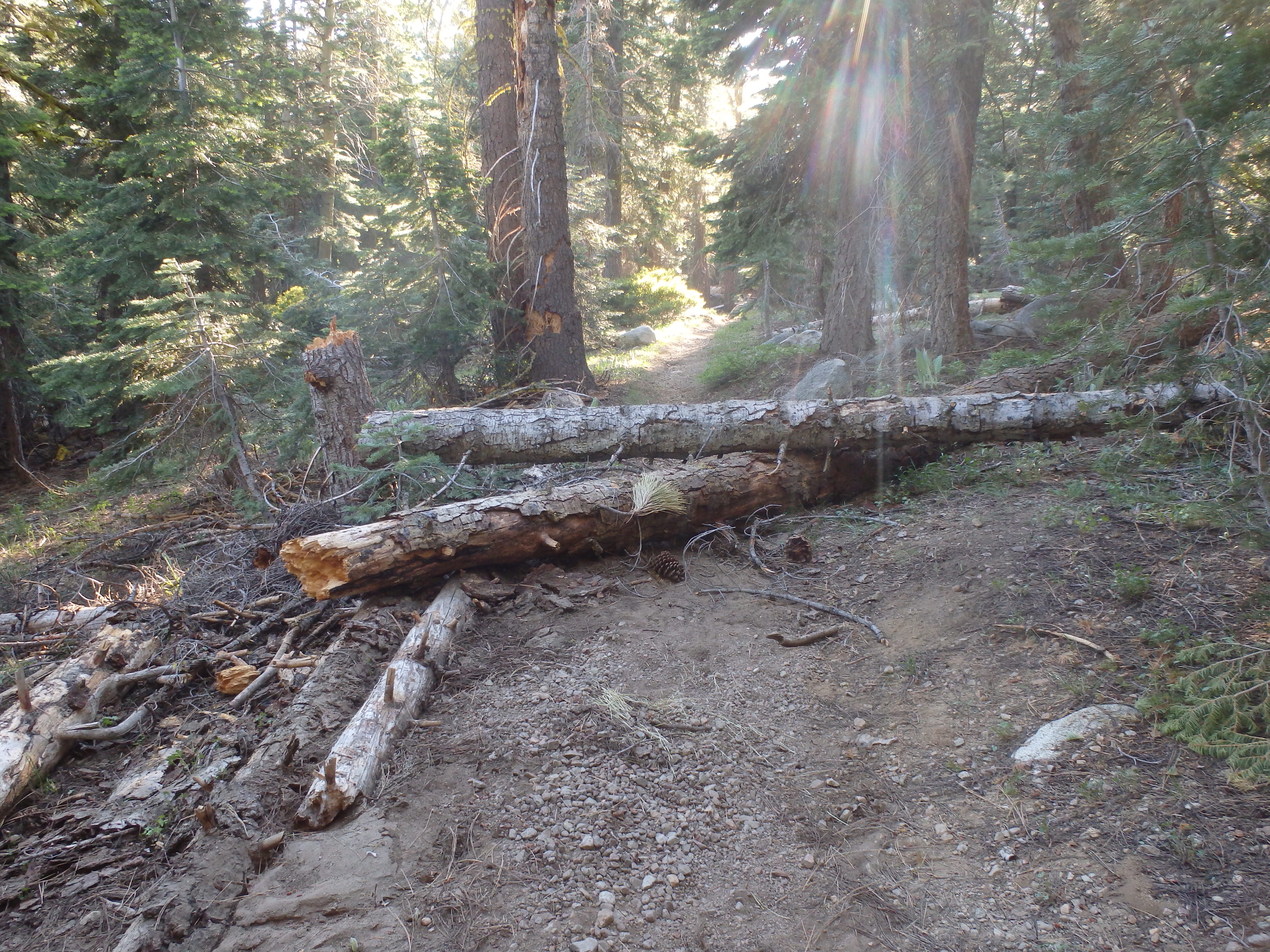
Powderhorn has 16 new down trees, joining the existing ones, for a total of 52. And a lot of winter debris, which surprised me given that I had cleared it last year. It is going to be difficult to keep Powderhorn open and useable over the next few years. Someone horse-mounted chainsawed a few down trees, and established a long but fairly safe bypass (to the creek side) at the slide-under tree. Though chainsaw use in the wilderness is illegal, I can’t fault people for doing this, as the trails would otherwise become unusable with the Forest Service absence of trail maintenance.

In the afternoon I hiked most of the Bear Pen Trail. The sign at the junction is on the ground. There are many down trees, and heavy winter debris in areas. The trail can be followed with a close eye, but a few riparian areas with willow and dogwood were challenging. I had not been on this trail since 2008, and it is not really that much worse than then. It is not much used by anyone. The trail route and distance shown on GaiaGPS maps, which are based on Open Street Map, are incorrect. The distance is not 2.2km, but about 4.4km, until the trail fades in the meadow.

I camped at Five Lakes Creek below Diamond Crossing, one of my favorite camp spots. Heading up Five Lakes Creek Trail north, and counted trees for the first time, using a clicker. 219 from Diamond Crossing to the north junction with Big Spring Trail, and 38 more from there to Whiskey Creek Camp. The tread is deeply eroded in several sections, as there has never been any water control installed on this part. The section between the south and north junctions with Big Spring Trail is now hard to find, and I lost it repeatedly. The few people who use this area seem to be using Big Spring Trail, not Five Lakes Creek Trail. At the junction with Shanks Cove Trail, the sign is on the ground.

Big Spring Trail has 18 down trees, but overall is in acceptable condition, and easy to follow except in one dry meadow where you have to search for it when it goes back into the trees, in either direction. At the crossing of the dry or nearly dry creekbed just above the Big Spring, the trail into the meadow jogs up creek, and if you miss this, you’ll be ankle-deep in the spring marshy area. I hung out in the meadow, another of my favorite places.

The trail crossings of Five Lakes Creek are probably still wet. One could find rock-hop crossings, but you get tangled up in brush and debris piles along the creek, so it is probably easiest to just wade across the creek.

The rest of the trail to Whiskey Creek Camp is somewhat better, probably mostly because it gets more use. I think a lot more people go just to Big Spring Meadow and not south from there, so the trail is more evident. This section of trail could be brought back, unlike the section to the south which is probably a lost cause.

I camped at the cliff edge beyond the Five Lakes (which two are large lakes, the western one of which breaks into two with lower water, and a large number of small ponds), windy, but a nice place to watch the end of one day and the beginning of the next.
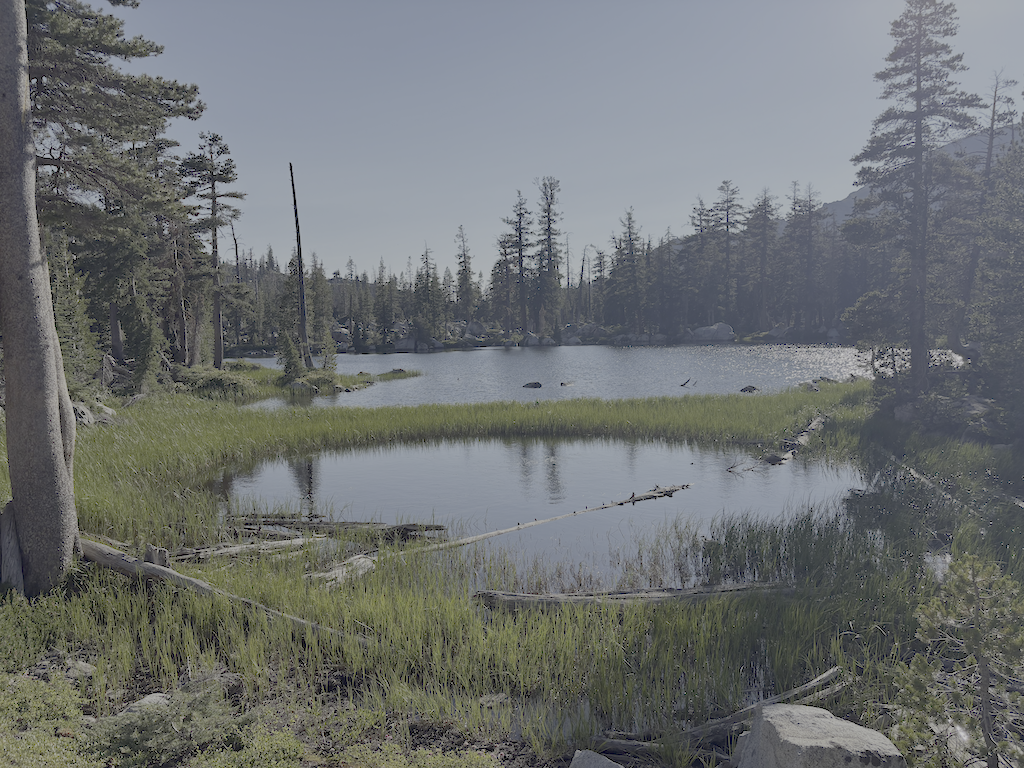
photo of Five Lakes second lake
Five Lakes second lake

Next morning out to River Ranch, TART bus to Truckee, morning at Dark Horse Coffee, and Amtrak bus home.

I’ve updated the Trail Conditions page with this survey trip. I am also gradually converting GPS tracks I’ve made over the years to routes, and providing links to them.

The trails I’ve not been on this season are Shanks Cove, Greyhorse, and Hell Hole. Maybe I’ll get there, maybe not, but as always, an invitation to anyone who does to submit a trip and trail conditions report.

Trail Conditions page

I have created a Trail Conditions page, available in the menu under Trails. The most common request I get from readers of the blog are about trail conditions for a trip they have planned. Rather than having to sift through multiple blog posts to find the information, this new page intends to pull it to one place. This page is just started, and only contains information about my most recent trip (and first trip of the season), but I will gradually add additional information.

Some of the trail entries will be quite old. Despite my desire, I don’t get to every trail every year. For older entries, the primary usefulness is about the number of down trees. For the unmaintained trails, the number of down trees only increases year to year. Part of my trail maintenance work is cutting smaller trees, but I have no ability to cut anything over 12 inches, nor do I do trail maintenance on every trail every year. On the trails that are maintained by others, often larger down trees are cut, but it can be late in the season before that happens.

Trails noted as ‘unmaintained’ are ones that I rarely get to, and are not maintained by any other organizations. There are a few trails that I do focus on, including Powderhorn, Whiskey Creek, Western States, and brushy parts of the PCT.

The conditions recorded include tread condition, number of large and smaller down trees, winter debris (see below), brush encroachment on the trail (brush grows rapidly!), trail junction and trailhead signing, and water conditions, which of course varies greatly during the season.

To quote from the page: “With the die-off of red firs, and to a lesser degree white firs and western white pines, there will be a continually increasing number of down trees on the trails. The term ‘winter debris’ used to mean branches that came down during the winter, but now includes an almost continuous rain of debris from dead trees, year-round.”

photo of down tree cut on Powderhorn Trail
down tree cut on Powderhorn Trail

First trip, down Five Lakes Creek

For my first trip of the season, July 4-10, much later than recent years, I headed in at the Five Lakes trailhead and went down Five Lakes Creek. There were only snow patches on the trails, and they would be gone by now. There are a few trees down as far as Whiskey Creek Camp, and a moderate amount of winter debris, the branches that come down over the winter and can be throw off if one has the time. From Whiskey Creek Camp southward, there are more trees and more debris, with the biggest issue being young firs bent over the trail. More snow than usual at these middle elevations bent these trees.

From Diamond Crossing south to Steamboat Creek, there are a lot of trees down, and a lot of winter debris. In fact, this trail segment has become quite difficult to follow. When you leave the trail to go above or below a fallen tree, it is very challenging to see the trail and get back on it, being so covered with debris that it looks just like the rest of the forest floor. If this trail doesn’t receive some maintenance within a couple of years, it is done for. Bears provide a lot of the trail maintenance on these lesser-used trails, and there is evidence that the bears are starting to prefer other, easier routes over the old trail, and if so, that is the beginning of the end. 

All of the named creek crossings were wet ones. Some are probably rock jumps now, but some may still be wet. The snow melt has created tread erosion in a number of places. No surprise. When you combine an almost complete lack of water control structures on the trails with a wetter winter, erosion is the result. 

I spent two days doing maintenance on the lower third of the Powderhorn Trail. The doghair fir is pushing into the trail, so the hiker has to push through it. I cut those back, so the trail is in good condition, with a bypass around one down tree. However, another down tree that can be bypassed by hikers may well be a barrier for equestrians since it is on a steep side slope in a dense forest. The real issues on the Powderhorn are in the middle third section, where doghair fir and whitethorn brush have essentially closed the trail. Though the alder section below the postpile formation has been an issue in the past, I’m guessing that it is still passable. I did not have time to work on the middle third, so good luck if you go there. 

I met a Forest Service wilderness ranger, Nathaniel, on the Five Lakes trail. This is the first time in many years that the Granite Chief has had dedicated staff, so I’m looking forward to more attention being paid. 

The flower show is just developing, with pentstemons, mules ears,and a few others. 

I did not go north or south on the PCT, nor any of the other trails in the wilderness, so have nothing to report on them. As always, I welcome comments from others on trail conditions, creek crossings, and water sources. 

Photos on Flickr