This backpack was September 10 to 14. More than a month ago, but when out of the wilderness, it is out of mind, and I forget that I haven’t posted trips. I’m planning one last backpack trip tomorrow (October 21), for Granite Chief. I backpack in the foothills and Bay Area during the winter.
My. trip up to Truckee on the California Zephyr was much delayed. A person was smoking in the bathroom and started a fire that smoked out that car and caused much consternation. My view of people who are so addicted to smoking that they can’t go without it, ought to try some other drug that ends their misery. He was hauled away in handcuffs by the county sheriff, but would be facing federal charges since Amtrak is a quasi-federal agency.
I went in at Five Lakes or Alpine Meadows trailhead (it gets referred to as both), and camped at Whiskey Creek Camp. I ran into a couple who had been doing light trailwork on the Five Lakes Creek Trail, and said they had been coming to the area since the 1970s, which was long before it was designated wilderness. I neglected to get their contact info, but it would be interesting to talk to them about their experience over the years. I don’t often run into people who have been going there longer than I have, but my first trip was 2002, I think.
I did trailwork on the Western States Trail, from Whiskey Creek Camp, but accomplished less than a kilometer of brushing, mostly whitethorn, which quickly encroaches on the trail. Early season whitethorn is pliable and doesn’t draw blood, but late in the season it is quite stiff and does draw blood.
Fall colors were well underway, casting a yellowish light, but the aspens had only just begun to turn, mostly a few branches but not whole trees. The air feels different, and sound carries differently. At twilight, two great horned owls were calling, for quite some while.
I hiked the Shanks Cove TraIl as far as Shanks Cove, which is an alder and willow filled wet area, which used to have some open meadow but has been filled in. The trail has at least 94 down trees, but the bigger challenge is following the trail through some patches of brush or alders, and I lost it four times. The crossing of Shanks Cove Creek is not obvious. There was a little maintenance here about ten years ago, but many of the down trees have been here far longer. The brush is not thick, except in a few places, but it would take a lot of work to clear. The creek was low except in bedrock sections. It’s a pretty canyon to hike, even if the trail is poor. I did not continue beyond Shanks Cove, so don’t know trail conditions for the climb to the ridge, and the other section that descends to the Western States Trail.
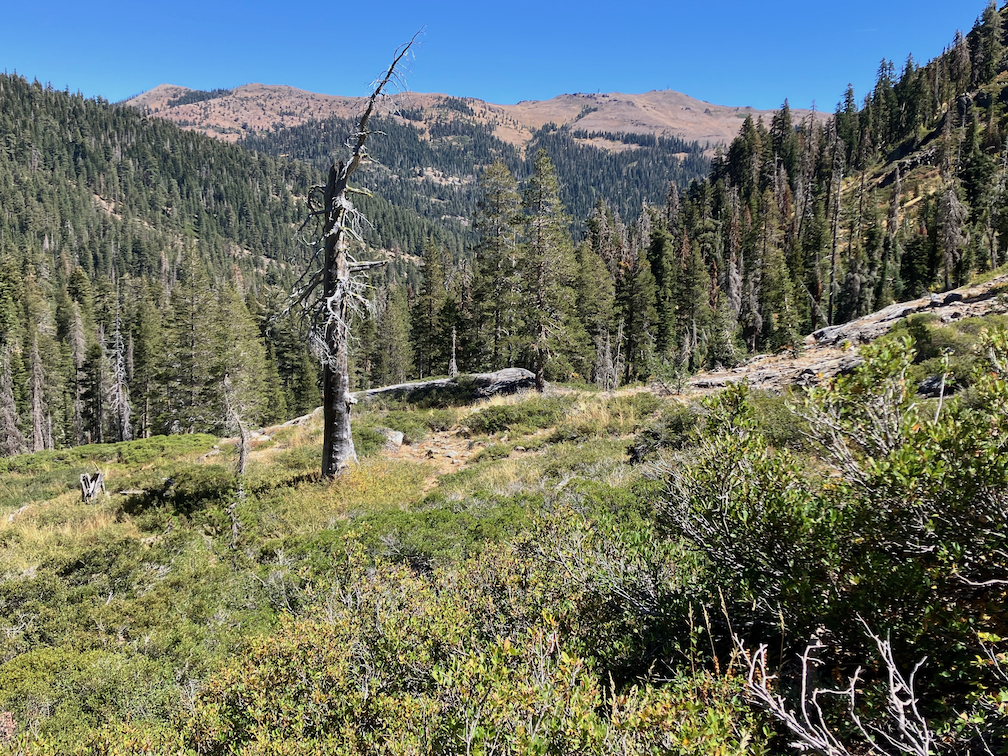
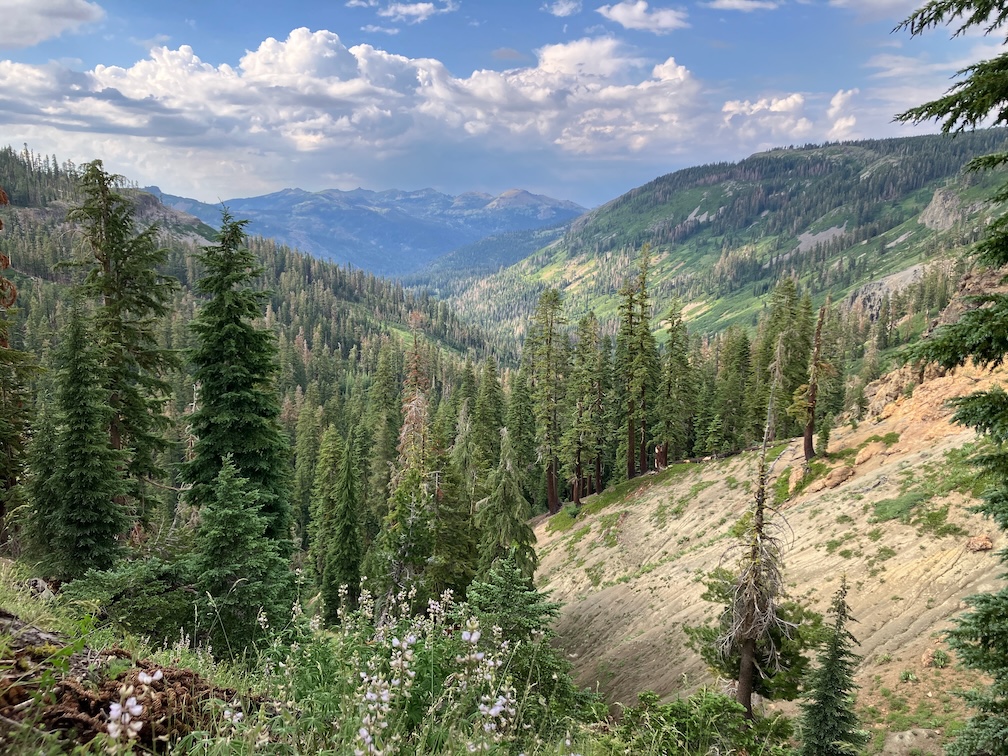
crest from Shanks Cove Trail
I hiked the PCT north to Middle Fork American River and camps the night there, great stars. The creek is low but flowing. I continued north to the Granite Chief Trail and out to Palisades Tahoe. TART bus to Truckee. I’ve started going to Dark Horse Coffee, on River Street in Truckee. Used to go to CoffeeBar, but their service deteriorated, and Dark Horse still has good service. As always, a tea drinker and not a coffee drinker.
Overall, all the creeks were still flowing, but noticeable low with the fall season. As the creeks drop, it is more challenging to gather water from them. Of the creeklets which cross the trails in several places, most were dry, but surprisingly, some were flowing quite well. It was a strange year for water, very wet early in the season, particularly at higher elevations where there was above average snow, but the lower elevations where there was almost no snow were dry early.
With this trip, I retired my old hiking boots and started with new. My boots are Altra Lone Peak, which is the only brand I’ve found that offers a wide toebox that my feet require. The old lasted a little over three years, since June 2021, not bad. The soles were more worn that the tops, but both were done. Altra has saved my hiking, as any boot without a wide toebox causes me great pain, and the one other common brand with wide toebox just doesn’t work for my feet.
The purpose of the trip was mainly trail condition survey. I often do that early in the season, but didn’t get to it this summer. Conditions for the trails I did are listed below. I went in at Granite Chief Trail (after enjoying Bluesday at Palisades Tahoe), then south on the PCT. The number of PCT hikers has dropped off, but there are still some going, either late starts or flip-flopping.
I was curious about rerouting of the Tevis Cup Trail, a project which started last summer and will continue through next summer. A CCC (California Conservation Corps) trail crew is base-camped at Little Needle Lake, and working from near the PCT to the west. The reroute is in varying stages, ranging from just sketched out enough to follow from being walked on by the trail crew repeatedly, to essentially complete. Several rock outcrops near the east end had just been blasted the day before, leaving a mess that requires a lot of reconstruction. The crew has worked as far west as a small seasonal creek, which will probably be the only water source on the rerouted trail. Though the trail route has been flagged through to its connection with the old trail, somewhere, I did not follow beyond the existing work, but I’m guessing a little more than half of the reroute has at least been started. This will be a very nice trail when completed! As I’ve written before, the Tevis Cup Trail design was horrible, gaining and losing altitude repeatedly, often for no apparent reason. I don’t recommend that you try to follow the new trail until the end of next summer, I do encourage you to enjoy it when finished.
A Great Basin Institute trail crew was working on the cross-trail between the PCT and Tevis Cup, which I call the Tevis connector though it is not clear what its official name and number is. They are camped at the flats beside the Middle Fork. Because the reroute crosses the slope of Lyon Ridge much higher than the old trail, several new switchbacks are being worked to bring it up to that level. If you follow the old trail west from the PCT, the obvious worked trail will take you all the way down to the Middle Fork. The junction with the old trail is marked by a rock wrapped with flagging, but could be easy to miss.
Knotweed is brilliant fall color right now, bright to pale red, and occasionally yellow and orange. It paints the west slopes below Wa-she-shu Peak with color, mixed in with other plants of fall color. Some of the wooley mules ears fields are browned out, while others are mix of green and yellow. Though few things are still flowering, the California fuschia at lower elevations are striking red.
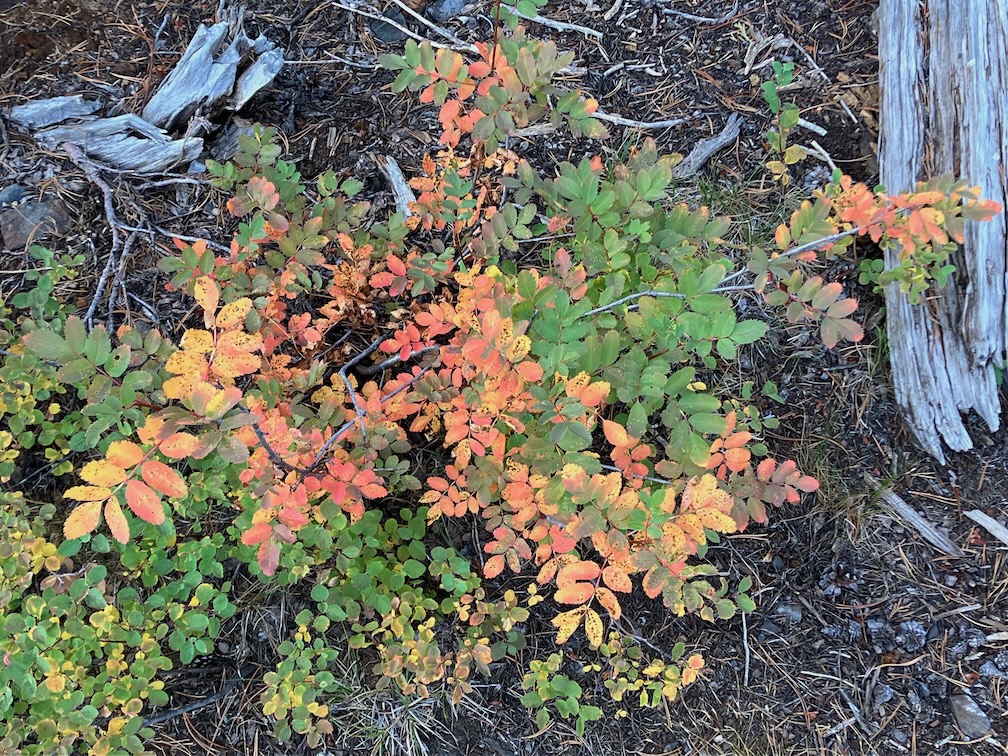
mountain ash in fall color
All my previous trips I had been sleeping under clouds, or smoke, or trees, but I had a full view of the sky with only a crescent moon to obscure. I have to admit I’ve forgotten a lot of constellations, but the night starts with the summer triangle overhead, and ends with Orion up in the east, and Jupiter.
I was going to do a loop out the Tevis Cup Trail to Talbot Creek Trail and back in on the Western States Trail in Picayune Valley, but realized I really didn’t want to deal with the old trail, and never will have to again. So I headed south on the PCT to Whiskey Creek Camp, and then west on the Western States Trail (which is called the Historical Western States Trail on some maps, I guess to distinguish it from the Western States Trail run on the Tevis Cup trail. Picayune is one of my favorite places in the wilderness, and I spent two nights there. Hiked out the trailhead one day, recording trail conditions, and lolled by the creek as much as possible.
The rain last week, while I was home, perked up three ferns that grow among the metamorphic rocks in Picayune Valley: cliff-brake, lace, and indian dream.
My ambition was to come back and do the Shanks Cove loop up the ridge and back down to Five Lakes Creek below Big Spring Meadows. But ambition failed me, and I stayed a night at Whiskey Creek Camp.
I hiked out Squaw Saddle Trail (has it been renamed?) and Five Lakes Trail to the trailhead. I walked the Bear Creek Trail towards River Ranch, planning to sleep part way along. But there are only two flat spots along the entire trail, one by the water tank and another on a bald hillock. But I noticed the hillock was covered with bicycle tracks, and I suddenly had a vision of being run over by night-riding bicyclists (which has become popular in the Tahoe area), and I had already passed the tank, so I walked all the way out to the stables and then bottom of Alpine Meadows road and camped by the river. I was surprised to see how many creeklets cross this trail, including at least three that are probably year-round. But the creeklets are all east of the water tank sleeping area.
While on this trip I finally identified the low shrub that I had been working on the Powderhorn Trail. It is snowberry, Symphoricarpos. It spreads by sending out runners that root. Sometimes across the trail, and those runners age to an almost unbreakable trip-wire, which is part of the reason I try to get it out by the roots, and cut it back if I can’t. On my earlier trip, the white berries were not there, but now they are, so I was able to identify. On the plus side, there was a patch of the gooseberry without spiny fruits around the old wilderness info sign at the beginning of the Tevis Cup Trail. Hmm, delicious.
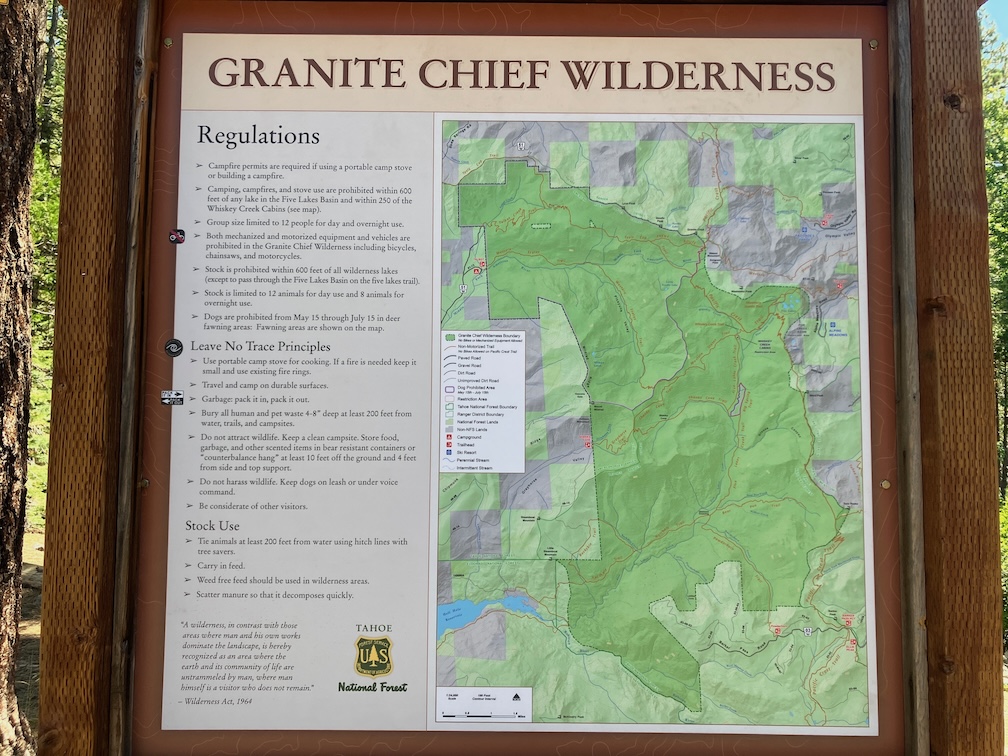
There is a new trailhead map at the Talbot trailhead. It has the extended wilderness boundary on the northwest (lands purchased by the American River Conservancy), the new name Wa-she-shu, and a few other details. Unfortunately, it still shows the Buckeye Trail, off the Hell Hole Trail, which is essentially unfindable.
Granite Chief Wilderness trailhead map at Talbot trailhead
I finally figured out why my hips have been hurting this entire season. The waist belt on my Osprey Atmos 50 AG backpack has velcro attachments between the hip belt and the waist belt. On one side, the velcro no longer holds where it is supposed to, so the waist belt no longer cinches as tight as it should. So the pack was riding low on my hips and causing pressure with every stride. It also explains why I was more and more holding onto and pulling in on the shoulder straps, trying to pull the pack up off my hips. Though these are called hip belts, they are meant to go above the hips, to ride on top of the pelvis and not on the hips. I will have to get that fixed during my late fall slow backpacking time.
Trail Conditions
Granite Chief Trail (15E23): good condition, one 9 inch down tree, could use spot brushing; adopted by Truckee Trails
PCT south to Tevis: good condition, one 6 inch, some debris*
Tevis Cup Trail (16E04): see notes above, old trail unacceptable, new reroute not complete
Tevis Connector: good condition
Little Needle Trail: This is not marked on maps and was formerly just a seldom used and hard to follow hunters trail, but with the CCC trail crew camps at the lake, it is now easy to follow.
PCT south to Whiskey Creek Trail: good condition, five down but all easy to step over or bypass, some debris
Whiskey Creek Trail: good condition, except broken tree fragments at the bottom
Western States Trail (16E10): to Shanks Trail, 16 down trees, some very brushy areas, moderate debris; to Talbot trailhead, about 30 down (forgot to record), some brushy areas, some areas of moderate debris; most of the down trees have established bypasses or can be stepped over/climbed over, but some newly fallen are difficult; though there are a lot of down trees on this trail, it is still worth walking or backpacking; the trail sign at the junction of Western States and Shanks is broken and down, but still readable
PCT south to Squaw Saddle Trail: good condition, one down tree, well brushed
Squaw Saddle Trail (if it is still called that): good condition
Five Lakes Trail to Alpine Meadows Trailhead: good condition, could use spot brushing
Trails not checked so far this season:
Shanks Trail
Greyhorse Taril
Hell Hole Trail
Talbot Creek Trail
*debris: I used to call this winter debris, the branches and cones that fall out of the trees during the winter, but since if falls year-round now from dead trees, I’m calling it debris.
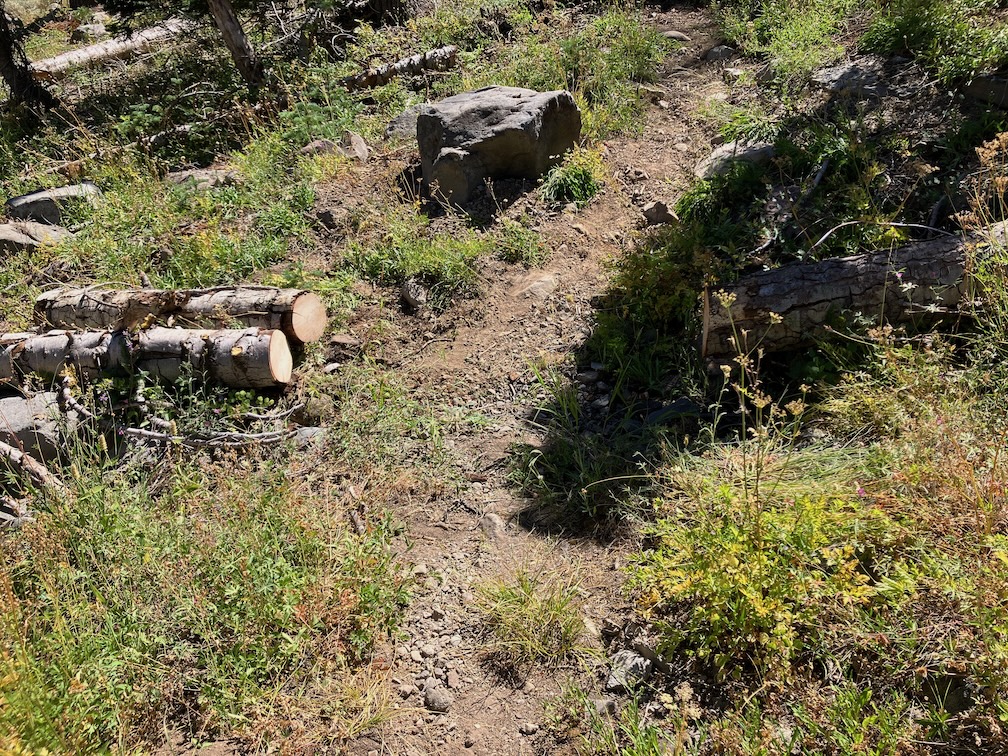
This backpack trip was just for doing trail work on the Powderhorn Trail, to make up for two aborted or shortened trail work trips earlier this year. And I completed the trail! Yay!
There is a real pleasure to walking a well-maintained trail.
Of course trail work is never really complete. While doing trail work, things are growing, and dying, and falling. The upper section of the trail is noticeably needing brushing and removing conifer encroachment, developing in the time since I worked that section.
I was curious about my history with the trail, so looked back at earlier posts.
2009: The trail was logged out by the Forest Service. This is the last time the FS worked on this trail, 15 years ago, so far as I know. All of the older, rotted and aged and often large down trees, were cut at this time. I don’t know if any other work was done at the time.
2010-2017?: A horse group rode in every year to Big Spring Meadow for a long camp. On their way in, they cut enough of the trees to keep the trail open and useable. I don’t know whether their plans changed or they gave up on the trail and went elsewhere.
2018: My first trail work, spot brushing and removing conifer sprouts (mostly red fir) that were closing in on the trail.
2021: My first focus on Powderhorn, including marking the location of down trees. At that time I was still hoping that the Forest Service would log out the trail again, and so relayed to them the size, nature, and location of the trees. Though they thanked me for this year, they ignored later submissions, so I stopped sending them.
2022: Continuing work on the trail, mostly the upper third.
2023: Continuing work on the trail, mostly the lower third.
2024: Continuing work on the trail, mostly the middle third.
before before and after and after
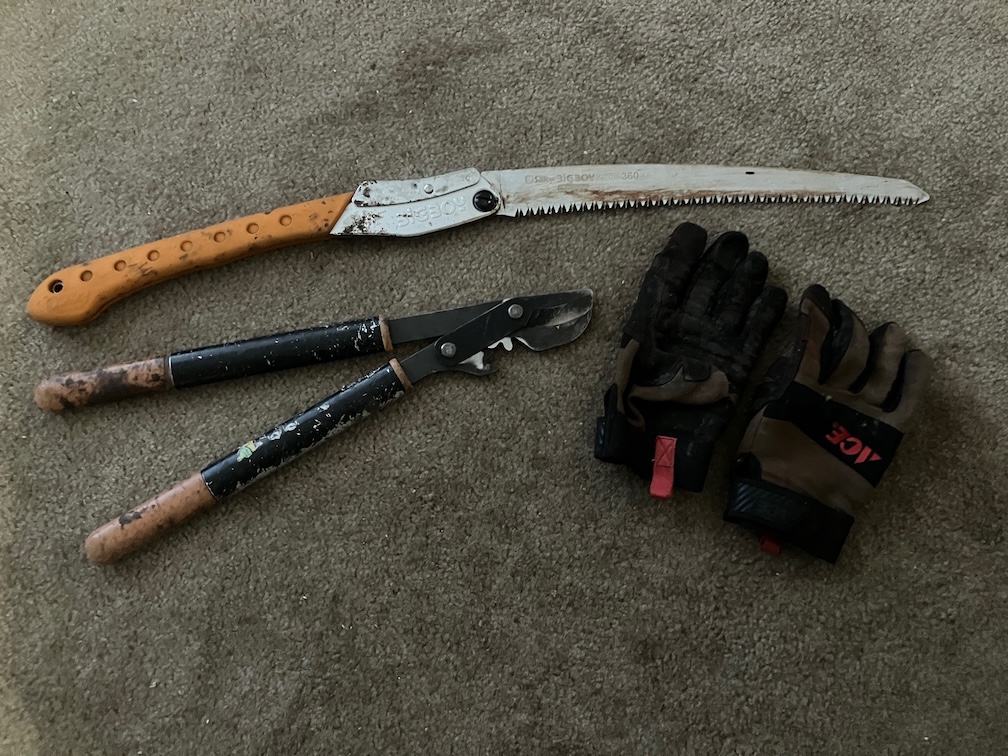
I recently bought a new trail tool, a Silky Big Boy 2000 15-inch folding saw, to replace my Fiskars 10-inch folding saw. What a difference! The length has allowed me to cut many smaller down trees that I had always had to ignore before. The saw easily cuts 9-inch logs, and at a stretch 12-inch logs, though 12 inches is slow going. Radius SQUARED really makes a difference. And being new, the saw is sharp and cuts well on the pull stroke (it is designed to cut on the pull and won’t work pushing). There were quite a number of new down trees this year over last year, but with cutting the smaller stuff, the overall number of down trees is now less than last year. For those wanting to know the details, my GaiaGPS folder ‘down-tree‘ shows all of them on the Powderhorn Trail.
tools of the trade: new Silky Big Boy folding saw, Fiskars nippers, and gloves
If you like the Powderhorn Trail, or have been thinking about going there, now is the time! By next year there will be new down trees. About half the red fir trees are dead, though it varies from nearly all to very few. Of course there are abundant sprouts crowding the trail. Some of these will die and become what I call spars (similar to snags, but I use snags for large standing dead trees) and lean into the trail, ready to snag your clothes or skin. A significant percentage of young red firs develop a lean, hanging into the trail. I call them leaners. The standing dead have prominent white mushroom bodies all over the trunks, so they are already rotting while standing, and will fall. It used to take a high wind year with saturated soils to being down trees, but they are now falling year-round.
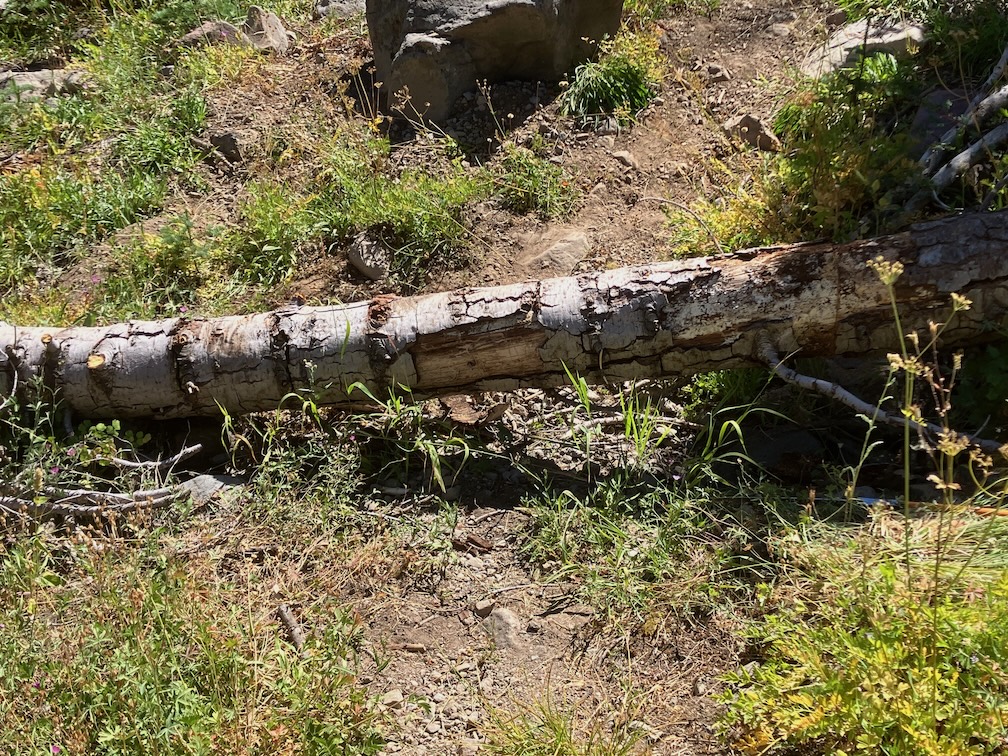
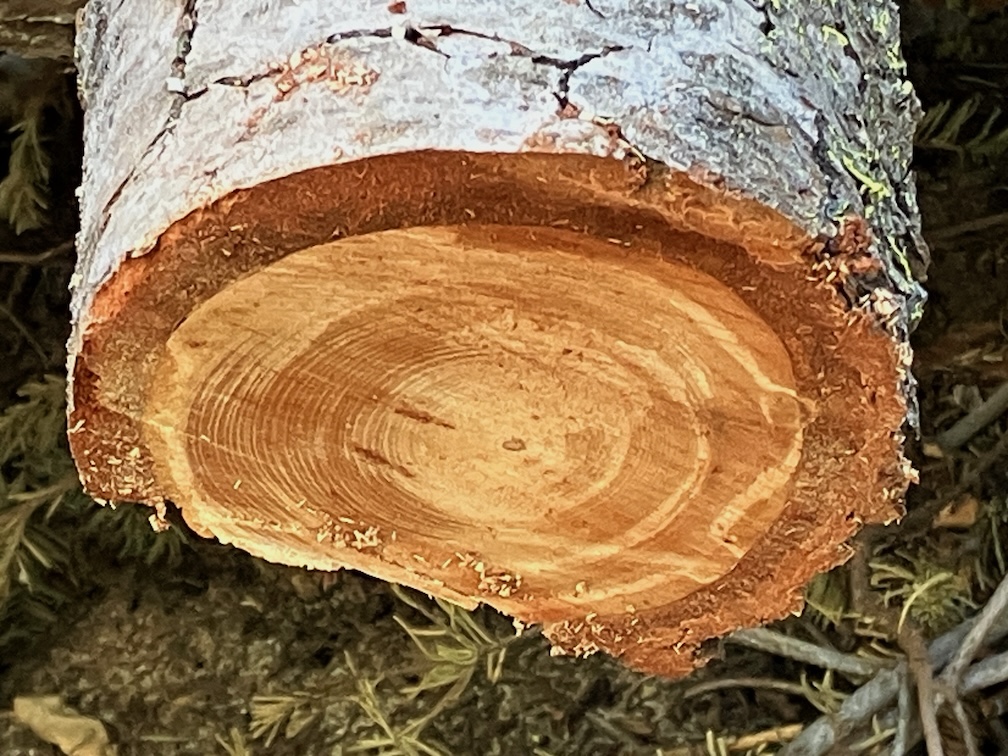
One of the down trees far too large for me to cut, I worked on the approach to the tree so that people could climb over or slide under. This red fir has the most dense wood I’ve ever experienced. A five-foot cut section of branch was so heavy I could hardly lift it. This must have been a very old and very slow growing tree. I’m unsure whether it died and fell, or was knocked down by another tree.
dense red fir rings
The trail has at least two down trees that cannot be passed by horses, so it must be considered closed and dangerous to equestrians. One is the slide-under tree, where backpackers can slide under the down tree. I had roughed out a bypass two years ago, but a new tree fell directly on the bypass, closing it. Another down tree would be a challenge to all but very trail-wise horses, and there is no bypass.
Sometime earlier this summer, someone rode a dirt bike into the wilderness and about a mile down the trail before giving up at a large down tree with no bypass. That person did quite a bit of trail damage and left ruts that will erode next spring. The power of internal combustion engines causes brain damage and immorality.
Five Lakes Creek is flowing but noticeable low. Same for Powderhorn Creek. The creeklet that crosses the trail is barely flowing and may be dry soon.
I have often done a trail condition survey trip early in the summer, but did not do so this year, so know nothing about trail conditions except the PCT, good condition, Whiskey Creek Trail, good condition, Five Lakes Trail, good condition, and Five Lakes Creek Trail, horrible condition. I may get to the other trails on my next trip.
This was a ‘didn’t go as planned’ trip. My plan was to do a lot of trail work on the Powderhorn Trail.
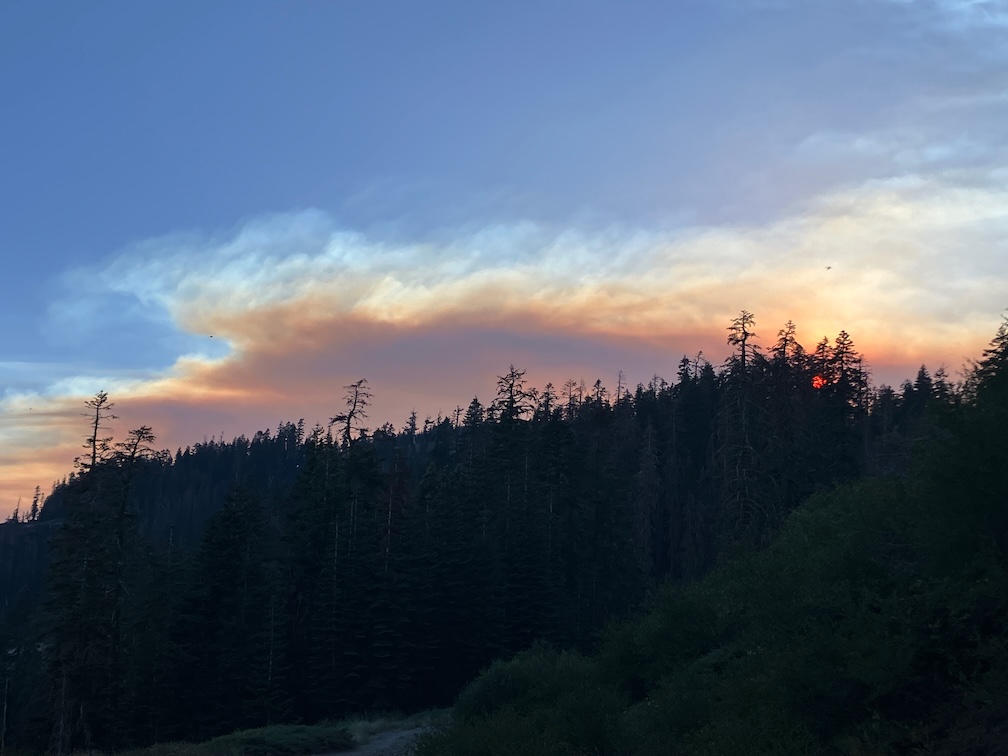
Train to Truckee, bus to Tahoe City and then Barker Pass Rd. I had hoped to hitch-hike to Barker Pass, but it was a weekday in the afternoon, and all the vehicles were going out, not up, so after a short hitch to the campground, I walked up the jeep road to the pass and then to Powderhorn trailhead. On my way up on the train, people were commenting on the smoke plume to the south, which turned out to be the Crozier fire north of Placerville. When I got to Powderhorn saddle, the plume was quite visible and spectacular, overhead. I started down into the canyon, but in short order the smoke descended into the canyon, reducing visibility to less than a quarter of a mile. I went back up to the saddle and camped there, where the air quality was a little better.
Crozier fire smoke plume
In the morning, smoke was filling Powderhorn, so I waited, and walked west on the old logging road to the creek, refilled water, and then back along the Barker Pass Rd to the saddle. The air cleared mid-morning, so I headed down and started my trail work. I have a new folding saw, which I’ll say more about next post, that allowed me to cut some down trees that I’ve always had to bypass, plus a little spot brushing. And then the smoke descended again, worse than before. So I headed out, and went to Barker Pass where the air was better, camped, and waited to see what would happen. Both the Rubicon drainage to the west and the Tahoe basin to the east were socked in with smoke in the morning. I realized that the only thing to do was head south on the PCT, away from the smoke plume. I was surprised by the number of PCT thru-hikers I saw, seems late in the season for them to be here.
By Richardson Lake, the air was good, and continued to get better on the PCT south. Looking back north, I could see that the smoke had descended into the valleys again, so if I’d tried again, I would have gotten smoked out again. There are a few patches of snow in the Crystal Range, but much less than two weeks ago. I spent time at my favorite juniper along the PCT, and then headed down into the General Creek drainage.
The connecting trail from PCT down to Genevieve Trail (which used to be called the General Creek Trail) is not really a trail. It was never constructed, has a lot of down trees, and is very hard to follow in places. This time of the season General Creek is just large pools with no flow, so is easy to cross, but I’ve had problems with that earlier in the season. I camped near the trail junction. This is a seldom used area. In the morning I headed over to Genevieve Lake, on a trail in decent shape with some down trees but easy to follow.
The Meeks Creek Trail (also called Tahoe Yosemite Trail on many maps, but it is a relict name) is a different world, only wilderness in name. Suddenly a whole lot of people, and more and more heading down Meeks Creek and out to the trailhead near Meeks Bay Resort. After iced tea, to Sugar Pine Point SP for a shower, then on to Tahoe City and Truckee, and the Amtrak bus home.
I started this trip at Granite Chief Trail in Olympic Valley, as it is the most convenient trailhead. The evening before I attended the Palisades Tahoe Bluesday concert in the village. A lot of people there, many from the Reno area, and the Reno blues group is one of the event sponsors. Camped out at a favorite spot part way up and off of the trail after the concert, and then headed up the trail early morning. My break was at a juniper tree about half way up, where I have often stopped, but someone has made a nice bench out of a dead juniper trunk, just below the tree. There have been helicopters up all morning, but over the ridge south, in the Alpine Meadows / Bear Creek valley. Probably a lightning strike tree.
Thunderstorms were building over the Mt Rose area northeast of Tahoe, but I don’t know if rain came of it. Someone at the concert was mentioning heavy rain that afternoon, but I didn’t catch where. As with last trip, there is zero precipitation in the forecast, but the reality is different. But I had no rain on this trip, and one full day of completely clear skies.
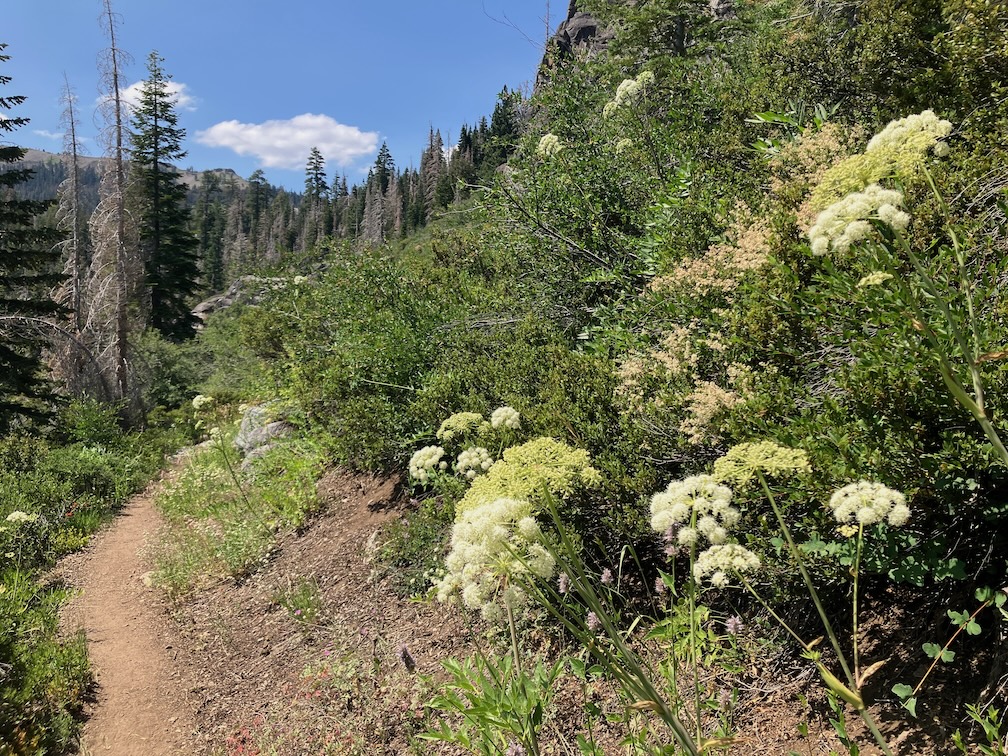
Angelica lineariloba, Apiaceae
I headed south on the PCT and then to Whiskey Creek Camp. There are a lot more PCT thru hikers than I would expect at the end of July. A few of them may make Canada. Then down Five Lakes Creek Trail, which raises my frustration level, climbing over down trees for long stretches. I took the main trail, not through Big Spring Meadow, and it appears to be unused until it rejoins the meadow trail. I lost it several times before and after the junction with Shanks Cove Trail. I walked a short distance on Shanks Cove, at it also appears unused. The few people who use Five Lakes Creek Trail go through Big Spring Meadow, which is understandable, it is a beautiful place. And the spring, though hard to access, is wonderful water. I camped at my common site beside Five Lakes Creek, off the trail near Diamond Crossing.
I did two and a half days of work on Powderhorn Trail. Though I had done the lower one-third last year, there were new down trees and winter debris, so I re-worked that section. I had laboriously cleared a bypass of the slide-under tree, safe for at least backcountry-wise horses. But a tree came down on the bypass, so the Powderhorn is again not accessible for equestrians. I then tackled the part I’ve not maintained in many years, the middle third. I made good though slow progress, completing up through the postpile meadow to the creeklet. This is about another 1/6, leaving 1/6 yet to do. And that 1/6 is largely a mess, about 1 km of down trees and winter debris, including one tree fallen directly on the trail.
I saw eight backpackers and two day hikers on the Powderhorn, which is a little surprising for a difficult trail that seems to be not much used. So maybe my work is worthwhile. It is certainly a pleasant experience on some parts of the trail, and if I can make is so, it is worthwhile.
Ageratina occidentalis, Asteraceae
I explored the Hell Hole Trail from the Diamond Crossing junction to Five Lakes Creek. It is hard to follow through the seasonal growth and dry grass. There are duck markers but they aren’t all inter-visible. The most recent trail alignment is very hard to follow as it approaches Five Lakes Creek, though the alder thickets. Someone has partly ducked an alternative route that stays north of the dry drainage and comes out on the gravel bar just upstream of the crossing. It is also not well marked, but may be a better alignment. The ducks/cairins that I had set up two years ago are all gone, washed away or fallen over, but the crossing is upstream of the log jam across the creek. It may be a little hard to find the trail on the west side of the creek, but once found, it should be pretty easy to follow. I’ve spent a lot of time finding and clearing this trail, all the way to the bottom near Hell Hole Reservoir. Of course, as with every trail, it has a lot of down trees.
After a half day of trail work, I headed out Powderhorn Trail, FR 3 to Barker Pass, north to the PCT-TRT trail junction, and then down the TRT into Ward Creek, and camped at a small site beside a creeklet. Though I hadn’t really needed my inner tent for mosquitos on this trip, I did here, ample mosquitos. All day there had been a strange overcast, which turned out to be smoke aloft from the Park Fire. Nothing at ground level, where the smoke is going north and east, but smoke aloft was coming south.
Next day I walk out to the road and down Ward Creek to Sunnyside, and caught the bus into Tahoe City. Went to the Commons Beach concert, and camped in the forest nearby, then morning TART bus to Truckee and the Amtrak bus home.
An update on my inflatable sleeping pad. After patching some small leaks, it was still deflating during the night at an accelerated rate. So after seven years of good use, it is retired. I bought a Nemo Tensor inflatable sleeping pad as a replacement. Slightly more weight and slightly bigger, but in the same range.
For my second trip to the Granite Chief, I took the Amtrak bus up to Truckee, then TART to Palisades Tahoe. Attended Bluesday, the weekly blues music. The band was Mark Hummel, famous, so the event was packed. I camped off the old Granite Chief Trail at a place that I’ve settled in on for sleeping out after the music. In response to getting chewed by mosquitos on my last trip, I brought my inner tent with mosquito netting, though the mosquito clouds had fallen off to some degree.
As always, I checked the weather forecast for Tahoe City when deciding what to take. The forecast was zero percent chance of rain. But while going from Granite Chief Trail to Whiskey Creek Camp, it rained for about two hours, moderate rain, from a thunderstorm with lightning and thunder. It stopped late afternoon, and I was able to stay somewhat dry by sheltering in a hollow dead tree. There was a preview when it rained lightly for a short time the night before. In fact, it rained a bit every night on the trip, while every day the forecast was the same, zero percent chance of rain. Either these thunderstorms were happening just over the ridges, not over weather stations, or the weather forecasting has failed.
On this trip I had several negative interactions with trail runners. The rule, though not the law, is that downhill people yield to uphill people. But runners seem to think they have the right of way over everyone else. One runner actually ran into me and knocked me off the trail. Several other runners said I should get out of their way. So I’ve adopted a new policy for myself: I don’t yield to trail runners. If they insist on having a negative physical interaction with me, I’ll knock them off the trail.
The morning after the thunderstorm, there were helicopters up with water buckets, first a small helicopter, and then a heavy-lift dual rotor helicopter. I’m not sure whether they were fighting a single location or more than one, because the fire was over the ridge from me.
The Forest Service, with this suppression-at-all-costs policy, is harming the wilderness ecosystem. Every fire that gets put out the same day is a fire that cannot reduce the fuel build=up. The wilderness will burn, that is inevitable, and when it burns, it will be a catastrophic, forest-clearing fire. Why? Because the Forest Service has suppressed fire and allowed fuel to build up to a completely unnatural level. Fire is part of the natural environment. I realize that it may be necessary for fires close to towns to be suppressed, and the fuel reduction function replaced by mechanical reduction, but the fire being suppressed was in the middle of the wilderness, not close to any human habitation. There have been trends over the years towards letting wilderness fires burn, and away from that, and the last few years there was a trend toward fire, but for some reason this year, all that progress has reversed and we are back to suppression-at-all-costs. The Forest Service, and the wilderness, will regret that.
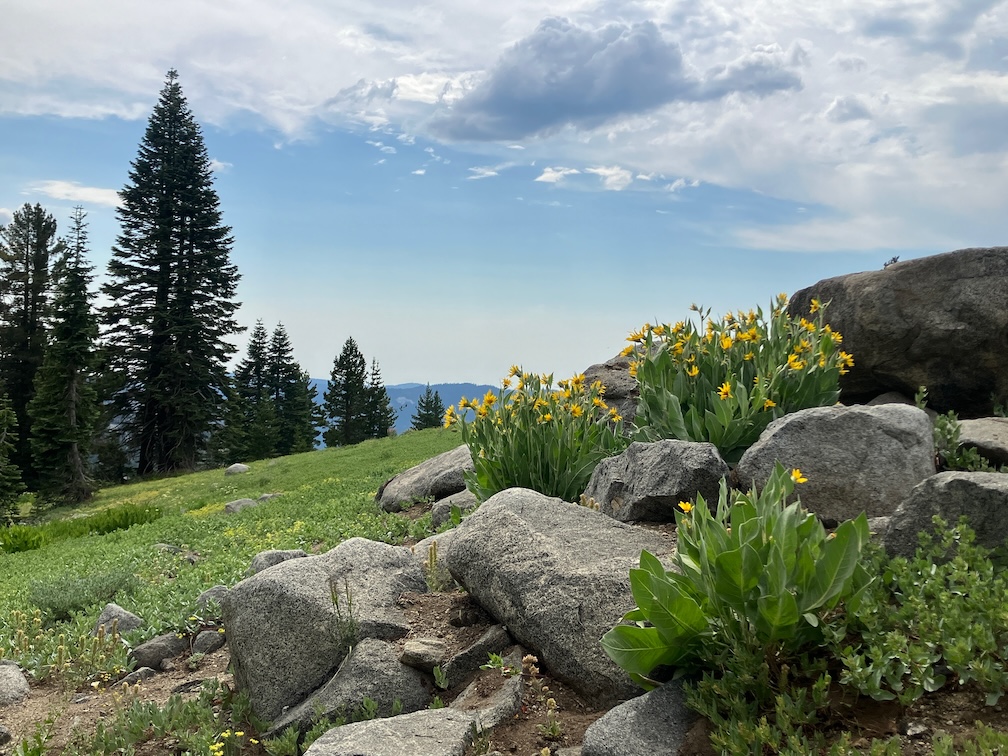
Wyethia mollis, Asteraceae
I worked the Whiskey Creek Camp trail, the short segment between the PCT and the camp, brushing and removing winter debris. This is the time of year to be cutting whitethorn, as it is soft with winter moisture. When it dries out more later in the season, it becomes hard and stiff, and draws a lot of blood from trail workers.
I still call the branches on the trail winter debris because it used to fall almost entirely during the winter and show up at snow melt, but in a sense it is a misnomer now, because dead red firs are coming down year-round now. In the Granite Chief, there are areas where more than half the red firs are dead, and other areas in which only a few are. Though not current, and focused on the northwest, the article Massive die-off hits fir trees across Pacific Northwest has some information. Apparently the die-off is not from a single cause, but a variety of factors. In any case, red firs are falling and will continue to fall, the trunks laying across trails and the dead branches scattered everywhere. Fire is not common in the red fir forest, so I can’t say whether suppression is contributing the the die-off or not.
I headed down Five Lakes Creek Trail to Diamond Crossing. This trail is worse every time I use it. It has not been logged out in more than 12 years, and there are more down trees every year, in some places I have to scramble up and down over several trees in a row, and the tread in between is covered with branches from the fallen trees. I get very frustrated by this trail and every time I use it, I wonder why I even try. I’ve not counted down trees recently, but it must be over 100. Use of this trail has dropped off over the years as other people abandon it as well. There are some footprints, but fewer every year.
I camped at my favorite spot beside Five Lakes Creek.
Powderhorn Canyon
Next day I did a half day of trail maintenance on the Powderhorn Trail. I’d planned on more, but ran out of motivation and energy. As I said last year, the upper third and lower third of the trail are in decent shape, but the middle third is in poor condition and getting worse. My tool set is nippers and a fanno saw, but by Fiskars, so quality and fairly lightweight. But I have no tools to tackle down trees larger than about four inches, so anything large gets ignored. Sometimes I can clear a path to and from the down tree, so at least it is easy to step over without getting feet tangled in debris. One large tree, that has been down for years, is a slide-under tree. I had built a bypass of this tree last year, useable by trail-wise stock, but a red fir fell directly on the bypass and it is beyond me to clear it again. So the trail is yet again closed to equestrian use.
I hiked out to the Powderhorn Trailhead, then to Barker Pass, down the jeep road to Blackwood Canyon, and out the next morning to catch the TART bus to the Amtrak bus to home.
Water is abundant so far this year. In addition to the larger creeks, many smaller creeks and creeklets that are not year-round are still carrying water.
My Thermarest NeoAir sleeping pad has been deflating during the night for quite a while. I’ve got to find the leak and fix it.
Yes, I’m still here. I’ve been backpacking a bit in the bay foothills and Bay Area, but this is my first backpack of the season in the Sierra.
I took the TART bus to Sugar Pine Point State Park, which is the end of the route. It used to go a little further, to Meeks Bay, and there used to be a shuttle that went all the way to South Lake Tahoe, but no more. I hiked up the General Creek Trail, and then a side trip to Lost Lake where I camped the night. Lost Lakes gets bicyclists, but few backpackers. The trail was rerouted, and it needed it, but it was laid out by mountain bikers so is not that pleasant to hike. But the lake is beautiful and quiet.
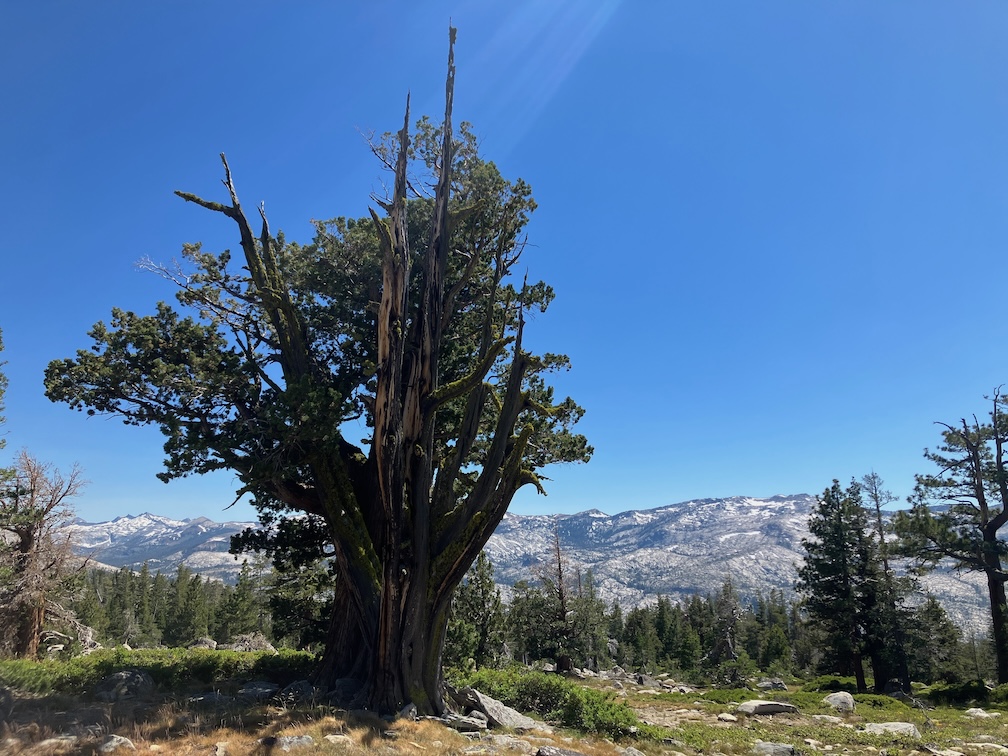
The next day I went south along General Creek. This used to be called the same General Creek Trail, but apparently has been renamed the Genevieve Trail. Last time I was there, years ago, the trail was impassible with down trees, but it has been maintained and there are only a few down trees now. The trail is easy to follow except in a few wet areas where the annual lush growth has obscured the trail. There is a steep connector trail heading west up to the PCT, where I turned north. I spent some time at my favorite tree, that I call The Juniper, and then continued north past Richardson Lake, across Miller Creek (still flowing in early July), and then up to Barker Pass where I camped the night. A long day!
Juniperus occidentalis, Pinaceae
From Barker Pass I continued north along the PCT/TRT, and camp at Whiskey Creek Camp, and the next night near the Tevis Connector trail.
To my surprise, the PCT has been brushed from the PCT/TRT junction to the Middle Fork American River crossing south of Granite Chief (a small creek at this point near the headwaters). I don’t know who did the brushing, maybe Forest Service, maybe Pacific Crest Trail Assocation, but it was a professional job, not the rough work done by one-off volunteers crews. I had figured to spend at least a week, maybe two, brushing this section, so now I can focus on other trails. Trees were also cut, but there a a few new ones down.
I continued north and then down the Granite Chief Trail to Olympic Valley. Music at Palisades Tahoe in the evening, sleep out up the trail a ways, and catch the TART bus back to Truckee. The train was quite late, and I had a meeting to make, so I returned to Sacramento on the Amtrak bus rather than California Zephyr.
Water: Almost every creek is flowing well, so I was able to stay stocked up and hydrated with no problem. There were a few snowbanks left, on and adjacent to the trail.
Insects: This year is what used to be an average mosquito year, though we have not had an average year in many years. I did not have my inner tent, the mosquito netting, with me on this trip, so had to hide out under my shirt at night. At lower elevations there were more flies than mosquitos, some of them biting flies. While at Lost Lake I expected to see bats munching mosquitos, but did not see a single one. The ecosystem is out of whack in the Sierra.
PCT thru hikers: It is thru hiker season, and there are a lot of people on the trail, heading north to Canada, or as far as they make it. There were also a few TRT hikers, most heading south rather than north.
I am having difficulty getting to labeling photos and posting in between trips, so my trip reports may be erratic during the summer. One day back home is not enough to clean and repack, and post. And I’ve been taking some other trips in between, like San Francisco and Oakland this last weekend (July 20-21). Ah well.
Finally, a trip without rain! The weather was perfect. Cool mornings, warm afternoons, fair weather cumulus clouds in the afternoon, clear skies at night with a new moon and incredible stars.
I camped four nights beside Five Lakes Creek, in a gentle area below the gorge but above where the Hell Hole Trail crosses. There is no trail to this place, but I found it in my explorations and it has become a favorite.
I went back to Powderhorn Trail to do maintenance. The horrible condition of this trail gnaws at me. Very few people used this trail this year, and I am afraid that people will just stop using the trail completely. The bears, of course, still use it, but even they seem to be using it less.
I worked the bottom part of the trail for three days. The first 1.5 miles from Diamond Crossing are now in good condition, other than the down trees. I spend a lot of time cutting back and thinning the fir trees which encroach on the trail. Most young trees die, the larger trees you see a the result of a long process of natural thinning. But in the meanwhile, the live trees crowd the trail, and both live trees and dead trees lean over into the trail. Along this section of the trail, traditional brushing is not the main work.
The upper 1.4 miles of trail is in acceptable condition. It needs some brushing and winter debris removal, but is quite usable. That leaves the middle section of the trail, about one mile, which, still, sucks (see my earlier post Powderhorn Trail maintenance 2023-07). In this section there is heavy winter debris on about half the trail, firs are crowding the trail, a lot of live and dead firs are leaning into the trail, and there is some brush. This section includes the postpile meadow, where the alders are beginning to crowd in but are not too bad yet.
One down tree on the trail presents a barrier to equestrian use. This is an off-the-ground tree that hikers and backpackers can slide under, but there is no safe bypass for equestrians. One could be created, with a lot of work, but for now, it is not safe.
It is unlikely that I’ll get back to Powderhorn this year. In fact, this may be the last of my mountain backpacks for this year, as my next window is not until the second half of October. If fall is late, perhaps again. Otherwise, foothill and coast range backpack trips.
I did my usual Amtrak bus to Truckee, TART bus to Barker Pass Rd, hitched a ride to Barker Pass and walked to the Powderhorn trailhead. Coming out, I walked back to Barker Pass, then attempted to hitch down, but during the week and after Labor Day, there isn’t much traffic, so I walked more than half the way. Bus back to Tahoe City, and the next morning, bus to Truckee and the Amtrak California Zephyr home. The train was almost on time!. Several times this season and others, I’ve had to take the Amtrak bus instead because the train was many hours late.
My last backpack was cut short by rain, again. As mentioned, I discovered on my last trip that my tent is no longer waterproof, and had ordered a new tent. It came after I had headed out on this trip. I wasn’t worried because the forecast was for a few times of light rain, and my old tent was up for that.
It started raining as I left the Granite Chief trailhead, at 2:00PM, and it continued for 14 hours, through 4:00AM the next morning. I continued hiking in hopes of a break to set up camp, but there was never a break and I finally stopped at Whiskey Creek Camp and set up in light rain. I had my rain jacket, so my upper body was not soaked, but my lower body was drenched and cold the entire time. Though the section of PCT from Tevis Cup Trail to Whiskey Creek junction is not terribly brushy, every bit of brush holds water to shed on me as I walk by. Whitethorn seems better at holding water than any other shrub. The willow thicket along the trail was like a rain storm on the spot.
upper Washeshu Creek in rain
During the night, the rain was never heavy, light most of time and moderate in the thunderstorms from about midnight to 2:00AM. But nightlong rain and saturated ground was too much for my tent. My sleeping bag was quite wet, and some of my other gear.
The next morning was another one uncertain whether the sun would come out. It did for a few minutes, but by late morning I realized that even if it came out it would not be enough to dry my bag. So I hiked out to River Ranch. The sun was out for a while there, and I managed to dry all my gear except sleeping bag, which would have taken several hours of direct sunlight. I had decided to take the bus into Tahoe City and dry my bag at the laundry, but then I looked at the weather forecast. It was another night of rain, never heavy, but light to moderate, for hours. So I took the bus to Truckee and went home!
Extensive rain at night is not characteristic of the Sierra Nevada. Summer thunderstorm season it often rains in the afternoon, and often clears by sunset but sometimes goes into the early evening. But all night? Not the way it used to be. I check my weather apps before heading into the backcountry, and in those few places where there is cell reception, while out hiking. Though at home in Sacramento, they tend to give similar forecasts and be reasonably accurate, no so for the mountains. The Apple Weather app continually underestimates the amount and duration of rain. Accuweather comes closest to what actually happens. Weather Underground is mixed.
Trail conditions, for the section of the PCT from Tevis Connector to Whiskey Creek junction: Getting brushy and needs brushing by next year. A few small trees down and one medium tree. A fair number of spars (the dead conifers that lean into the trail and rip at skin and clothing). Winter debris light to moderate.
There is a large tree down across the crossing of Whiskey Creek. The rock hop is still available, but requires climbing through or around branches. You can also walk the log itself, but the bark is still sloughing off, and it is a little hard to get up onto down off the tree.
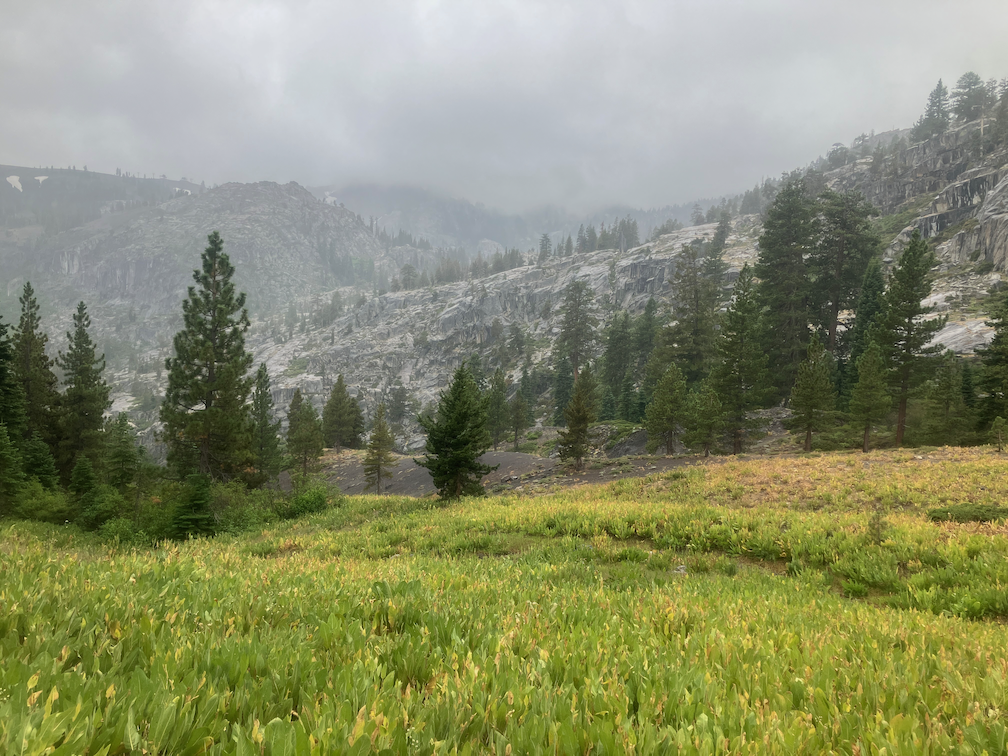
 Granite Chief Wilderness