I have created a Trail Conditions page, available in the menu under Trails. The most common request I get from readers of the blog are about trail conditions for a trip they have planned. Rather than having to sift through multiple blog posts to find the information, this new page intends to pull it to one place. This page is just started, and only contains information about my most recent trip (and first trip of the season), but I will gradually add additional information.
Some of the trail entries will be quite old. Despite my desire, I don’t get to every trail every year. For older entries, the primary usefulness is about the number of down trees. For the unmaintained trails, the number of down trees only increases year to year. Part of my trail maintenance work is cutting smaller trees, but I have no ability to cut anything over 12 inches, nor do I do trail maintenance on every trail every year. On the trails that are maintained by others, often larger down trees are cut, but it can be late in the season before that happens.
Trails noted as ‘unmaintained’ are ones that I rarely get to, and are not maintained by any other organizations. There are a few trails that I do focus on, including Powderhorn, Whiskey Creek, Western States, and brushy parts of the PCT.
The conditions recorded include tread condition, number of large and smaller down trees, winter debris (see below), brush encroachment on the trail (brush grows rapidly!), trail junction and trailhead signing, and water conditions, which of course varies greatly during the season.
To quote from the page: “With the die-off of red firs, and to a lesser degree white firs and western white pines, there will be a continually increasing number of down trees on the trails. The term ‘winter debris’ used to mean branches that came down during the winter, but now includes an almost continuous rain of debris from dead trees, year-round.”
With this trip, I retired my old hiking boots and started with new. My boots are Altra Lone Peak, which is the only brand I’ve found that offers a wide toebox that my feet require. The old lasted a little over three years, since June 2021, not bad. The soles were more worn that the tops, but both were done. Altra has saved my hiking, as any boot without a wide toebox causes me great pain, and the one other common brand with wide toebox just doesn’t work for my feet.
The purpose of the trip was mainly trail condition survey. I often do that early in the season, but didn’t get to it this summer. Conditions for the trails I did are listed below. I went in at Granite Chief Trail (after enjoying Bluesday at Palisades Tahoe), then south on the PCT. The number of PCT hikers has dropped off, but there are still some going, either late starts or flip-flopping.
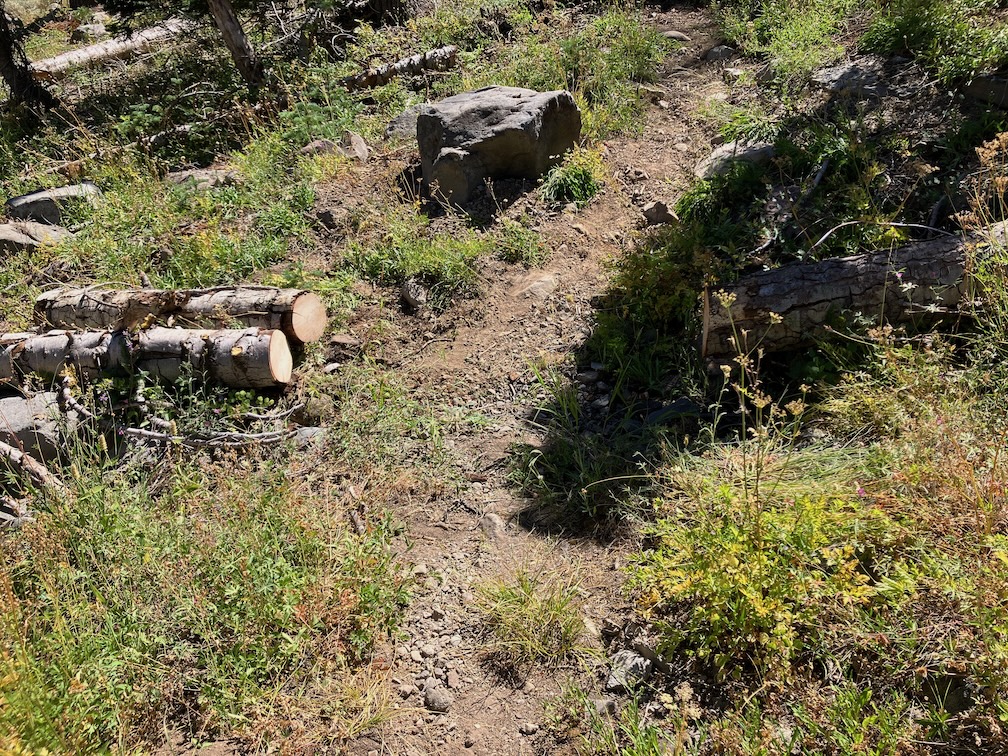
I was curious about rerouting of the Tevis Cup Trail, a project which started last summer and will continue through next summer. A CCC (California Conservation Corps) trail crew is base-camped at Little Needle Lake, and working from near the PCT to the west. The reroute is in varying stages, ranging from just sketched out enough to follow from being walked on by the trail crew repeatedly, to essentially complete. Several rock outcrops near the east end had just been blasted the day before, leaving a mess that requires a lot of reconstruction. The crew has worked as far west as a small seasonal creek, which will probably be the only water source on the rerouted trail. Though the trail route has been flagged through to its connection with the old trail, somewhere, I did not follow beyond the existing work, but I’m guessing a little more than half of the reroute has at least been started. This will be a very nice trail when completed! As I’ve written before, the Tevis Cup Trail design was horrible, gaining and losing altitude repeatedly, often for no apparent reason. I don’t recommend that you try to follow the new trail until the end of next summer, I do encourage you to enjoy it when finished.
A Great Basin Institute trail crew was working on the cross-trail between the PCT and Tevis Cup, which I call the Tevis connector though it is not clear what its official name and number is. They are camped at the flats beside the Middle Fork. Because the reroute crosses the slope of Lyon Ridge much higher than the old trail, several new switchbacks are being worked to bring it up to that level. If you follow the old trail west from the PCT, the obvious worked trail will take you all the way down to the Middle Fork. The junction with the old trail is marked by a rock wrapped with flagging, but could be easy to miss.
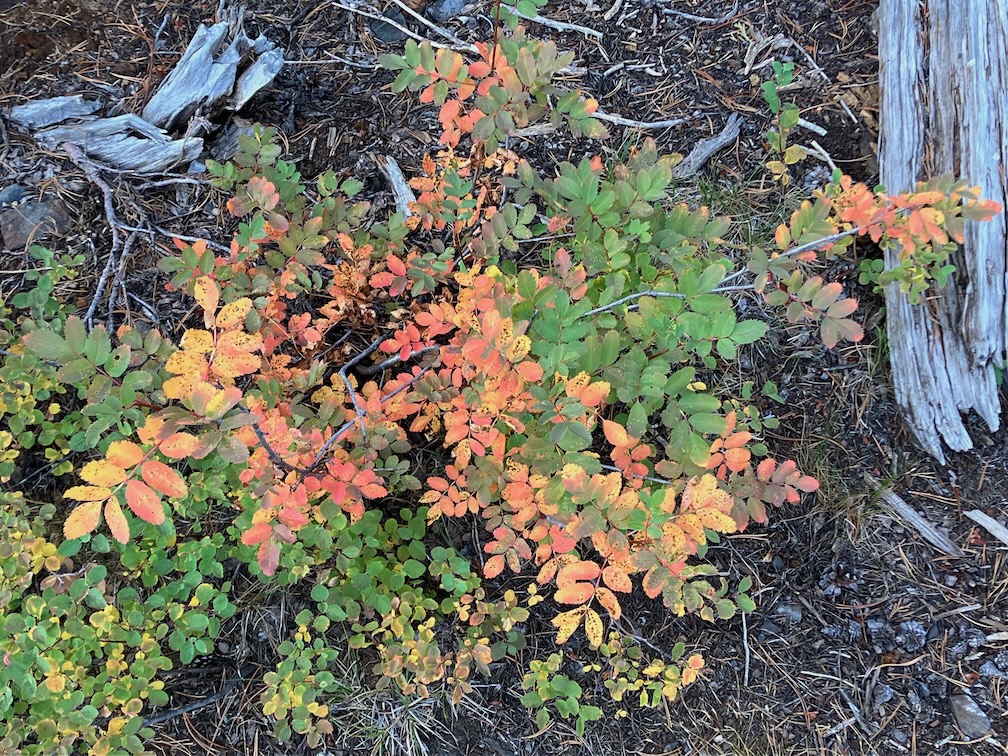
Knotweed is brilliant fall color right now, bright to pale red, and occasionally yellow and orange. It paints the west slopes below Wa-she-shu Peak with color, mixed in with other plants of fall color. Some of the wooley mules ears fields are browned out, while others are mix of green and yellow. Though few things are still flowering, the California fuschia at lower elevations are striking red.
mountain ash in fall color
All my previous trips I had been sleeping under clouds, or smoke, or trees, but I had a full view of the sky with only a crescent moon to obscure. I have to admit I’ve forgotten a lot of constellations, but the night starts with the summer triangle overhead, and ends with Orion up in the east, and Jupiter.
I was going to do a loop out the Tevis Cup Trail to Talbot Creek Trail and back in on the Western States Trail in Picayune Valley, but realized I really didn’t want to deal with the old trail, and never will have to again. So I headed south on the PCT to Whiskey Creek Camp, and then west on the Western States Trail (which is called the Historical Western States Trail on some maps, I guess to distinguish it from the Western States Trail run on the Tevis Cup trail. Picayune is one of my favorite places in the wilderness, and I spent two nights there. Hiked out the trailhead one day, recording trail conditions, and lolled by the creek as much as possible.
The rain last week, while I was home, perked up three ferns that grow among the metamorphic rocks in Picayune Valley: cliff-brake, lace, and indian dream.
My ambition was to come back and do the Shanks Cove loop up the ridge and back down to Five Lakes Creek below Big Spring Meadows. But ambition failed me, and I stayed a night at Whiskey Creek Camp.
I hiked out Squaw Saddle Trail (has it been renamed?) and Five Lakes Trail to the trailhead. I walked the Bear Creek Trail towards River Ranch, planning to sleep part way along. But there are only two flat spots along the entire trail, one by the water tank and another on a bald hillock. But I noticed the hillock was covered with bicycle tracks, and I suddenly had a vision of being run over by night-riding bicyclists (which has become popular in the Tahoe area), and I had already passed the tank, so I walked all the way out to the stables and then bottom of Alpine Meadows road and camped by the river. I was surprised to see how many creeklets cross this trail, including at least three that are probably year-round. But the creeklets are all east of the water tank sleeping area.
While on this trip I finally identified the low shrub that I had been working on the Powderhorn Trail. It is snowberry, Symphoricarpos. It spreads by sending out runners that root. Sometimes across the trail, and those runners age to an almost unbreakable trip-wire, which is part of the reason I try to get it out by the roots, and cut it back if I can’t. On my earlier trip, the white berries were not there, but now they are, so I was able to identify. On the plus side, there was a patch of the gooseberry without spiny fruits around the old wilderness info sign at the beginning of the Tevis Cup Trail. Hmm, delicious.
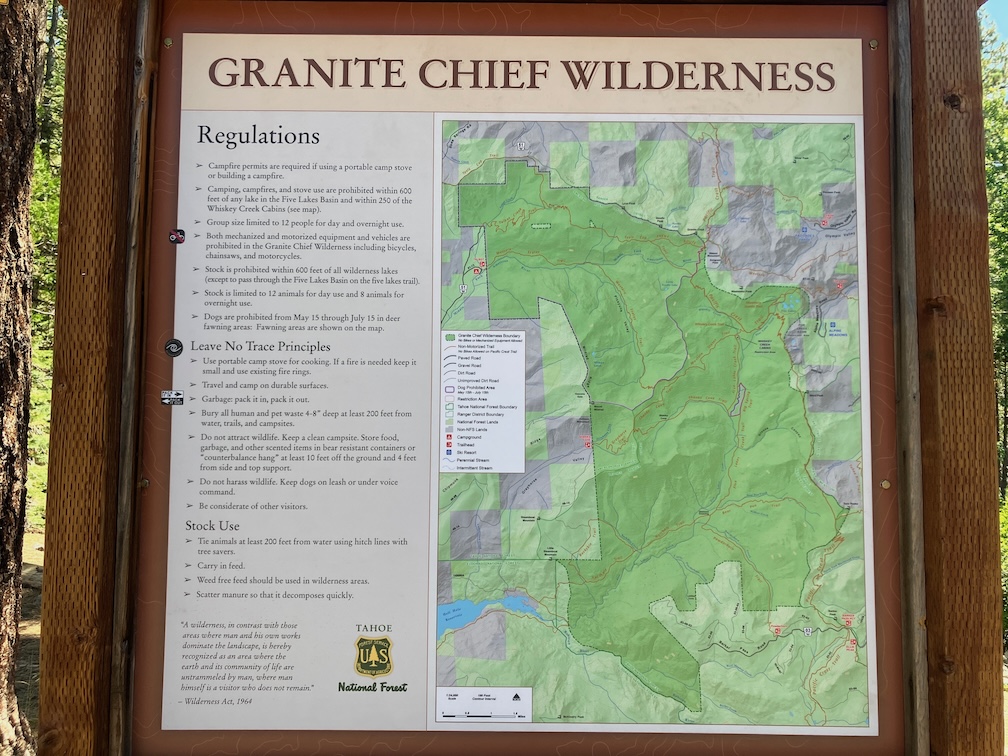
There is a new trailhead map at the Talbot trailhead. It has the extended wilderness boundary on the northwest (lands purchased by the American River Conservancy), the new name Wa-she-shu, and a few other details. Unfortunately, it still shows the Buckeye Trail, off the Hell Hole Trail, which is essentially unfindable.
Granite Chief Wilderness trailhead map at Talbot trailhead
I finally figured out why my hips have been hurting this entire season. The waist belt on my Osprey Atmos 50 AG backpack has velcro attachments between the hip belt and the waist belt. On one side, the velcro no longer holds where it is supposed to, so the waist belt no longer cinches as tight as it should. So the pack was riding low on my hips and causing pressure with every stride. It also explains why I was more and more holding onto and pulling in on the shoulder straps, trying to pull the pack up off my hips. Though these are called hip belts, they are meant to go above the hips, to ride on top of the pelvis and not on the hips. I will have to get that fixed during my late fall slow backpacking time.
Trail Conditions
Granite Chief Trail (15E23): good condition, one 9 inch down tree, could use spot brushing; adopted by Truckee Trails
PCT south to Tevis: good condition, one 6 inch, some debris*
Tevis Cup Trail (16E04): see notes above, old trail unacceptable, new reroute not complete
Tevis Connector: good condition
Little Needle Trail: This is not marked on maps and was formerly just a seldom used and hard to follow hunters trail, but with the CCC trail crew camps at the lake, it is now easy to follow.
PCT south to Whiskey Creek Trail: good condition, five down but all easy to step over or bypass, some debris
Whiskey Creek Trail: good condition, except broken tree fragments at the bottom
Western States Trail (16E10): to Shanks Trail, 16 down trees, some very brushy areas, moderate debris; to Talbot trailhead, about 30 down (forgot to record), some brushy areas, some areas of moderate debris; most of the down trees have established bypasses or can be stepped over/climbed over, but some newly fallen are difficult; though there are a lot of down trees on this trail, it is still worth walking or backpacking; the trail sign at the junction of Western States and Shanks is broken and down, but still readable
PCT south to Squaw Saddle Trail: good condition, one down tree, well brushed
Squaw Saddle Trail (if it is still called that): good condition
Five Lakes Trail to Alpine Meadows Trailhead: good condition, could use spot brushing
Trails not checked so far this season:
Shanks Trail
Greyhorse Taril
Hell Hole Trail
Talbot Creek Trail
*debris: I used to call this winter debris, the branches and cones that fall out of the trees during the winter, but since if falls year-round now from dead trees, I’m calling it debris.
This backpack trip was just for doing trail work on the Powderhorn Trail, to make up for two aborted or shortened trail work trips earlier this year. And I completed the trail! Yay!
There is a real pleasure to walking a well-maintained trail.
Of course trail work is never really complete. While doing trail work, things are growing, and dying, and falling. The upper section of the trail is noticeably needing brushing and removing conifer encroachment, developing in the time since I worked that section.
I was curious about my history with the trail, so looked back at earlier posts.
2009: The trail was logged out by the Forest Service. This is the last time the FS worked on this trail, 15 years ago, so far as I know. All of the older, rotted and aged and often large down trees, were cut at this time. I don’t know if any other work was done at the time.
2010-2017?: A horse group rode in every year to Big Spring Meadow for a long camp. On their way in, they cut enough of the trees to keep the trail open and useable. I don’t know whether their plans changed or they gave up on the trail and went elsewhere.
2018: My first trail work, spot brushing and removing conifer sprouts (mostly red fir) that were closing in on the trail.
2021: My first focus on Powderhorn, including marking the location of down trees. At that time I was still hoping that the Forest Service would log out the trail again, and so relayed to them the size, nature, and location of the trees. Though they thanked me for this year, they ignored later submissions, so I stopped sending them.
2022: Continuing work on the trail, mostly the upper third.
2023: Continuing work on the trail, mostly the lower third.
2024: Continuing work on the trail, mostly the middle third.
before before and after and after
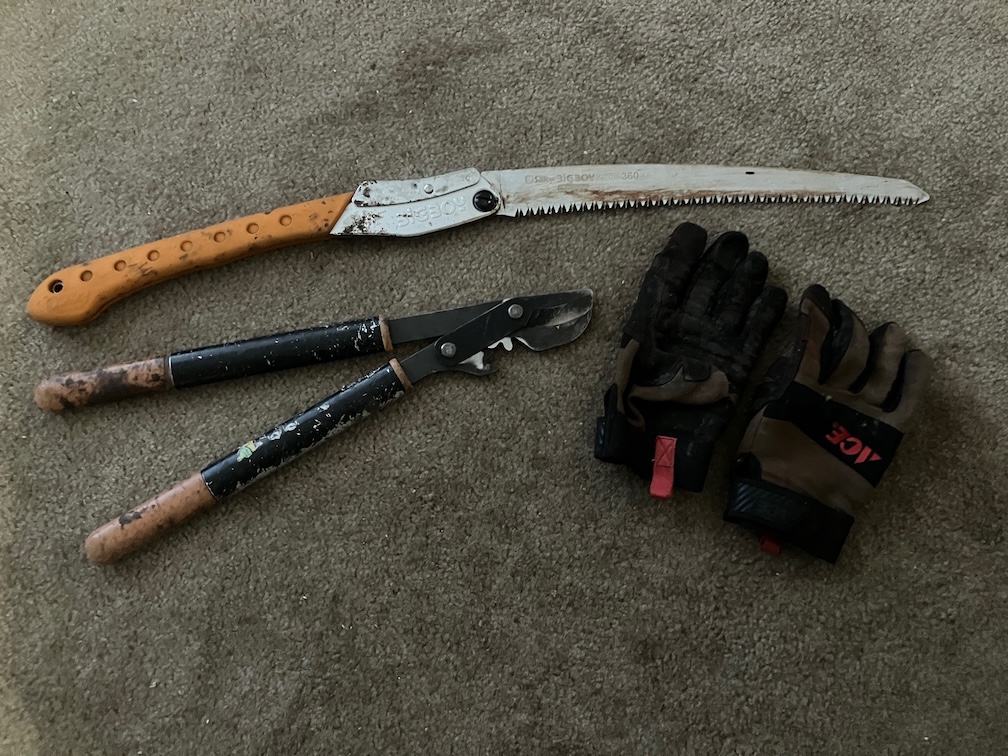
I recently bought a new trail tool, a Silky Big Boy 2000 15-inch folding saw, to replace my Fiskars 10-inch folding saw. What a difference! The length has allowed me to cut many smaller down trees that I had always had to ignore before. The saw easily cuts 9-inch logs, and at a stretch 12-inch logs, though 12 inches is slow going. Radius SQUARED really makes a difference. And being new, the saw is sharp and cuts well on the pull stroke (it is designed to cut on the pull and won’t work pushing). There were quite a number of new down trees this year over last year, but with cutting the smaller stuff, the overall number of down trees is now less than last year. For those wanting to know the details, my GaiaGPS folder ‘down-tree‘ shows all of them on the Powderhorn Trail.
tools of the trade: new Silky Big Boy folding saw, Fiskars nippers, and gloves
If you like the Powderhorn Trail, or have been thinking about going there, now is the time! By next year there will be new down trees. About half the red fir trees are dead, though it varies from nearly all to very few. Of course there are abundant sprouts crowding the trail. Some of these will die and become what I call spars (similar to snags, but I use snags for large standing dead trees) and lean into the trail, ready to snag your clothes or skin. A significant percentage of young red firs develop a lean, hanging into the trail. I call them leaners. The standing dead have prominent white mushroom bodies all over the trunks, so they are already rotting while standing, and will fall. It used to take a high wind year with saturated soils to being down trees, but they are now falling year-round.
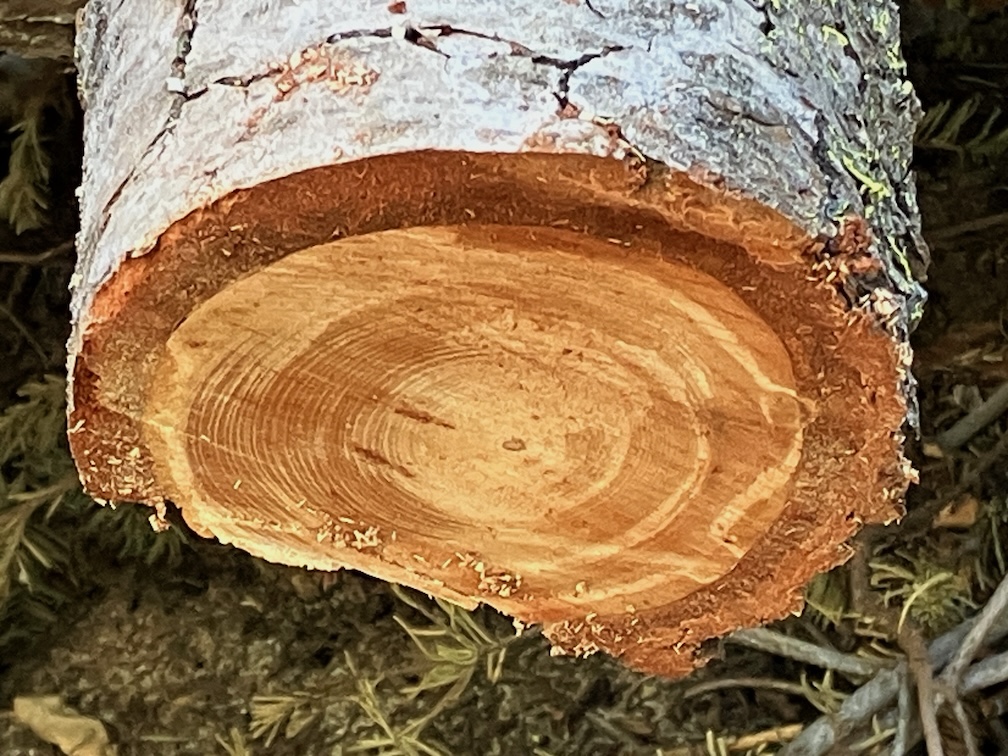
One of the down trees far too large for me to cut, I worked on the approach to the tree so that people could climb over or slide under. This red fir has the most dense wood I’ve ever experienced. A five-foot cut section of branch was so heavy I could hardly lift it. This must have been a very old and very slow growing tree. I’m unsure whether it died and fell, or was knocked down by another tree.
dense red fir rings
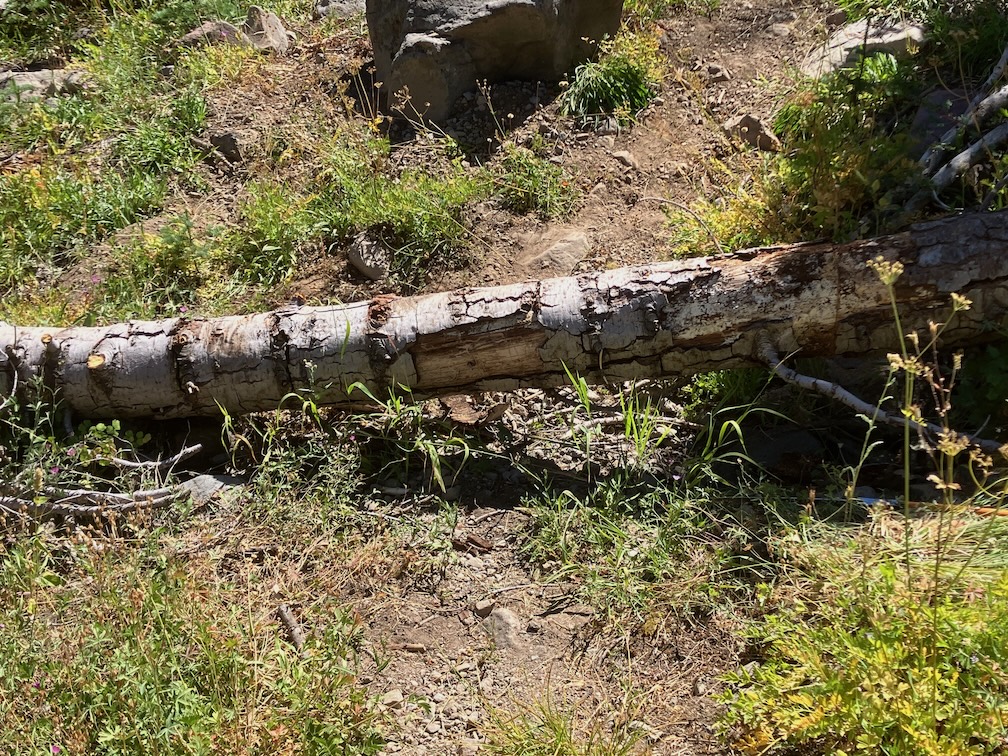
The trail has at least two down trees that cannot be passed by horses, so it must be considered closed and dangerous to equestrians. One is the slide-under tree, where backpackers can slide under the down tree. I had roughed out a bypass two years ago, but a new tree fell directly on the bypass, closing it. Another down tree would be a challenge to all but very trail-wise horses, and there is no bypass.
Sometime earlier this summer, someone rode a dirt bike into the wilderness and about a mile down the trail before giving up at a large down tree with no bypass. That person did quite a bit of trail damage and left ruts that will erode next spring. The power of internal combustion engines causes brain damage and immorality.
Five Lakes Creek is flowing but noticeable low. Same for Powderhorn Creek. The creeklet that crosses the trail is barely flowing and may be dry soon.
I have often done a trail condition survey trip early in the summer, but did not do so this year, so know nothing about trail conditions except the PCT, good condition, Whiskey Creek Trail, good condition, Five Lakes Trail, good condition, and Five Lakes Creek Trail, horrible condition. I may get to the other trails on my next trip.
This is the time of year when people start asking for snow and trail conditions reports. I have nothing to report. Because I am a car-free person, and therefore dependent on trains and transit for getting to the wilderness, and my travel is not essential, I haven’t been up in the Granite Chief area this season, and won’t be for a while. Of course I will walk there if I must (from Sacramento), but that is a five day trip just to get up to the area, and so I won’t have anything to say until the middle of June, at best.
But… I hope that others will report snow and trail conditions. So if you are a reader of this blog, and get up to the wilderness, or even the approach trails, please leave a note here to help others out with trip planning.
This is a summary of the comments that I made to the original blog post while in the field, and a bit additional from the second part of my trip. These observations were made 2019-07-15 through 2019-07-24, so snow conditions and creek crossings will have changed by now. Peak snow melt is definitely past, and all the creeks are dropping.
Granite Chief Trail: good condition, one 42 inch tree tangle and a few smaller; first snow 2370m, more towards top but all passable.
PCT Granite Chief Trail to Granite Chief saddle: 20% snow coverage overall, but complete coverage up the north side of saddle. Thru hikers have beat out a reasonable route. Steep north slope requires snow spikes, or tedious step kicking.
Tevis Cup Trail: some snow at beginning and in trees west of old boundary. Several muddy areas and water running on trail, a few erosion problems. West part from old boundary rerouted and now a trail rather than logging roads.
Talbot Trail: no issues, other than it is boring and comes out onto FR51 way too early. No water past the creek near the north end.
Western States Trail (Picayune): overall good condition; a few medium trees, one large, several small; tangle of downed trees just below ridge is now cleared; some snow patches. Crossing of Talbot Creek rock hop or log. Crossing of Middle Fork, knee deep wade with poles for stability, or logs down below, rock hop not possible yet.
Five Lakes Creek Trail: about 30 down trees, all but one large easy to step over or go around. Crossing Five Lakes Creek, knee deep wade in moderately fast water; Bear Pen Creek, shallow wade; no rock hop for either yet. Grouse Creek is a rock-hop (Grouse Creek will dry completely at some point during the summer). Moderate winter debris on the trail.
Whiskey Creek Trail: one medium tree down at beginning. Whiskey Creek now a rock-hop (updated 2019-07-24).
from Alpine Meadows TH: Five Lakes Trail good condition; Squaw Saddle trail good condition; PCT Five Lakes jct to Whiskey Creek jct good condition, one small tree.
Powderhorn Trail: about 25 trees down, most small but one medium and two large; two might not be passible for horses. A lot of winter debris on the trail. All watercourses flowing. Snow from boundary up to ridge 40%, trail can be followed with a close eye.
PCT from Barker Pass to TRT: snow patches on east side of ridge after trail reaches ridge; multiple patches on the east/north side of ridge approaching the wilderness boundary, though the steep snowbank that stops people in many years is easy to navigate this year; snow patches through the trees to the PCT/TRT junction.
Hell Hole Trail: I did sufficient trail maintenance that the trail can now be followed from Diamond Crossing to Steamboat Creek, including through the downfall tangle past Buckeye Creek where the trail was lost. There are hundreds of trees down (really!), but almost all can be stepped over, climbed over, or bypassed on well established use paths. There is thick winter debris on the trail in many sections, only a small part of which was removed. The trail past Steamboat Creek has become more vague with time, and I’m not sure it can be followed anymore, but I did not explore extensively. Five Lakes Creek is a shallow wade, both forks of Buckeye Creek are rock hops, and Steamboat Creek is a rock hop. Though Steamboat Creek was flowing well 2019-07-24, it always dries at the trail crossing at some point during the summer, though water might be found upstream or downstream.
Trails not checked: Shanks Cove Trail (it was reported to me by hikers that they were unable to follow the trail from the junction with Western States to the ridgeline, probably in the downfall area climbing out of the little valley). Lower Hell Hole Trail. Greyhorse Trail. Bear Pen Trail. Most of the PCT. I figure information about the PCT is more widely available, so I did not do trail condition observations on the majority of the PCT through the wilderness.
With the deep snows of winter still lingering, I have been spending my backpacking time on the Bay Area Ridge Trail, which generally follows the ridge lines around the San Francisco Bay. There are 375 miles completed of an eventual 550 or so, and I’ve done about 64%.
My first trip to the Granite Chief will be July 15, and I’ll have some information on trail conditions at the end of that trip. The best source of trail conditions I could find is the Tahoe Rim Trail Association’s Current Trail Conditions page. Though the TRT only edges the Granite Chief Wilderness, the elevations are similar and trail conditions might therefore be similar.
If you, dear readers, have anything to report, please either comment on this post or send me an email (allisondan52@gmail.com). Since I’m out backpacking elsewhere, I might not get to posting for you for a few days, so better to comment directly, but whatever works for you works for me.
I have not been on all the trails yet this season, but will report on ones I have been. The PCT is in good condition; the Granite Chief Trail is in good condition; Five Lakes Creek Trail is in decent condition, some down trees but nothing that can’t be bypassed; the Powderhorn Trail is becoming quite brushy and though I did some work here, there are many days left to do, and there is a tangle of down trees about 2/3 of the way from the top that could not be bypassed by horses due to the terrain; Western States Trail is in decent condition from Whiskey Creek Camp to the saddle, with some brushy sections and some down trees, but the section just below the saddle dropping into Picayune Vally is a mess of down trees and the trail hard to follow; the lower section of Western States in Picayune Valley has had some trail maintenance and is in good condition.
Dan McGee commented on the Shanks Cove Trail on the Trails and Maps post. I think I had reported the issues with that trail, but now can’t find it, and it certainly was not on the Trails page. A number of years ago there was a significant downfall of huge red fir trees in the gully just past the small seasonal drainage south of the Western States Trail junction. This has never been cleared, and has gotten worse by the year. As a result, the whole trail is becoming less used, and is brushy and obscure in other places. I don’t have anything to report about the south section of the trail, from Greyhorse Trail down to Five Lakes Creek Trail, but will after my next trip. Unless you are good at route finding and enjoy clambering up and down over huge trees, this is a section to avoid until the Forest Service clears the trail again.
Water is still moderately plentiful at the normal spots in the backcountry, however, the lower elevations are getting really dry and the higher elevations will dry soon. By the end of the season, I’d expect only the largest and most reliable sources to be running.
As always, your trip reports and trail condition comments are welcome. I no longer am able to get in early in the season and review all the trails, so I and others depend on YOU passing along information.
People have been asking me about snow conditions in the Granite Chief, and I’m sorry to say I don’t have any information for you. I will be going in on a backpack trip Monday, July 3, and may have a chance to post briefly while I’m on that trip (there is some cell reception from the crest, though none in the rest of the wilderness), but if not, then at the end of the trip about July 11.
If you have information, or trip reports, please share them by replying to this post. If you had an approved comment in the past, your comment will go up immediately, if not, I have to approve it, but again, may be able to do that when I’m on the crest. If there is still a lot of snow up high, I’ll head down into the Five Lakes Creek basin, where the bears have never heard of cell phones.
I went backpacking this last week along two sections of the Bay Area Ridge Trail, in part because I figured there was still a lot of snow in the Granite Chief. But a week of very warm weather may have opened up some of the trails, and I’m anxious to get into the high country.
I’ve had two backpacks this year doing trail maintenance on the Pacific Crest Trail through the Granite Chief Wilderness. Since almost all my time was up on the PCT, I don’t have anything to report about the rest of the wildneress, but since I have two more backpack trips coming up, will have a report on much if not all of the trail system.
I brushed from Granite Chief trail on the north to Five Lakes Creek in the middle, and the trail is in good condition except for a short 0.1 mile part between Whiskey Creek Camp trail and Five Lakes trail that I didn’t get done, though it is not bad. I also did the Whiskey Creek Camp trail since it was getting a bit brushy. While in this area I spent some time exploring around Five Lakes Creek and Whiskey Creek, looking for the old trails that were there before the new PCT alignment was completed. In some places these old trails are easy to follow, but no always. I still think there is a trail on the south side of Five Lakes Creek to Big Spring Meadow, but so far I haven’t located it.
On the second trip I focused on the PCT north from the PCT/TRT trail junction near Twin Peaks. There are several sections here that are very brushy, and a few that are essentially closed in. I got all but one of these opened up again, to a point where they should be OK for about five years. But there is one very brushy section that I did not get to, and will be very bad by next year. It is about 0.2 miles. I did spot brushing on the remainder, and it is in decent shape but could use work. I think this year I accomplished what I have not in several years, keeping up with the rate of brush growth, though not gaining on it, which is why there are some badly brushed-in sections left. Next year perhaps I’ll get those last very brushy parts done, and be “caught up” at least for a couple of years.
PCT trail before brushing, overgrown with tobacco brush
PCT trail after brushing, cleared to five-year width
One of my purposes of my Picayune Valley and Shanks Cove trip earlier this year was to create GPS tracks for the Western States and Shanks Cove trails. In the area of the saddle between the Five Lakes Creek basin and Picayune Valley, the trail alignment shown on the National Geographic Trails Illustrated maps is incorrect. It turns out, now that Trimble Outdoors has added National Forest roads and trails as an available overlay in MyTopo Maps, that the Forest Service base maps are incorrect.

 Granite Chief Wilderness