Monthly Archives: July 2021

PCT trailwork 2021-07

This trip was primarily for trail work. I had noticed on my previous trip that the section of the PCT trail between roughly Twin Peaks and Ward Peak (actually, only part of that), was beginning to be brushed in again. Looking at past posts, it appears that I did some work here in 2014, but didn’t finish, and then finished in 2016. So it has been five years, at least, since this section was brushed. Most of my brushing I think of as ‘five-year’ brushing, cutting things back enough that the work will last about five years, so this works out.

As always, the tobacco brush (Ceanothus velutinus) is the fastest growing of the brush and the most likely to brush a section of trail closed. As with most plants, cutting it leads to it producing multiple stems, so the result of my 2014-2016 work is that a lot of the tobacco brush has multiple younger stems, which take much longer to cut. Sometimes I can get down to the root of the plant, and get it all out, but that is unusual, and doing this effectively would require different tools than I take, a pulaski or similar. I discovered, to my surprise, that at the oldest root wad of the tobacco brush, there is a large, deep taproot. Bitter cherry also spouts from the cut base and sends its stems into the trail, but it is easier to get out by the roots. Even manzanita, though slow growing, will encroach on the trail over time. Several other brush species, less common at least in this area, also encroach on the trail, but the fast growing whitethorn is not common along here.

The photo below shows a brushed-in section of the trail, the ridgeline switchback. And it still looks like that, because I did not get to this part in my work. In fact, I only accomplished about one-quarter of what needs to be done. My excuse is that it was hot in the afternoons and I could just not accomplish much. And it was hot – the rocks get almost skin-burning hot. The temperatures are funny. Up above the bridge the wind is often blowing, and was blowing the entire time of this trip, and it is comfortable. But when I squat down or sit down to cut brush, I’m out of the wind and it is very hot.
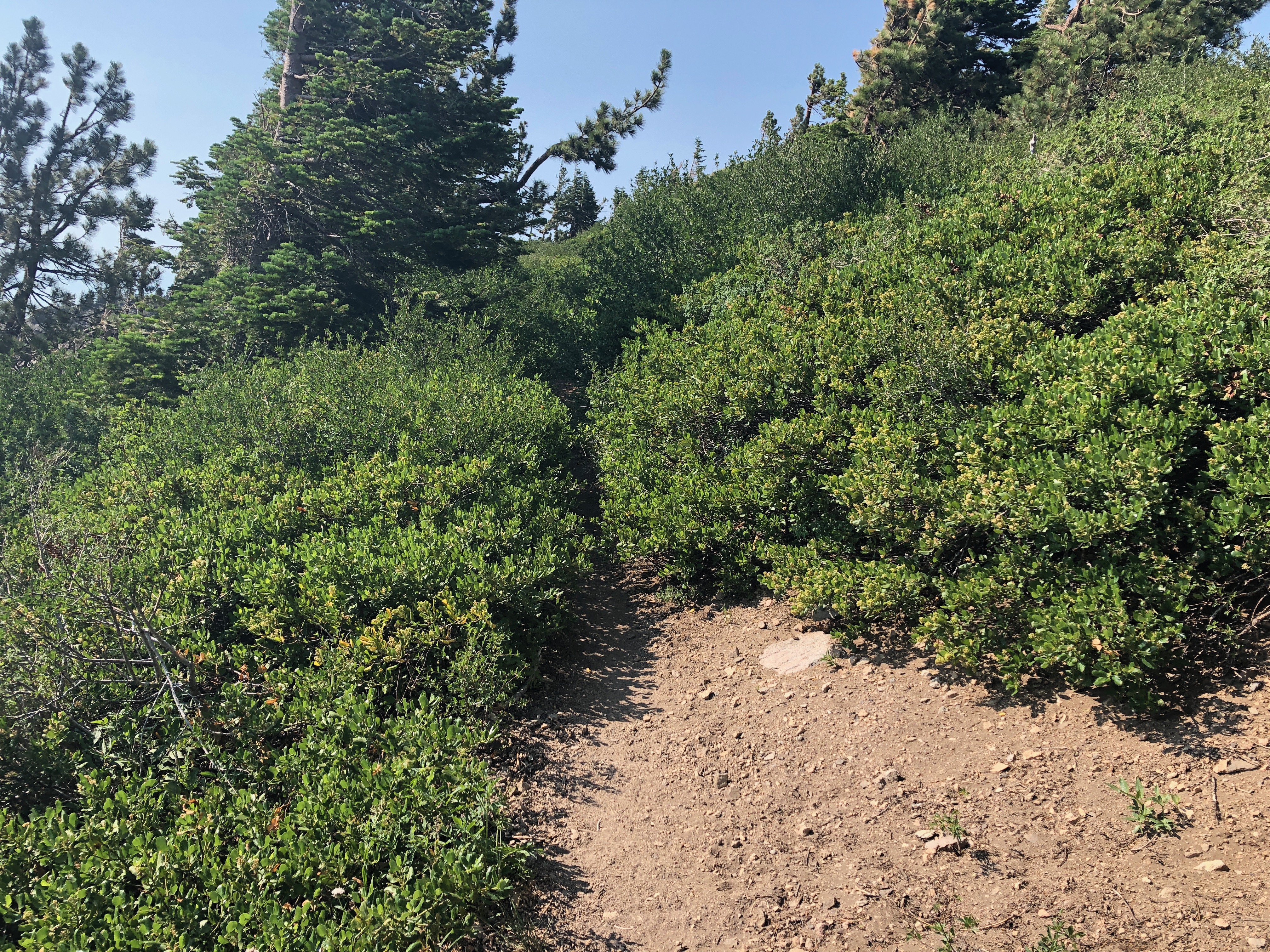
PCT brushed in

There are no water sources on the ridge between the springs in North Fork Blackwood Canyon and Five Lakes Creek, so I have to pack in water. I resupplied, from the springs, once during my trip, and when I ran out of water the second time, headed out. The three springs close together are very low, and I’m sure will dry up this summer. Another single spring further south is still flowing well. And of course North Fork Blackwood Creek is likely to have water all season. In years with more snow, I’ve been able to melt snow from the snowbanks that last on the east side of the ridge, but this year those snowbanks were gone back in June.

I primarily use two campsites on the ridge, the one heavily used by PCT thru hikers near the PCT/TRT junction, and a small one north of Twin Peaks that is not much used. I discovered that a wood rat lives nearby. It stole my plastic spoon, so I have to make a sort of workable one out of a stick, and also chewed on my pack straps and work gloves. After that night, I put everything away and hung my pack up in a tree.

On my way out the last day, a new fire southeast was popping up, the Tamarack Fire, which is still going as I write (Sunday, July 25), now about 66,000 acres and only a quarter contained. During my time on the ridge and then down at Tahoe, the smoke was all going north, along the east side of the Carson Range, so not affecting my area, but I understand that now some smoke is coming over to Tahoe and the crest.
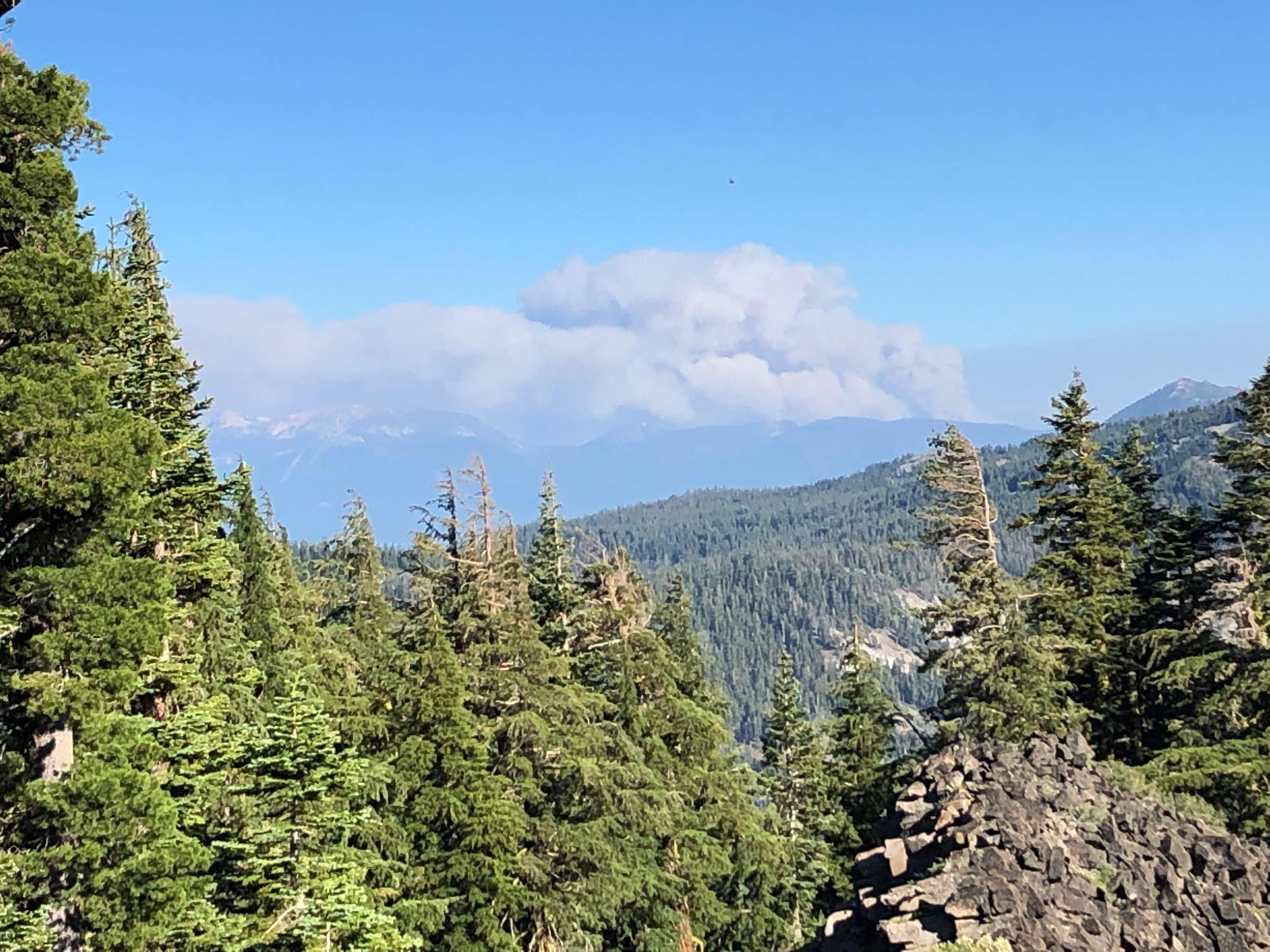
Tamarack Fire

On this trip, I took both insect repellent and my inner netting tent. Ironically, there were far fewer mosquitoes than there had been two weeks before, but it was still nice to go to sleep without the buzzing.

For this trip, I walked from Tahoe City to Kaspian Campground, which is where Barker Pass Road leaves the highway, walked up the road and then the jeep road past Blackwood Campground to the crest. Blackwood Campground now charges a fee – it was the last of the campground in the entire Tahoe basin that was free. As a result, it was empty. I headed north on the PCT from Barker Pass to my work area. Going out, I took the TRT trail down to Ward Creek, where I camped the night, and then on through Paige Meadows to Tahoe City.

I’m falling into a pattern of wanting to hear music after my backpack trips, so I went to the Saturday afternoon music in Squaw Village, blues by Mike Schermer, which was fun. It seems it is mostly locals, people who have homes or shares in the village, who attend these. There were a lot of kids dancing, having a good time.

And then home on the Amtrak bus from Truckee.

Tomorrow, in for more trail work. Maybe I’ll get to half or 3/4 done.

Photos on Flickr: https://www.flickr.com/photos/allisondan/albums/72157719601232047; Granite Chief Wilderness collection on Flickr: https://www.flickr.com/photos/allisondan/collections/72157637640215275/
PCT & Powderhorn 2021-06

The Granite Chief Trail, up from Squaw Valley to the PCT, is in good condition. A sign indicates it has been adopted by the Truckee Trails Association, so this is one trail I probably won’t have to maintain again. Yay!

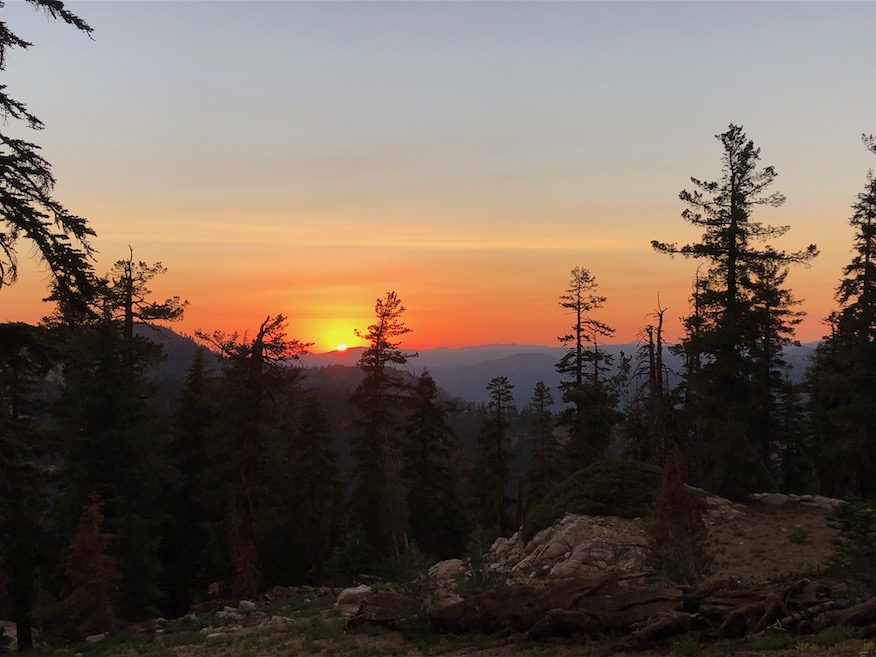
I camped just off the PCT, looking down the North Fork American River canyon, with a good sunset and sunrise, probably in part due to some fire smoke from fires to the north. There are still some patches of snow on the north side of Lyon Peak ridge (Foresthill Divide), but not much left. I walked the PCT south to the junction of the PCT and TRT, where there is a campsite well used by thru hikers and others. I’m seeing about 40 thru hikers a day, mostly in bunches but some solo. As is typical, about half look happy to be there and the other half clearly does not. It is a strange thing that people do.

sunset over North Fork American River

I headed south on the PCT to Barker Pass, then along Forest Highway 3 to Powderhorn trailhead, and down to Diamond Crossing. There are a number of trees down on this trail, though all but one were easy to go over or around, and it could definitely use brushing and cutting back of the doghair firs that crowd the trail.

I helped two dayhikers, in from Powderhorn, to find the pools along Five Lakes Creek near Diamond Crossing, which they would not likely have found on their own. The Five Lakes Creek Trail is in poor condition, many trees down, many of them down now for years. The Forest Service has not maintained this trail in at least six years, and it was being somewhat maintained by a horse group that headed into Big Spring meadow every year, but seems to have given up on using the trail, it is so bad.

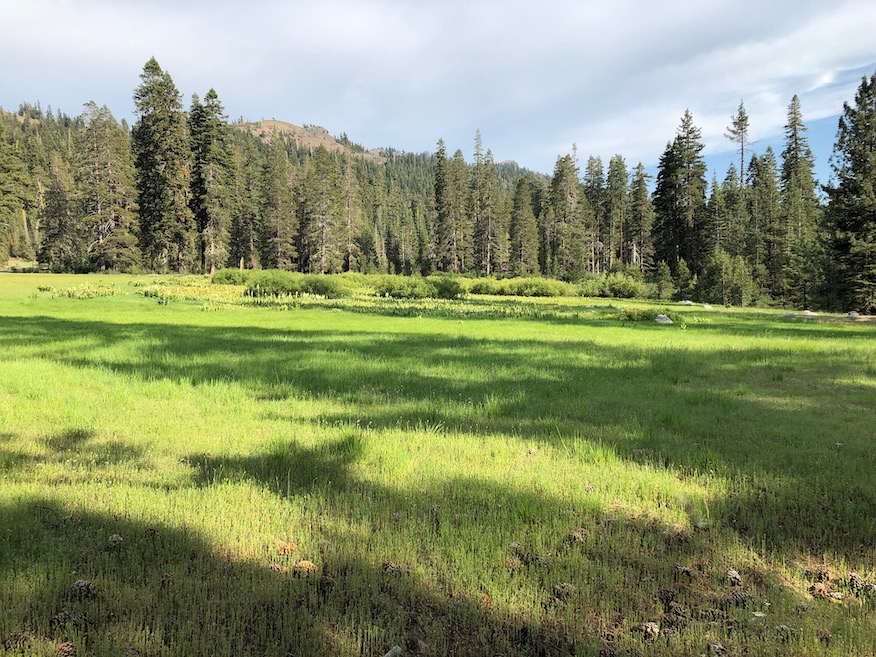
I camped at Big Spring meadow, one of my favorite spots, a great place to watch the beginning of the day and the end of the day, and enjoy the huge pines. The meadow is drier than usual for this time of year, but not fall dry. The spring is flowing well, and I don’t think it ever dries up. I explored up the east side of Five Lakes Creek, finding the old trail which used to be on that side. Some parts are easy to see, in the wet areas with willow alder and willow thickets, not, and I did not find the place where it crosses over to the west side. I’ve also explored down from the PCT/Five Lakes junction, but haven’t yet connected the two.

Big Spring meadow

I hung out at Whiskey Creek Camp to meet Paul Vandervoort, who I’ve been emailing for several years but never met. He was leading a dayhiking group from Reno, going over into Picayune Valley and then climbing out to the Tevis Cup Trail, and back out.

I headed out the Five Lakes Creek Trail, PCT, and Five Lakes Trail, with some exploring around the Five Lakes area, which I usually zoom by on my way elsewhere. The lakes were low but most still had water. There are anywhere from three lakes to fifteen lakes, depending on the time of year. The largest lake, the one to the west, breaks into two lakes as the water level drops, and the one I call third lake gets smaller but I’ve not seen it dry.

From there I went up over the old Squaw Saddle Trail, no longer maintained, and into Squaw Valley. It joins the Western States Trail (one of the many alignments) and heads east along the south side of the valley. Where the trail is closed for construction of the new Alpine to Squaw gondola, I dropped down to Squaw Village and hung out there for a while.

I took the bus into Tahoe City, where I camp out for the night before going to Truckee in the morning to catch the train. It is far too noisy in Truckee to sleep out, due to Interstate 80 with its constant roar of truck traffic. Tahoe City is much quieter. While charging my phone at the plaza overlook, a band came and set up to play, so I stayed to enjoy there semi-reggae and talk to people.

I was wondering how the flowers would be in the drought year. At higher elevations, they actually don’t seem much different, except that they are about half the stature of a ‘normal’ year. Their abundance is about the same, though.

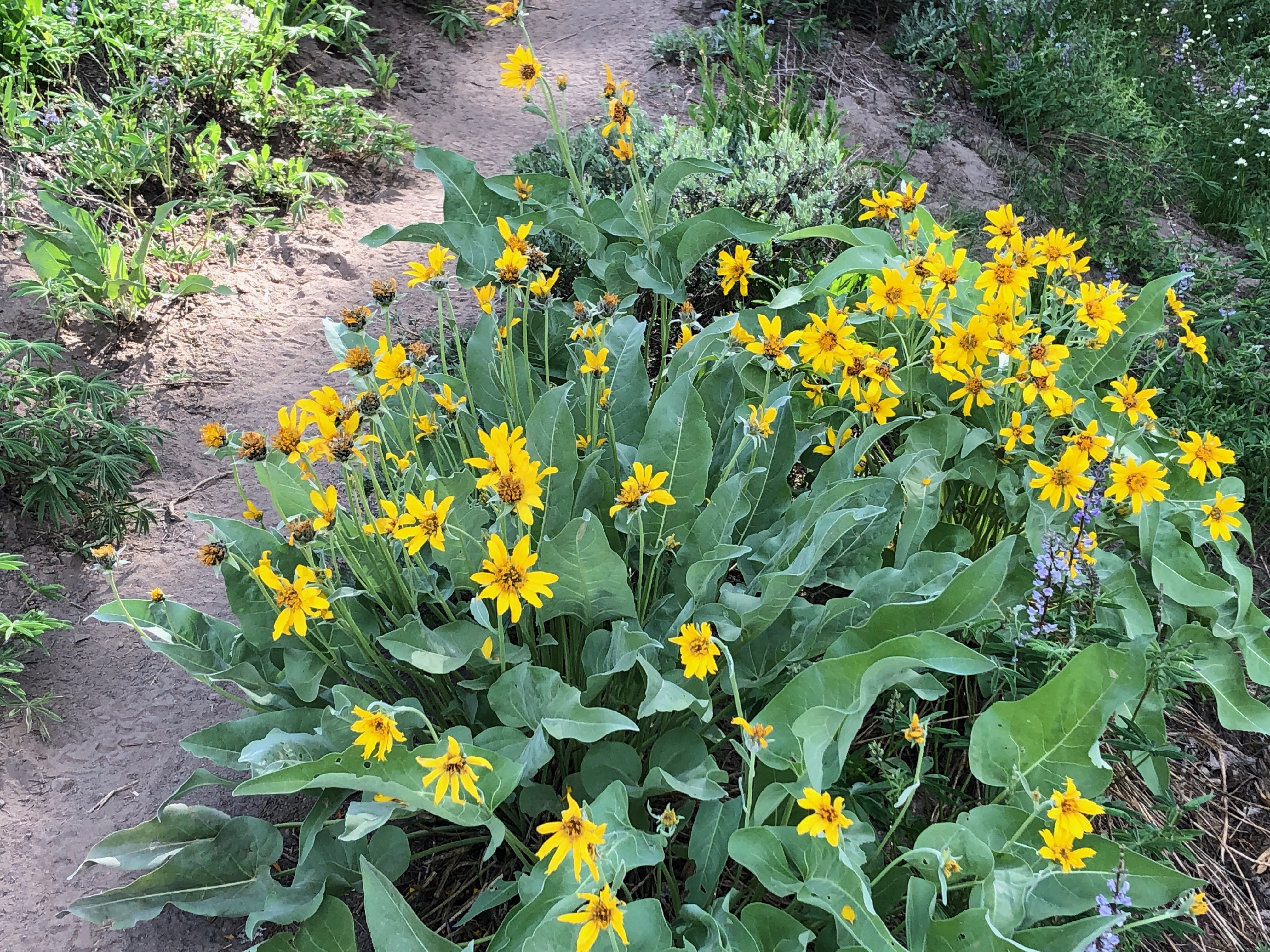
Arrowleaf Balsamroot (Balsamhoriza)

On this trip I did not take insect repellent, and did not take my inner tent with insect netting, so was quite bothered by mosquitoes. If it were cooler, I’d just hide in my sleeping bag and go to sleep, but the evenings were too warm to do that. They are not as thick as they used to be, but still…

I have some new hiking shoes. For years my toes have been turning, and as a result, I need a wider toe box, but my heel is not widening, so wide shoes don’t do it for me. I’m trying out Altra Lone Peak trail runner shoes. They have a wide toe box but normal width elsewhere. They aren’t really heavy enough for hiking shoes, so I probably won’t be doing any off-trail hiking in them, but I have to say, my toes were happy.

Photos on Flickr: https://www.flickr.com/photos/allisondan/albums/72157719601028882; Granite Chief collection on Flickr: https://www.flickr.com/photos/allisondan/collections/72157637640215275/